Richard Bellon – författare
Visar alla böcker från författaren Richard Bellon. Handla med fri frakt och snabb leverans.
2 produkter
2 produkter
Correspondence of John Tyndall, Volume 16
The Correspondence, January 1878-November 1881
Inbunden, Engelska, 2026
1 926 kr
Kommande
The 500 letters in this sixteenth volume of The Correspondence of John Tyndall document the period from January 1, 1878, to December 31, 1881. They chart a defining stage in the later life and career of an aging John Tyndall with unprecedented detail. Key developments evidence the fragility of a self-fashioned Carlylean hero, one whose sustenance increasingly relied on the companionate, domestic partnership that he enjoyed with his wife, Louisa. While they vacationed in the new summer home they built together in the Swiss Alps, where they experienced a shared reverence for nature, Louisa immersed herself daily in the business of Tyndall’s scientific work, directly assisting with experiments like the action of freshly fallen snow on the transmission of sound. But his failing bodily health—cascades of sickness, chronic insomnia above all else—disturbed his daily labours, transforming routine tasks into exhausting slogs. He also feared that growing forces of disorder—in his native Ireland most distressingly—threatened political, social, and economic stability.
Del 14 - Scientific and Learned Cultures and Their Institutions
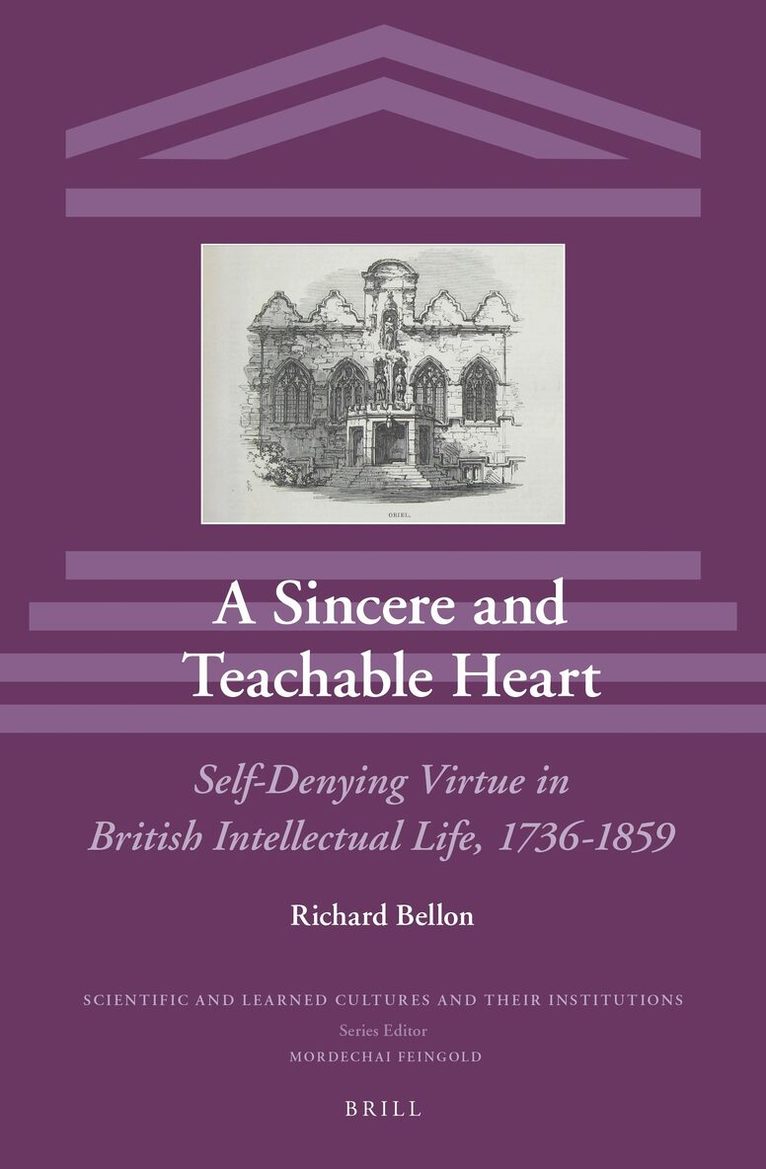
Sincere and Teachable Heart
Self-Denying Virtue in British Intellectual Life, 1736-1859
Inbunden, Engelska, 2014
2 634 kr
Skickas inom 3-6 vardagar
In A Sincere and Teachable Heart: Self-Denying Virtue in British Intellectual Life, 1736-1859, Richard Bellon demonstrates that respectability and authority in eighteenth- and nineteenth-century Britain were not grounded foremost in ideas or specialist skills but in the self-denying virtues of patience and humility. Three case studies clarify this relationship between intellectual standards and practical moral duty. The first shows that the Victorians adapted a universal conception of sainthood to the responsibilities specific to class, gender, social rank, and vocation. The second illustrates how these ideals of self-discipline achieved their form and cultural vigor by analyzing the eighteenth-century moral philosophy of Joseph Butler, John Wesley, Samuel Johnson, and William Paley. The final reinterprets conflict between the liberal Anglican Noetics and the conservative Oxford Movement as a clash over the means of developing habits of self-denial.