R.M. O'Donnell – författare
Visar alla böcker från författaren R.M. O'Donnell. Handla med fri frakt och snabb leverans.
5 produkter
Keynes: Philosophy, Economics and Politics
The Philosophical Foundations of Keynes’s Thought and their Influence on his Economics and Politics
Inbunden, 1989
1643 kr
Lägg i varukorg
A systematic study contending that the distinctive theory of rationality found at the heart of Keynes' philosophy moulded his economic theorist policy-making, scientific methodology and politics. It aims to resolve his departure from Neoclassical economics to his radical "General Theory".
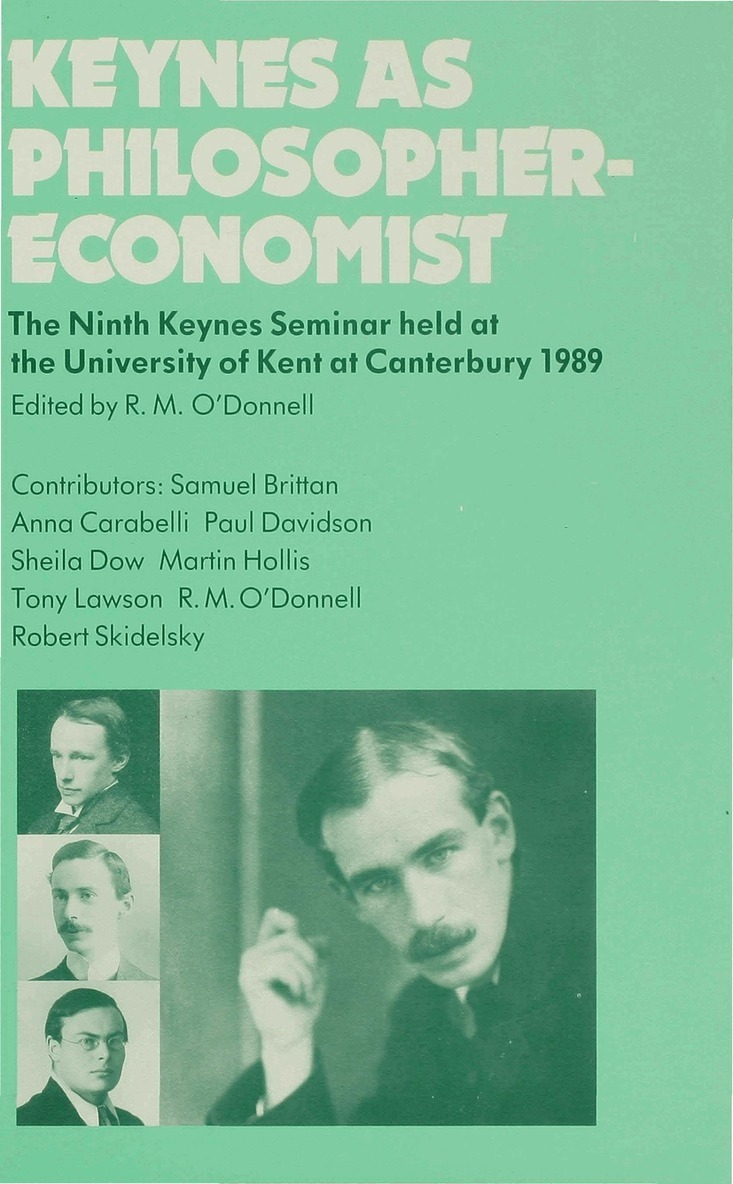
Keynes as Philosopher-Economist
The Ninth Keynes Seminar held at the University of Kent at Canterbury, 1989
Inbunden, 1991
1692 kr
Lägg i varukorg
Recently, a new area of scholarship has based itself on the fact that Keynes was a philosopher before he was an economist. It aims to provide more profound understandings of Keynes's economic writings through an examination of his philosophical contributions, particularly his Treatise on …
Keynes: Philosophy, Economics and Politics
The Philosophical Foundations of Keynes’s Thought and their Influence on his Economics and Politics
E-bok, 1989
2243 kr
Lägg i varukorg
A systematic study contending that the distinctive theory of rationality found at the heart of Keynes'' philosophy moulded his economic theorist policy-making, scientific methodology and politics. It aims to resolve his departure from Neoclassical economics to his radical "General Theory".
Keynes: Philosophy, Economics and Politics
The Philosophical Foundations of Keynes’s Thought and their Influence on his Economics and Politics
Häftad, 1989
1643 kr
Lägg i varukorg
A systematic study contending that the distinctive theory of rationality found at the heart of Keynes' philosophy moulded his economic theorist policy-making, scientific methodology and politics. It aims to resolve his departure from Neoclassical economics to his radical "General Theory".
Keynes as Philosopher-Economist
The Ninth Keynes Seminar held at the University of Kent at Canterbury, 1989
E-bok, 1991
2260 kr
Lägg i varukorg
Recently, a new area of scholarship has based itself on the fact that Keynes was a philosopher before he was an economist. It aims to provide more profound understandings of Keynes''s economic writings through an examination of his philosophical contributions, particularly his Treatise on …