Robert A. Carter - Böcker
Visar alla böcker från författaren Robert A. Carter. Handla med fri frakt och snabb leverans.
7 produkter
7 produkter
197 kr
Skickas inom 7-10 vardagar
"An excellent book based on exhaustive research and written with fresh insight. It is a spellbinding accomplishment and brings both the man and his era to life. . . . It is an extraordinary achievement."-Arizona Daily Star "Carter presents this astounding tale in a very balanced fashion, providing both the nineteenth-century rationale and his repug-nance at acts today considered shocking. . . . Through Carter's writing, the heroic and ultimately sad life of a remarkable human being makes a deep impact."-Richmond Times Dispatch "A comprehensive, sharply rendered life of showman William 'Buffalo Bill' Cody pries realities away from legend. . . . A splendid portrait of Cody's life and times, at once poignant, boisterous, and disturbing."-Kirkus Reviews (starred review) "There's a large audience for American, and particularly Western, history, and those readers will not want to miss this genial account."-Publishers Weekly "This is the remarkable story of an amazing life. Cody not only lived the adventure of the frontier, he helped create the American West of the imagination. A fascinating story and a must-read for anyone interested in the evolution of the Western myth."-Casey Tefertillerauthor, Wyatt Earp: The Life Behind the Legend
378 kr
Skickas inom 5-8 vardagar
308 kr
Skickas inom 5-8 vardagar
294 kr
Skickas inom 5-8 vardagar
Sandusky, Mansfield & Newark Railroad
Early History of The Lake Erie Division of the B&O
Häftad, Engelska, 2024
274 kr
Skickas inom 5-8 vardagar
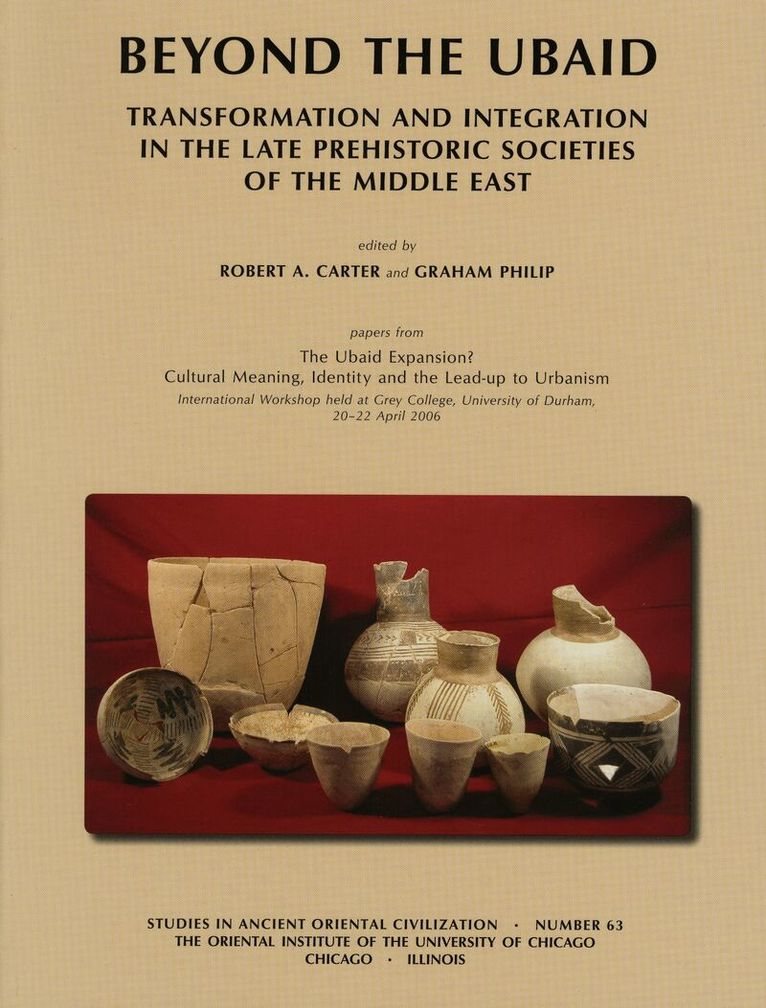
Del 63 - Studies in Ancient Oriental Civilization
Beyond the Ubaid
Transformation and Integration in the Late Prehistoric Societies of the Middle East
Häftad, Engelska, 2010
663 kr
Skickas inom 5-8 vardagar
Originally coined to signify a style of pottery in southern Iraq, and by extension an associated people and a chronological period, the term "Ubaid" is now often used loosely to denote a vast Near Eastern interaction zone, characterized by similarities in material culture, particularly ceramic styles, which existed during the sixth and fifth millennia B.C. This zone extended over 2,000 km from the shores of the Mediterranean to the Straits of Hormuz, including parts of Anatolia and perhaps even the Caucasus. The volume contains twenty-three papers that explore what the "Ubaid" is, how it is identified, and how the Ubaid in one location compares to another in a distant location. The papers are the result of "The Ubaid Expansion? Cultural Meaning, Identity and the Lead-up to Urbanism," an International Workshop held at Grey College, University of Durham, 20-22 April 2006.
1 437 kr
Skickas inom 3-6 vardagar
Since Antiquity, the natural pearls of the Gulf have been celebrated as the world's finest, most lustrous and most plentiful. From the early days of maritime trade until the 1920s, they were the primary commodity of Arabia and Persia's coastal communities and were traded across the globe, becoming one of the most sought-after luxury commodities in the world. Rising international demand between the 17th and 20th centuries led to the Gulf's pearling becoming their economic mainstay. Pearls, fished in their millions, became the pillar of the regional economy, dominating lives, health and expectations of entire sheikhdoms and fledgling states. This influx of people and wealth to the coast permanently reshaped the social, economic, and cultural fabric of the Gulf, providing manpower and capital that germinated and nurtured the city-states—notably Bahrain, Doha, Abu Dhabi, Dubai, Sharjah and Ras Al Khaimah—that endure there today.Despite its formative role, little is written about this seven-thousand-year-old industry. In this newly designed edition of Dr Robert Carter's ground-breaking work, the full evolution of pearling on both the Arabian and Persian sides of the Gulf is uncovered, revealing its profound influence on the region's political, social, and urban configuration. The study also draws striking parallels between the Gulf's dependence on pearls and the oil industry that would later replace it. With updated maps, photography, and archival imagery, the new edition covers, in unprecedented detail, the history, development, conduct, florescence and catastrophic collapse of the industry in the early 20th century. It will fascinate not only those wishing to understand the growth and conduct of the pearl fishery but also those interested in the broader history of the region, the origins of the Gulf states, and the colourful story one of mankind's most highly prized precious gemstones.