Robert A. Desharnais – författare
Visar alla böcker från författaren Robert A. Desharnais. Handla med fri frakt och snabb leverans.
5 produkter
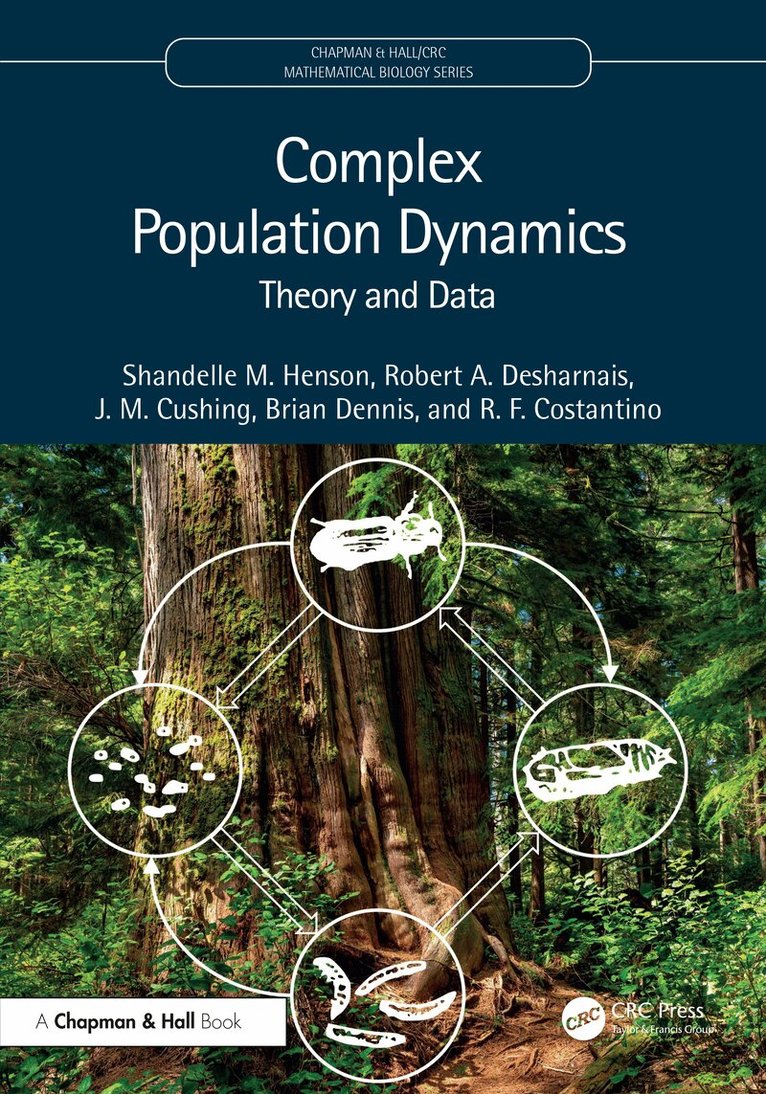
Complex Population Dynamics
Theory and Data
Av Shandelle M. Henson, Robert A. Desharnais m. fl.
Inbunden, 2026
1526 kr
Lägg i varukorg
Complex Population Dynamics: Theory and Data brings together over two decades of research and reflection on experimental nonlinear population dynamics. The broad theme of the book is the interface of population data and mathematical models. The authors establish a cornerstone example of a …
Complex Population Dynamics
Theory and Data
Av R. F. Costantino, Brian Dennis m. fl.
E-bok, 2026
1714 kr
Lägg i varukorg
Complex Population Dynamics: Theory and Data brings together over two decades of research and reflection on experimental nonlinear population dynamics. The broad theme of the book is the interface of population data and mathematical models. The authors establish a cornerstone example of a …
Complex Population Dynamics
Theory and Data
Av R. F. Costantino, Brian Dennis m. fl.
E-bok, 2026
1714 kr
Lägg i varukorg
Complex Population Dynamics: Theory and Data brings together over two decades of research and reflection on experimental nonlinear population dynamics. The broad theme of the book is the interface of population data and mathematical models. The authors establish a cornerstone example of a …
Population Dynamics and the Tribolium Model: Genetics and Demography
Av Robert A. Desharnais, Robert F. Costantino
E-bok, 2012
1459 kr
Lägg i varukorg
The study of populations is becoming increasingly focused on dynamics. We believe there are two reasons for this trend. The ftrst is the impactof nonlinear dynamics with its exciting ideas and colorful language: bifurcations, domains of attraction, chaos, fractals, strange attractors. Complexity, …
Population Dynamics and the Tribolium Model: Genetics and Demography
Av Robert F. Costantino, Robert A. Desharnais
Häftad, 2011
1098 kr
Lägg i varukorg
The study of populations is becoming increasingly focused on dynamics. We believe there are two reasons for this trend. The ftrst is the impactof nonlinear dynamics with its exciting ideas and colorful language: bifurcations, domains of attraction, chaos, fractals, strange attractors. Complexity, …