Robert Cummings Neville – författare
Visar alla böcker från författaren Robert Cummings Neville. Handla med fri frakt och snabb leverans.
61 produkter
Symbols of Jesus
A Christology of Symbolic Engagement
Häftad, 2002
764 kr
Lägg i varukorg
This is a systematic theology focusing on what makes Jesus important in Christianity. It studies six families of symbols about Jesus, showing how they are true for some people, not true for others, and not meaningful for a third group. Divine creation is analysed in metaphysical and symbolic terms, …
Symbols of Jesus
A Christology of Symbolic Engagement
Inbunden, 2001
1237 kr
Lägg i varukorg
This is a systematic theology focusing on what makes Jesus important in Christianity. It studies six families of symbols about Jesus, showing how they are true for some people, not true for others, and not meaningful for a third group. Divine creation is analysed in metaphysical and symbolic terms, …
On the Scope and Truth of Theology
Theology as Symbolic Engagement
Inbunden, 2006
2276 kr
Lägg i varukorg
This is the first volume of Robert Cumming Neville's magnum opus, Theology as Symbolic Engagement. Neville is the premier American systematic theologian of our time. His work is profoundly influenced by Paul Tillich, Friedrich Schleiermacher, and the American pragmatists John Dewey and Charles …
On the Scope and Truth of Theology
Theology as Symbolic Engagement
Häftad, 2006
1070 kr
Lägg i varukorg
This is the first volume of Robert Cumming Neville's magnum opus, Theology as Symbolic Engagement. Neville is the premier American systematic theologian of our time. His work is profoundly influenced by Paul Tillich, Friedrich Schleiermacher, and the American pragmatists John Dewey and Charles …
On the Scope and Truth of Theology
Theology as Symbolic Engagement
E-bok, 2006
1169 kr
Lägg i varukorg
This is the first volume of Robert Cumming Neville''s magnum opus, Theology as Symbolic Engagement . Neville is the premier American systematic theologian of our time. His work is profoundly influenced by Paul Tillich, Friedrich Schleiermacher, and the American pragmatists John Dewey and Charles …
On the Scope and Truth of Theology
Theology as Symbolic Engagement
E-bok, 2006
1169 kr
Lägg i varukorg
This is the first volume of Robert Cumming Neville''s magnum opus, Theology as Symbolic Engagement . Neville is the premier American systematic theologian of our time. His work is profoundly influenced by Paul Tillich, Friedrich Schleiermacher, and the American pragmatists John Dewey and Charles …
Theology Primer
Häftad, 1991
463 kr
Lägg i varukorg
A concise, philosophically grounded introduction to Christian systematic theology that organizes core doctrines—such as creation, Trinity, sin, salvation, and Christology—within a framework open to contemporary social, ethical, and interreligious dialogue.What does it mean to think theologically in …
Eternity and Time's Flow
Häftad, 1993
371 kr
Lägg i varukorg
Neville returns eternity to the center of consideration by analyzing the obsessive culture that attempts to get along denying it; and he analyzes the nature of time's flow itself, the nature of divine eternity, and the subtle problems of personal immortality. He argues that time and eternity …
Truth of Broken Symbols
Häftad, 1995
487 kr
Lägg i varukorg
Provides a cross-cultural analysis of how religious symbols function from a theological and philosophical perspective.This book provides a cross-cultural analysis of how religious symbols function from a theological and philosophical perspective. Showing how religious symbols can be true in various …
T'ai-Chi Ch'uan Experience
Reflections and Perceptions on Body-Mind Harmony
Av Sophia Delza, Robert Cummings Neville
Häftad, 1996
517 kr
Lägg i varukorg
The leading proponent in America of the Wu style discusses the spiritual and aesthetic meanings of t'ai chi ch'uan.In her previous book, T'ai-Chi Ch'uan: Body and Mind in Harmony: The Integration of Meaning and Method, Sophia Delza describes the Wu Style with careful directions and illustrations …
Human Condition
A Volume in the Comparative Religious Ideas Project
Häftad, 2000
487 kr
Lägg i varukorg
Explores the human condition in a range of world religions and discusses the issue and philosophical implications of comparison itself.This multi-authored collaborative work on the idea of the human condition as a comparative category cuts across major religious traditions and cultures. Extensive …
Religion in Late Modernity
Häftad, 2002
487 kr
Lägg i varukorg
A well-known theologian and philosopher offers a late-modern perspective on religion, one opposed to the received truths of postmodern religious thought.Religion in Late Modernity runs against the grain of common suppositions of contemporary theology and philosophy of religion. Against the common …
Ritual and Deference
Extending Chinese Philosophy in a Comparative Context
Häftad, 2009
463 kr
Lägg i varukorg
Brings Confucianism and Daoism into conversation with contemporary philosophy and the contemporary world situation.Ritual and Deference develops Robert Cummings Neville's thesis that contemporary philosophy has much to gain by shaping itself through important themes of the Chinese philosophical …
Soldier, Sage, Saint
Häftad, 1989
470 kr
Lägg i varukorg
This is a philosophic study of some aspects of spiritual development, broadly defined. Professor Neville has been influenced significantly by comparison between several of the world's great spiritual traditions, and he has tried to be faithful to experiences in those traditions. Readers whose …
Tao and the Daimon
Segments of a Religious Inquiry
Häftad, 1983
363 kr
Lägg i varukorg
The Tao and the Daimon examines a central theme in religious studies: the question of the authority and authenticity of traditional religious faith and practice (tao) in light of the challenge from the spirit of critical reason (Socrates' daimon). From a non-judgmental, historical standpoint, it …
Existence
Inbunden, 2014
1174 kr
Lägg i varukorg
The second volume in a trilogy advancing a systematic philosophical theology, this book explores the realities of human existence articulated by religion.Religion, writes Robert Cummings Neville, articulates existential predicaments and provides venues for ecstatic fulfillment. Like its companion …
Existence
Häftad, 2015
504 kr
Lägg i varukorg
The second volume in a trilogy advancing a systematic philosophical theology, this book explores the realities of human existence articulated by religion.Religion, writes Robert Cummings Neville, articulates existential predicaments and provides venues for ecstatic fulfillment. Like its companion …
Philosophical Theology Set
Inbunden, 2015
3047 kr
Lägg i varukorg
A three-volume philosophical theology by Robert Cummings Neville that redefines ultimacy, human existence, and religion for believers and skeptics alike.From one of the most distinguished contemporary philosophers of religion, Robert Cummings Neville presents a bold, systematic rethinking of …
Good Is One, Its Manifestations Many
Confucian Essays on Metaphysics, Morals, Rituals, Institutions, and Genders
Inbunden, 2016
1286 kr
Lägg i varukorg
Presents a twenty-first-century, progressive, liberal Confucianism.Building on his long-standing work in metaphysics and Asian philosophy, Robert Cummings Neville presents a series of essays that cumulatively articulate a contemporary, progressive Confucian position as a global philosophy. Through …
Defining Religion
Essays in Philosophy of Religion
Häftad, 2019
487 kr
Lägg i varukorg
Provides a new orientation to philosophy of religion and a new theory of how religion ought to be defined.In this collection of essays, written over the past decade, Robert Cummings Neville addresses contemporary debates about the concept of religion and the importance of the comparative method in …
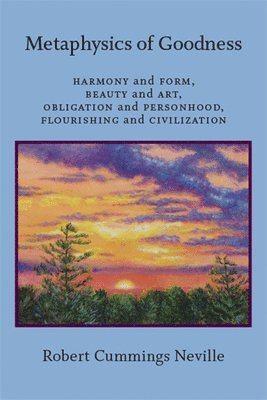
Metaphysics of Goodness
Harmony and Form, Beauty and Art, Obligation and Personhood, Flourishing and Civilization
Häftad, 2020
435 kr
Lägg i varukorg
Develops a theory of culture based on a metaphysics that elaborates on the Platonic and Confucian traditions.In Metaphysics of Goodness, Robert Cummings Neville extends Alfred North Whitehead's project of cultural studies, which was based on a new metaphysics that Whitehead developed in Adventures …
Religion in Multidisciplinary Perspective
Philosophical, Theological, and Scientific Approaches to Wesley J. Wildman
Av F. LeRon Shults, Robert Cummings Neville
Häftad, 2022
487 kr
Lägg i varukorg
An up-to-date examination of the work of one of the most inventive thinkers in the study of religion.Religion in Multidisciplinary Perspective provides the first comprehensive treatment of the work of Wesley J. Wildman, one of the most inventive thinkers in the field of religious studies. Scholars …
Religion in Multidisciplinary Perspective
Philosophical, Theological, and Scientific Approaches to Wesley J. Wildman
Av F. LeRon Shults, Robert Cummings Neville
Inbunden, 2022
1286 kr
Lägg i varukorg
An up-to-date examination of the work of one of the most inventive thinkers in the study of religion.Religion in Multidisciplinary Perspective provides the first comprehensive treatment of the work of Wesley J. Wildman, one of the most inventive thinkers in the field of religious studies. Scholars …
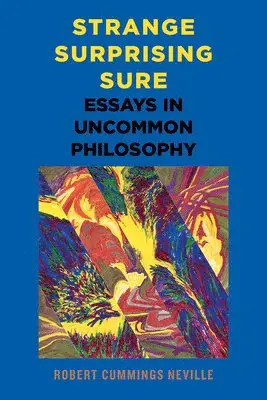
Strange, Surprising, Sure
Essays in Uncommon Philosophy
Inbunden, 2024
1595 kr
Lägg i varukorg
Accessible and wide-ranging essays on the philosophy of religion.In Strange, Surprising, Sure, Robert Cummings Neville presents a theory of being, change, and value, and engages other philosophers who deal with these concepts. The book's central thesis is that the entire created world includes …
Strange, Surprising, Sure
Essays in Uncommon Philosophy
Häftad, 2025
421 kr
Lägg i varukorg
Accessible and wide-ranging essays on the philosophy of religion.In Strange, Surprising, Sure, Robert Cummings Neville presents a theory of being, change, and value, and engages other philosophers who deal with these concepts. The book's central thesis is that the entire created world includes …
Seasons of the Christian Life
E-bok, 2016
416 kr
Lägg i varukorg
Once liberal Christianity was preached in ways that defined it in the public eye. Now Christianity is identified almost exclusively with its conservative expressions. Seasons of the Christian Life presents a series of sermons articulating a liberal Christianity over against its conservative …
Nurture in Time and Eternity
E-bok, 2016
485 kr
Lägg i varukorg
The dimension of eternity has been lost from much contemporary religious consciousness. Liberals tend to focus on action within time, as do conservatives, who see history as a battleground for a war of good against evil. Spiritual life, however, also requires nurturing a sense of eternity within …