Robert Franzese - Böcker
Visar alla böcker från författaren Robert Franzese. Handla med fri frakt och snabb leverans.
5 produkter
5 produkter
318 kr
Skickas inom 7-10 vardagar
Social scientists study complex phenomena about which they often propose intricate hypotheses tested with linear-interactive or multiplicative terms. While interaction terms are hardly new to social science research, researchers have yet to develop a common methodology for using and interpreting them. Modeling and Interpreting Interactive Hypotheses in Regression Analysis provides step-by-step guidance on how to connect substantive theories to statistical models and how to interpret and present the results."Kam and Franzese is a must-have for all empirical social scientists interested in teasing out the complexities of their data."---Janet M. Box-Steffensmeier, Ohio State University"Kam and Franzese have written what will become the definitive source on dealing with interaction terms and testing interactive hypotheses. It will serve as the standard reference for political scientists and will be one of those books that everyone will turn to when helping our students or doing our work. But more than that, this book is the best text I have seen for getting students to really think about the importance of careful specification and testing of their hypotheses."---David A. M. Peterson, Texas A&M University"Kam and Franzese have given scholars and teachers of regression models something they've needed for years: a clear, concise guide to understanding multiplicative interactions. Motivated by real substantive examples and packed with valuable examples and graphs, their book belongs on the shelf of every working social scientist."---Christopher Zorn, University of South Carolina"Kam and Franzese make it easy to model what good researchers have known for a long time: many important and interesting causal effects depend on the presence of other conditions. Their book shows how to explore interactive hypotheses in your own research and how to present your results. The book is straightforward yet technically sophisticated. There are no more excuses for misunderstanding, misrepresenting, or simply missing out on interaction effects!"---Andrew Gould, University of Notre DameCindy D. Kam is Assistant Professor, Department of Political Science, University of California, Davis.Robert J. Franzese Jr. is Associate Professor, Department of Political Science, University of Michigan, and Research Associate Professor, Center for Political Studies, Institute for Social Research, University of Michigan.For datasets, syntax, and worksheets to help readers work through the examples covered in the book, visit: www.press.umich.edu/KamFranzese/Interactions.html
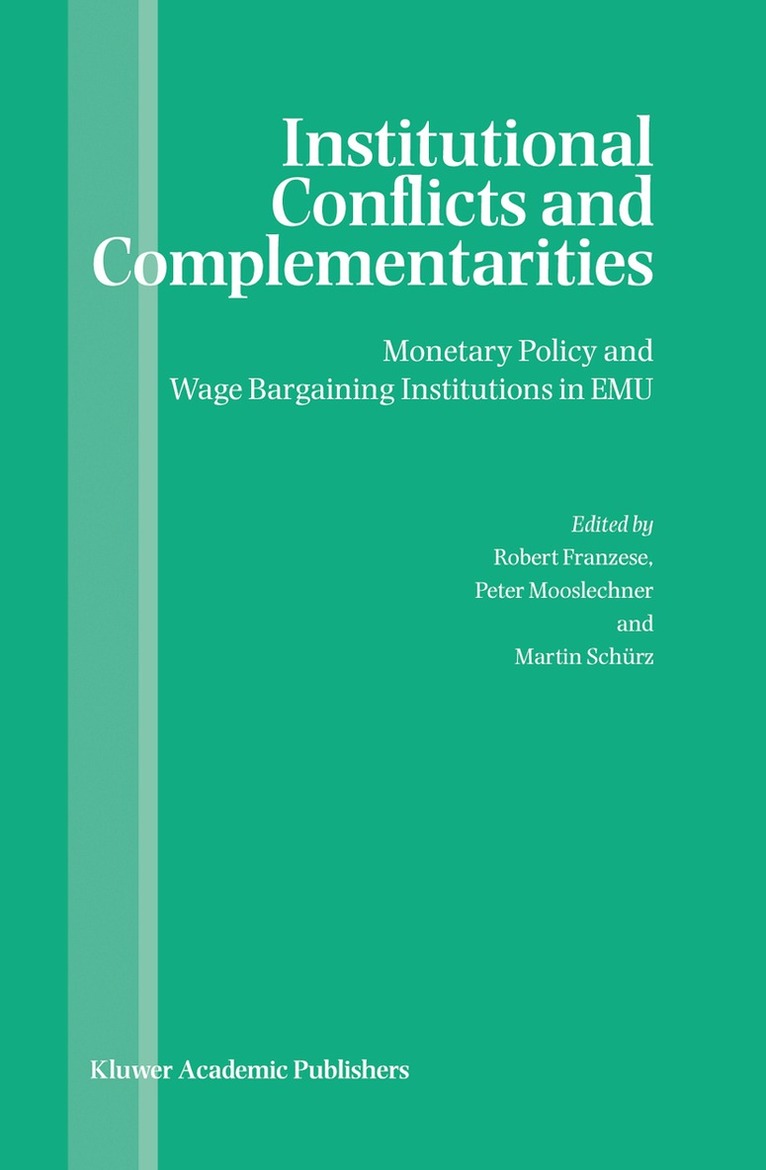
Institutional Conflicts and Complementarities
Monetary Policy and Wage Bargaining Institutions in EMU
Inbunden, Engelska, 2003
1 101 kr
Skickas inom 10-15 vardagar
This important collection presents an authoritative selection of papers on "Institutional Conflicts and Complementarities" This publication is intent on building bridges between economics and the other social sciences. The focus is on the interaction between monetary policy and wage bargaining institutions in European Monetary Union (EMU). Institutional Conflicts and Complementarities is written by acknowledged experts in their field. The outcome is a broad analysis of the interactions of labour market actors and central banks. The volume addresses the recent changes in EMU. An important theoretical, empirical, and policy-relevant conclusion that emerges from Institutional Conflicts and Complementarities is that even perfectly credible monetary conservatism has long-term real effects, even in equilibrium models with fully rational expectations. The contributions to Institutional Conflicts and Complementarities identify linkages between wage bargaining institutions and central banks with a particular focus on EMU.We consider complementarities between institutions located in different areas of the political economy and ask: Can labour-market actors and independent central banks interact in mutually reinforcing ways? The analyses in Institutional Conflicts and Complementarities study critically the neutrality assumption under the conditions of institutional interactions in EMU.
Institutional Conflicts and Complementarities
Monetary Policy and Wage Bargaining Institutions in EMU
Häftad, Engelska, 2010
1 095 kr
Skickas inom 10-15 vardagar
This important collection presents an authoritative selection of papers on "Institutional Conflicts and Complementarities" This publication is intent on building bridges between economics and the other social sciences.
15 064 kr
Tillfälligt slut
This four volume Major Work brings together the key articles that laid the foundations, extended and deepened the techniques, and demonstrated the application of the empirical-methodological toolbox of modern positive political science. The fundamental challenges of positive, empirical political science are many, and this collection helps to untangle and delineate the various issues by structuring the contents into four thematic sections: · Multicausality· Heterogeneity & Context Conditionality· Temporal & Unit (Inter)Dependence· Ubiquitous Endogeneity The rationale behind the collection’s structure and selection of contents is carefully laid out and explained in an illuminating introductory chapter, written by esteemed editor Robert J. Franzese.
The SAGE Handbook of Research Methods in Political Science and International Relations
Inbunden, Engelska, 2020
4 191 kr
Skickas inom 11-20 vardagar
The SAGE Handbook of Research Methods in Political Science and International Relations offers a comprehensive overview of research processes in social science — from the ideation and design of research projects, through the construction of theoretical arguments, to conceptualization, measurement, & data collection, and quantitative & qualitative empirical analysis — exposited through 65 major new contributions from leading international methodologists. Each chapter surveys, builds upon, and extends the modern state of the art in its area. Following through its six-part organization, undergraduate and graduate students, researchers and practicing academics will be guided through the design, methods, and analysis of issues in Political Science and International Relations: Part One: Formulating Good Research Questions & Designing Good Research ProjectsPart Two: Methods of Theoretical ArgumentationPart Three: Conceptualization & MeasurementPart Four: Large-Scale Data Collection & Representation MethodsPart Five: Quantitative-Empirical MethodsPart Six: Qualitative & "Mixed" Methods