Robert L. Launer – författare
Visar alla böcker från författaren Robert L. Launer. Handla med fri frakt och snabb leverans.
2 produkter
2 produkter
E-bok
PDF, Engelska, 2014756 kr
Läs direkt efter köp
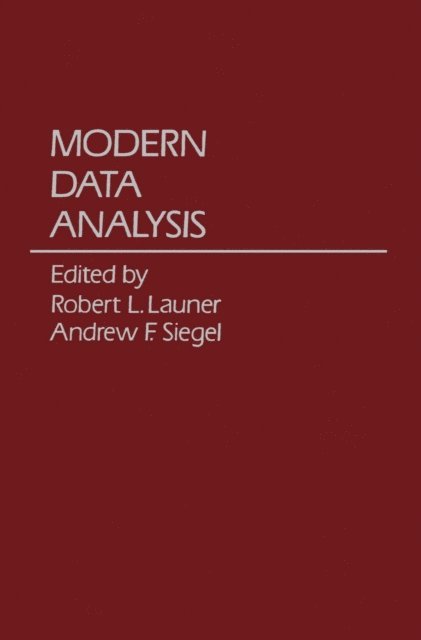
Modern Data Analysis contains the proceedings of a Workshop on Modern Data Analysis held in Raleigh, North Carolina, on June 2-4, 1980 under the auspices of the United States Army Research Office. The papers review theories and methods of data analysis and cover topics ranging from single and multiple quantile-quantile (Q-Q) plotting procedures to biplot display and pencil-and-paper exploratory data analysis methods. Projection pursuit methods for data analysis are also discussed. Comprised of nine chapters, this book begins with an introduction to styles of data analysis techniques, followed by an analysis of single and multiple Q-Q plotting procedures. Problems involving extreme-value data and the behavior of sample averages are considered. Subsequent chapters deal with the use of smelting in guiding re-expression; geometric data analysis; and influence functions and regression diagnostics. The final chapter examines the use and interpretation of robust analysis of variance for the general non-full-rank linear model. The procedures are described in terms of their mathematical structure, which leads to efficient computational algorithms. This monograph should be of interest to mathematicians and statisticians.
E-bok
PDF, Engelska, 2014756 kr
Läs direkt efter köp
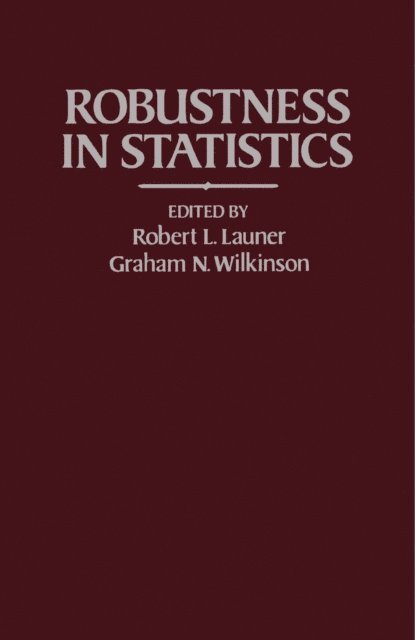
Robustness in Statistics contains the proceedings of a Workshop on Robustness in Statistics held on April 11-12, 1978, at the Army Research Office in Research Triangle Park, North Carolina. The papers review the state of the art in statistical robustness and cover topics ranging from robust estimation to the robustness of residual displays and robust smoothing. The application of robust regression to trajectory data reduction is also discussed. Comprised of 14 chapters, this book begins with an introduction to robust estimation, paying particular attention to iteration schemes and error structure of estimators. Sensitivity and influence curves as well as their connection with jackknife estimates are described. The reader is then introduced to a simple analog of trimmed means that can be used for studying residuals from a robust point-of-view; a class of robust estimators (called P-estimators) based on the location and scale-invariant Pitman estimators of location; and robust estimation in the presence of outliers. Subsequent chapters deal with robust regression and its use to reduce trajectory data; tests for censoring of extreme values, especially when population distributions are incompletely defined; and robust estimation for time series autoregressions. This monograph should be of interest to mathematicians and statisticians.