Robert Seager II – författare
Visar alla böcker från författaren Robert Seager II. Handla med fri frakt och snabb leverans.
3 produkter
3 produkter
E-bok
PDF, Engelska, 20141 094 kr
Läs direkt efter köp
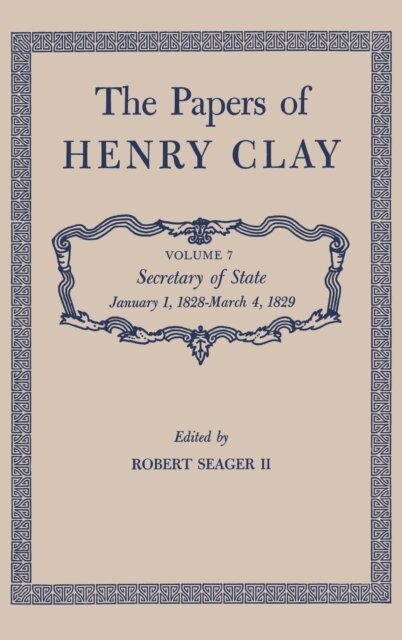
The Papers of Henry Clay span the crucial first half of the nineteenth century in American history. Few men in his time were so intimately concerned with the formation of national policy, and few influenced so profoundly the growth of American political institutions.Volume 7, the fourth and final of those dealing with Clay's role as secretary of state, carries the story of his career from January 1, 1828, to March 3, 1829. During these fourteen months, Clay and President John Quincy Adams strive unsuccessfully to solve a number of nagging diplomatic problems before leaving office. Among these are the northeast boundary controversy with Great Britain, the exclusion of American trade from the British West Indies, and the settlement of U.S. spoliation claims with France. Equally frustrating to Clay is the fact that the enormous amount of time and effort he has expended in Adams's reelection campaign has produced so little in return. To his genuine amazement and dismay, Andrew Jackson defeats Adams decisively.The volume ends in March 1829 with Clay facing an uncertain future. Unsure whether he wants again to practice law, he contemplates instead the prospect of managing "e;Ashland,"e; his Lexington estate. At the same time, convinced that the Jackson administration can only end in disaster, Clay's thoughts turn to running again for the White House in 1832. With this possibility in mind, the nation's ninth secretary of state leaves Washington for home.Publication of this book was assisted by a grant from the National Historical Publications and Records Commission.
E-bok
PDF, Engelska, 20141 368 kr
Läs direkt efter köp
Returning to Kentucky in the spring of 1829 after four years as secretary of state in the administration of John Quincy Adams, Henry Clay quickly regained the political dominance at home that would carry him to the U.S. Senate in 1831. Assuming leadership of the anti-Jackson forces, Senator Clay in 1832 mounted a spirited campaign for the presidency, advocating recharter of the national bank, high protective tariffs, and internal improvements, and alleging the administrative incompetence of Jackson and his cronies. Clay's defeat by the popular military hero was probably foreordained, but he emerged with sufficient national prestige to play the leading role in mediation of the nullification crisis of December 1832-March 1833. The battle over the constitutionality of the protective tariff, during which the words secession, invasion, and civil war were freely used, pitted Jackson and the power of the federal government against the states' rights politicians of South Carolina. Clay's masterful legislative compromise of 1833 defused a tense situation and brought him national applause as savior of the Union.Continuing his efforts to form a political coalition strong enough to defeat the Jacksonians, Clay was successful in a Senate resolution to censure the president for unconstitutional exercise of power in removing government deposits from the Bank of the United States. But as the election of 1836 drew near it became evident that the emerging coalition could not defeat Democrat Martin Van Buren, Jackson's hand- picked candidate; as the Reign of Jackson drew to a close, Clay could only view the national scene with dismay.Publication of this book was assisted by a grant from the National Endowment for the Humanities.
E-bok
PDF, Engelska, 20141 368 kr
Läs direkt efter köp
The Papers of Henry Clay span the crucial first half of the nineteenth century in American history. Few men in his time were so intimately concerned with the formation of national policy, and few influenced so profoundly the growth of American political institutions.The year 1837 found Henry Clay hard at work in a successful effort to organize and strengthen the new Whig party. In his attempt to provide for it an ideological core, he emphasized restoration of the Bank of the United States, distribution of the treasury surplus to the states, continued adherence to his Compromise Tariff Act of 1833, and federal funding of internal improvements. The achievement of these goals, Clay reasoned, would mitigate the severe impact of the Depression of 1837 and sweep the Whigs into the White House in 1840.Soon after the election of 1836, Clay began running again for the presidency. By 1838 it was clear to him that he would have to come to grips politically with the long-muted slavery question. This he did in February 1839 in a Senate speech that was so proslavery, anti-abolitionist, and racially extremist that it cost him the Whig presidential nomination at the Harrisburg convention in December 1839. William Henry Harrison was nominated in his stead and won handily. But one month after his inauguration Harrison died and Vice President John Tyler, a states' rights Democrat turned Whig, was elevated to the presidency.Senator Clay emerged from his disappointment at Harrisburg as the acknowledged leader of the Whig party and further unified it in a wide-ranging assault on the Tyler administration's refusal to support Whig principles. By the end of 1843 Tyler had been broken, the Whig party was Clay's to lead, and the Kentuckian was again in the presidential lists. Confident that 1844 would surely be his year, Clay unfortunately failed to see the formation and growth of the black cloud that was Texas annexation.Publication of this book was assisted by a grant from the National Historical Publications and Records Commission.