Robert Whitaker – författare
Visar alla böcker från författaren . Handla med fri frakt och snabb leverans.
12 produkter
12 produkter
Häftad, Engelska, 2009
227 kr
Skickas inom 5-8 vardagar
E-bok
Engelska, 2008103 kr
Läs direkt efter köp
They shot them down like rabbits . . . September 30, 1919. The United States teetered on the edge of a racial civil war. During the previous three months, racial fighting had erupted in twenty-five cities. And deep in the Arkansas Delta, black sharecroppers were meeting in a humble wooden church, forming a union and making plans to sue their white landowners, who for years had cheated them out of their fair share of the cotton crop. A car pulled up outside the church . . . What happened next has long been shrouded in controversy.In this heartbreaking but ultimately triumphant story of courage and will, journalist Robert Whitaker carefully documents—and exposes—one of the worst racial massacres in American history. Over the course of several days, posses and federal troops gunned down more than one hundred men, women, and children.But that is just the beginning of this astonishing story. White authorities also arrested more than three hundred black farmers, and in trials that lasted only a few hours, all-white juries sentenced twelve of the union leaders to die in the electric chair. One of the juries returned a death verdict after two minutes of deliberation. All hope seemed lost, and then an extraordinary lawyer from Little Rock stepped forward: Scipio Africanus Jones. Jones, who’d been born a slave, joined forces with the NAACP to mount an appeal in which he argued that his clients’ constitutional rights to a fair trial had been violated. Never before had the U.S. Supreme Court set aside a criminal verdict in a state court because the proceedings had been unfair, so the state of Arkansas, confident of victory, had a carpenter build coffins for the men.We all know the names of the many legendary heroes that emerged from the civil rights movement: Thurgood Marshall, Rosa Parks, and Martin Luther King Jr. among them. Whitaker’s important book commemorates a legal struggle, Moore v. Dempsey, that paved the way for that later remaking of our country, and tells too of a man, Scipio Africanus Jones, whose name surely deserves to be known by all Americans.From the Hardcover edition.
Häftad, Engelska, 2011
193 kr
Skickas
E-bok
Engelska, 2010179 kr
Läs direkt efter köp
Now with bonus material, including a new foreword and afterword with updated researchIn this astonishing and startling book, award-winning science and history writer Robert Whitaker investigates a medical mystery: Why has the number of disabled mentally ill in the United States tripled over the past two decades? Every day, 1,100 adults and children are added to the government disability rolls because they have become newly disabled by mental illness, with this epidemic spreading most rapidly among our nation’s children. What is going on? Anatomy of an Epidemic challenges readers to think through that question themselves. First, Whitaker investigates what is known today about the biological causes of mental disorders. Do psychiatric medications fix “chemical imbalances” in the brain, or do they, in fact, create them? Researchers spent decades studying that question, and by the late 1980s, they had their answer. Readers will be startled—and dismayed—to discover what was reported in the scientific journals. Then comes the scientific query at the heart of this book: During the past fifty years, when investigators looked at how psychiatric drugs affected long-term outcomes, what did they find? Did they discover that the drugs help people stay well? Function better? Enjoy good physical health? Or did they find that these medications, for some paradoxical reason, increase the likelihood that people will become chronically ill, less able to function well, more prone to physical illness? This is the first book to look at the merits of psychiatric medications through the prism of long-term results. Are long-term recovery rates higher for medicated or unmedicated schizophrenia patients? Does taking an antidepressant decrease or increase the risk that a depressed person will become disabled by the disorder? Do bipolar patients fare better today than they did forty years ago, or much worse? When the National Institute of Mental Health (NIMH) studied the long-term outcomes of children with ADHD, did they determine that stimulants provide any benefit? By the end of this review of the outcomes literature, readers are certain to have a haunting question of their own: Why have the results from these long-term studies—all of which point to the same startling conclusion—been kept from the public? In this compelling history, Whitaker also tells the personal stories of children and adults swept up in this epidemic. Finally, he reports on innovative programs of psychiatric care in Europe and the United States that are producing good long-term outcomes. Our nation has been hit by an epidemic of disabling mental illness, and yet, as Anatomy of an Epidemic reveals, the medical blueprints for curbing that epidemic have already been drawn up.
Häftad, Engelska, 2016
219 kr
Skickas inom 5-8 vardagar
In the early years of the 18th century, a band of French scientists set off on a daring, decade-long expedition to South America in a race to measure the precise shape of the earth. Like Lewis and Clark's exploration of the American West, their incredible mission revealed the mysteries of a little-known continent to a world hungry for discovery. Scaling 16,000foot mountains in the Peruvian Andes, and braving jaguars, pumas, insects, and vampire bats in the jungle, the scientists barely completed their mission. One was murdered, another perished from fever, and a third-Jean Godin-nearly died of heartbreak. At the expedition's end, Jean and his Peruvian wife, Isabel Grameson, became stranded at opposite ends of the Amazon, victims of a tangled web of international politics. Isabel's solo journey to reunite with Jean after their calamitous twenty-year separation was so dramatic that it left all of 18th-century Europe spellbound. Her survival-unprecedented in the annals of Amazon exploration-was a testament to human endurance, female resourcefulness, and the power of devotion.Drawing on the original writings of the French mapmakers, as well as his own experience retracing Isabel's journey, acclaimed writer Robert Whitaker weaves a riveting tale rich in adventure, intrigue, and scientific achievement.Never before told, The Mapmaker's Wife is an epic love story that unfolds against the backdrop of "the greatest expedition the world has ever known."
Häftad, Engelska, 2005
171 kr
Skickas
In 1735 a team of French scientists set out on a daring expedition into the South American wilderness to resolve one of the great scientific challenges of the time: the precise size and shape of the Earth. Scaling the Andes and journeying along the Amazon, the mapmakers faced all manner of danger, while madness, disease and violent death each took their toll. However one, Jean Godin, fell in love with a local girl called Isabel Grameson. When the time came for the expedition to return to France, Godin travelled ahead to ensure the way was safe for his new family. But on reaching French Guiana, disaster struck: Spain and Portugal closed their borders and he was stranded, unable to return to Isabel. What followed lies at the core of this extraordinary tale - a heartbreaking 20-year separation that ended when Isabel, believing she might never see her husband again, decided to make her own way across the continent: a journey that began in hope but became hell on earth...Drawing on his own experience retracing Isabel's epic trek as well as contemporary records, Robert Whitaker recounts a captivating true story of love and survival set against the backdrop of what many still regard as 'the greatest expedition the world has ever known'.
Inbunden, Engelska, 2025
333 kr
Skickas inom 5-8 vardagar
Häftad, Engelska, 2025
166 kr
Skickas inom 5-8 vardagar
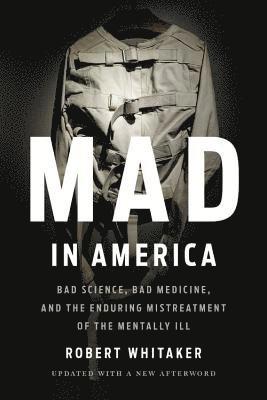
Mad In America (Revised)
Bad Science, Bad Medicine, and the Enduring Mistreatment of the Mentally Ill
Häftad, Engelska, 2019
179 kr
Skickas inom 5-8 vardagar
Schizophrenics in the United States currently fare worse than patients in the world's poorest countries. In Mad in America, medical journalist Robert Whitaker argues that modern treatments for the severely mentally ill are just old medicine in new bottles, and that we as a society are deeply deluded about their efficacy. The widespread use of lobotomies in the 1920s and 1930s gave way in the 1950s to electroshock and a wave of new drugs. In what is perhaps Whitaker's most damning revelation, Mad in America examines how drug companies in the 1980s and 1990s skewed their studies to prove that new antipsychotic drugs were more effective than the old, while keeping patients in the dark about dangerous side effects. A haunting, deeply compassionate book-updated with a new introduction and prologue bringing in the latest medical treatments and trends-Mad in America raises important questions about our obligations to the mad, the meaning of "insanity," and what we value most about the human mind.
Häftad, Tyska, 2026
573 kr
Skickas inom 3-6 vardagar
E-bok
Spanska, 2018140 kr
Läs direkt efter köp
Cuando el galardonado periodista científico Robert Whitaker se percató de que entre 1987 y 2007 el número de pacientes con discapacidad por enfermedad mental se había casi triplicado, en paralelo a un espectacular aumento en la producción de droga psicotrópica, comenzó a reflexionar.Parece como si estos psicofármacos fueran "balas mágicas" que dejan fuera de juego a la enfermedad mental, reinsertando a los pacientes a las filas de la ciudadanía productiva. Pero numerosos estudios clínicos publicados hace más de 50 años en prestigiosas revistas científicas, revelaban una anomalía sorprendente: en repetidas ocasiones, las drogas psiquiátricas empeoran la enfermedad mental, y disparan los riesgos de daño hepático, de aumento de peso, de colesterol, o de azúcar en la sangre. Realmente no se sabe qué causa la enfermedad mental, no hay cura o tratamiento paliativo que se encuentre en esas píldoras. Las conclusiones de Whitaker, tras examinar estos medicamentos a través del prisma de los resultados a largo plazo, exponen el brutal engaño de una industria que mueve miles de millones.
Inbunden, Svenska, 2014
246 kr
Skickas
I över femtio års tid har psykiatrin och läkemedelsindustrin hävdat att medicinerna mot våra vanligaste psykiska åkommor bara har blivit bättre och bättre. Om detta vore sant, kunde man vänta sig att antalet drabbade skulle ha minskat. Men så har inte skett. Antalet personer med psykiska problem har istället ökat explosionsartat - i takt med att medicineringen har ökat. Det är alltså någonting som inte stämmer med den psykiatriska framgångssagan. I Pillerparadoxen berättar vetenskapsjournalisten Robert Whitaker en helt annan, mer överraskande och mer chockerande historia. Med hjälp av omfattande kartläggning och analys av forskningen på området visar han bland annat att läkemedel som ges mot schizofreni, depression, ångest, bipolär sjukdom och ADHD inte alls har de långsiktigt positiva effekter som ofta hävdas. Tvärtom, visar forskningen, kan långvarig medicinering förvärra befintliga symptom och orsaka nya, samt i värsta fall göra dessa kroniska. OM FÖRFATTAREN Robert Whitaker är författare och journalist. Han har tidigare bland annat utgivit Mad in America, som av Discover Magazine utnämndes till en av 2002 års främsta populärvetenskapliga böcker. Robert Whitaker är även ansvarig utgivare för hemsidan Mad in America, ett i USA inflytelserikt forum för kritisk diskussion om psykiatriska mediciner. FRÅN MOTTAGANDET I USA "Pillerparadoxen är utan tvekan den mest belysande boken om psykiatrisk behandling som jag någonsin läst, och jag har läst hundratals. När jag tog del av den, och insåg omfattningen av de psykiska besvär som förorsakats av läkemedelsindustrin, drog jag spontant paralleller till Rachel Carsons Tyst vår." Bruce E. Levine, Huffington Post "Pillerparadoxen är ett av de mest alarmerande och betydelsefulla grävande reportagen jag har läst på länge. Kanske någonsin. Whitaker har övertygat mig om att psykiatrin i USA, i samarbete med läkemedelsindustrin, är i full färd med att göra sig skyldig till det största fallet av iatrogenes skadlig medicinsk behandling i historien. Han är den slags vetenskapsjournalist som gör mig stolt över att vara vetenskapsjournalist." John Horgan, Scientific American "En mäktig anklagelseakt mot hur psykiatrin fungerar idag." Marcia Angell, New York Review of Books "... argumenten är oroväckande klarsynta och genomgående underbyggda. Tillsammans bildar de en provokativ men trovärdig tes, som levereras med skönlitterär vitalitet. Whitaker lyckas vara fördömande och samtidigt envist optimistisk i denna fängslande, skrämmande och övertygande bok." Druin Burch, New Scientist "En viktig bok vars tes förtjänar seriös behandling." Alex Good, The Record "Pillerparadoxen kartlägger kontroversiell terräng på ett sätt som påminner om en kriminalroman ... Psykiatriska läkemedel har förändrat livet för miljoner. Den här boken undersöker vad som hade hänt utan läkemedlen. Det är ett alternativ värt att begrunda." Laura Fitzpatrick, The Time "Pillerparadoxen river ner psykiatrins noggrant uppbyggda och färgglatt målade arkitektur, och riktar sedan en halogenlampa mot rasmassorna som är kvar. Whitaker följer den gamla skolan. Han tittar på forskningen. Men till skillnad från andra författare läser Whitaker all forskning han kan hitta inte bara de studier som stödjer det förhärskande synsättet. Ta allt du vet om psykiatri. Vänd upp och ner på det. Då får du en ganska bra bild av vad Whitaker har upptäckt." Jenny Westberg, Examiner "Jag rekommenderar starkt denna bok till alla oss som är intresserade av vad som händer på psykiatrins område. Whitaker är en seriös och välinformerad undersökande journalist ... en solid, välunderbyggd framställan som vilar på fakta." Bernadette Grosjean, Psychiatric Services "Whitakers oroande tes är sannerligen värd ett grundligt övervägande och en seriös debatt. Medicinens historia, och psykiatrins historia i synnerhet, är överfylld av brett accepterade och tillämpade behandlingar som senare visade sig vara ineffektiva och skadliga." Daniel Herman, MIWatch UTMÄRKELSER Investigative Reporters and Editors, IRE, tilldelade 2010 Pillerparadoxen utmärkelsen bästa grävande journalistik i bokform med följande motivering: "Denna avslöjande undersökning av läkemedelsindustrin och dess kopplingar till vårdsystemet presenterar oroväckande belägg för att samma mediciner som skrivs ut mot psykiska sjukdomar kan bidra till att förvärra problemen. Whitaker framlägger bevis som tyder på att medicinerna riskerar att göra åkommor som depression, bipolär sjukdom och schizofreni kroniska och svårt handikappande. Whitaker varvar djupgående analys av medicinsk forskning och kliniska studier med övertygande exempel ur verkliga livet. Resultatet blir en svidande vidräkning med den förhärskande synen att psykiska besvär per definition kan och bör läkemedelsbehandlas."