Rochelle C. Dreyfuss - Böcker
Visar alla böcker från författaren Rochelle C. Dreyfuss. Handla med fri frakt och snabb leverans.
7 produkter
7 produkter
A Neofederalist Vision of TRIPS
The Resilience of the International Intellectual Property Regime
Inbunden, Engelska, 2012
1 216 kr
Skickas inom 5-8 vardagar
The TRIPS Agreement (Agreement on Trade-Related Aspects of Intellectual Property Rights), signed on April 15, 1994, introduced intellectual property protection into the World Trade Organization's multilateral trading system for the first time, and it remains the most comprehensive international agreement on intellectual property to date. A Neofederalist Vision of TRIPS by Graeme B. Dinwoodie and Rochelle C. Dreyfuss examines its interpretation, its impact on the creative environment, and its effect on national and international lawmaking. It propounds a vision of TRIPS as creating a neofederalist regime, one that will ensure the resilience of the international intellectual property system in time of rapid change. In this vision, WTO members retain considerable flexibility to tailor intellectual property law to their national priorities and to experiment with changes necessary to meet new technological and social challenges, but agree to operate within an international framework. This framework, while less powerful than the central administration of a federal government, comprises a series of substantive and procedural commitments that promote the coordination of both the present intellectual property system as well as future international intellectual property lawmaking. Part I demonstrates the centrality of state autonomy throughout the history of international negotiations over intellectual property. Part II, which looks at the present, analyzes the decisions of the WTO in intellectual property cases. It concludes that the WTO has been inattentive to the benefits of promoting cultural diversity, the values inherent in intellectual property, the rich fabric of its law and lore, the necessary balance between producers and users of knowledge goods, and the relationship between the law and the technological environment in which it must operate. Looking to the future, Part III develops a framework for integrating the increasingly fragmented international system and proposes the recognition of an international intellectual property acquis, a set of longstanding principles that have informed, and should continue to inform intellectual property lawmaking. The acquis would include both express and latent components of the international regime, put access-regarding guarantees such as user rights on a par with proprietary interests and enshrine the fundamental importance of national autonomy in the international system.
3 269 kr
Skickas inom 3-6 vardagar
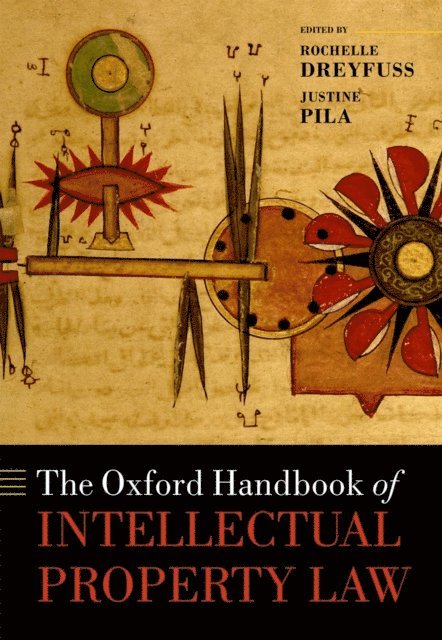
We live in an age in which expressive, informational, and technological subject matter are becoming increasingly important. Intellectual property is the primary means by which the law seeks to regulate such subject matter. It aims to promote innovation and creativity, and in doing so to support solutions to global environmental and health problems, as well as freedom of expression and democracy. It also seeks to stimulate economic growth and competition, accounting for its centrality to EU Internal Market and international trade and development policies. Additionally, it is of enormous and increasing importance to business. As a result there is a substantial and ever-growing interest in intellectual property law across all spheres of industry and social policy, including an interest in its legal principles, its social and normative foundations, and its place and operation in the political economy. This handbook written by leading academics and practitioners from the field of intellectual property law, and suitable for both a specialist legal readership and an intelligent but non-specialist legal and non-legal readership, provides a comprehensive account of the following areas: - The foundations of IP law, including its emergence and development in different jurisdictions and regions; - The substantive rules and principles of IP; and - Important issues arising from the existence and operation of IP in the political economy.
Working Within the Boundaries of Intellectual Property
Innovation Policy For The Knowledge Society
Inbunden, Engelska, 2010
3 100 kr
Skickas inom 5-8 vardagar
This book is the long-awaited companion volume to the highly acclaimed Expanding the Boundaries of Intellectual Property, published by Oxford University Press in 2001. That book argued for strong private rights whilst at the same time calling for caution in the expansionary trend. In the period since the first volume, intellectual property protection has grown ever stronger, and this new book focuses on finding ways to cope with the fragmentation of rights and the complex framework this expansion of rights has created. At the core of the book are considerations of such initiatives as patent clearing models, standard setting organizations, licensing arrangements and informal work-arounds. It also examines the measures that seek to protect the public domain, including strategic licensing, collective rights organizations, and non-profit ventures such as creative commons and open-source publishing. Drawing on expertise from a number of disciplines including law, economics and sociology, the book is international in approach and fuses scholarly research with legal practice. It will be of great interest to scholars in intellectual property and innovation, policy-makers, and practitioners with an interest in the future of the field.
791 kr
Skickas inom 7-10 vardagar
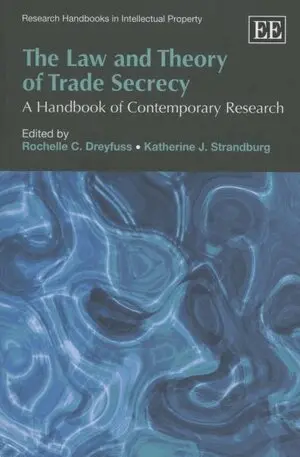
This timely Handbook marks a major shift in innovation studies, moving the focus of attention from the standard intellectual property regimes of copyright, patent, and trademark, to an exploration of trade secrecy and the laws governing know-how, tacit knowledge, and confidential relationships. The editors introduce the long tradition of trade secrecy protection and its emerging importance as a focus of scholarly inquiry. The book then presents theoretical, doctrinal, and comparative considerations of the foundations of trade secrecy, before moving on to study the impact of trade secrecy regimes on innovation and on other social values. Coverage includes topics such as sharing norms, expressive interests, culture, politics, competition, health, and the environment.This important Handbook offers the first modern exploration of trade secrecy law and will strongly appeal to intellectual property academics, and to students and lawyers practicing in the intellectual property area. Professors in competition law, constitutional law and environmental law will also find much to interest them in this book, as will innovation theorists.Contributors include: R.G. Bone, C.M. Correa, R. Denicola, R.S. Eisenberg, V. Falce, H. First, J.C. Fromer, G. Ghidini, C.T. Graves, M.A. Lemley, D.S. Levine, D.E. Long, M.L. Lyndon, M.J. Madison, F.A. Pasquale, J.H. Reichman, M. Risch, P. Samuelson, S.K. Sandeen, G. Van Overwalle, E. von Hippel, D.L. Zimmerman
1 278 kr
Skickas inom 7-10 vardagar
Elgar Advanced Introductions are stimulating and thoughtful introductions to major fields in the social sciences, business and law, expertly written by the world’s leading scholars. Designed to be accessible yet rigorous, they offer concise and lucid surveys of the substantive and policy issues associated with discrete subject areas.Concise yet comprehensive, this book provides an eloquent overview of the international patent system, outlining the agreements states have entered to protect inventions and enforce patent rights. It explores the mechanisms that ensure compliance in relation to these obligations and how they have been interpreted by international bodies.Margo A. Bagley and Rochelle C. Dreyfuss assess different systems for protecting technological innovations, such as trade secrets, design protection, genetic resources, traditional knowledge, digital sequence information and AI. They examine the procedural agreements facilitating patent applications in multiple countries, including the Patent Cooperation Agreement, the Strasbourg Agreement and the Budapest Treaty. The book concludes with the authors’ call for greater attention to be paid to building an equitable system that recognizes all forms of knowledge creation, protects public health and advances the goals of sustainable development.Key Features:Analyzes emerging trends on regional protection, converging standards and global enforcementUses examples from the COVID pandemic to illustrate the patent system's impact on countries of differing income levelsDetails the substantive obligations of the Paris Convention, TRIPS Agreement and preferential trade agreements regarding the protection of technological innovations, including patent, trade secret and design protectionStudents and scholars of patent law and international intellectual property law more generally will greatly benefit from this unique introduction. It is also a hugely beneficial resource for any stakeholders working with and within the patent system or with technological innovation more broadly.
242 kr
Skickas inom 7-10 vardagar
Elgar Advanced Introductions are stimulating and thoughtful introductions to major fields in the social sciences, business and law, expertly written by the world’s leading scholars. Designed to be accessible yet rigorous, they offer concise and lucid surveys of the substantive and policy issues associated with discrete subject areas.Concise yet comprehensive, this book provides an eloquent overview of the international patent system, outlining the agreements states have entered to protect inventions and enforce patent rights. It explores the mechanisms that ensure compliance in relation to these obligations and how they have been interpreted by international bodies.Margo A. Bagley and Rochelle C. Dreyfuss assess different systems for protecting technological innovations, such as trade secrets, design protection, genetic resources, traditional knowledge, digital sequence information and AI. They examine the procedural agreements facilitating patent applications in multiple countries, including the Patent Cooperation Agreement, the Strasbourg Agreement and the Budapest Treaty. The book concludes with the authors’ call for greater attention to be paid to building an equitable system that recognizes all forms of knowledge creation, protects public health and advances the goals of sustainable development.Key Features:Analyzes emerging trends on regional protection, converging standards and global enforcementUses examples from the COVID pandemic to illustrate the patent system's impact on countries of differing income levelsDetails the substantive obligations of the Paris Convention, TRIPS Agreement and preferential trade agreements regarding the protection of technological innovations, including patent, trade secret and design protectionStudents and scholars of patent law and international intellectual property law more generally will greatly benefit from this unique introduction. It is also a hugely beneficial resource for any stakeholders working with and within the patent system or with technological innovation more broadly.
3 470 kr
Skickas inom 7-10 vardagar
This timely Handbook marks a major shift in innovation studies, moving the focus of attention from the standard intellectual property regimes of copyright, patent, and trademark, to an exploration of trade secrecy and the laws governing know-how, tacit knowledge, and confidential relationships. The editors introduce the long tradition of trade secrecy protection and its emerging importance as a focus of scholarly inquiry. The book then presents theoretical, doctrinal, and comparative considerations of the foundations of trade secrecy, before moving on to study the impact of trade secrecy regimes on innovation and on other social values. Coverage includes topics such as sharing norms, expressive interests, culture, politics, competition, health, and the environment.This important Handbook offers the first modern exploration of trade secrecy law and will strongly appeal to intellectual property academics, and to students and lawyers practicing in the intellectual property area. Professors in competition law, constitutional law and environmental law will also find much to interest them in this book, as will innovation theorists.Contributors include: R.G. Bone, C.M. Correa, R. Denicola, R.S. Eisenberg, V. Falce, H. First, J.C. Fromer, G. Ghidini, C.T. Graves, M.A. Lemley, D.S. Levine, D.E. Long, M.L. Lyndon, M.J. Madison, F.A. Pasquale, J.H. Reichman, M. Risch, P. Samuelson, S.K. Sandeen, G. Van Overwalle, E. von Hippel, D.L. Zimmerman