Roderick Macleod – författare
Visar alla böcker från författaren Roderick Macleod. Handla med fri frakt och snabb leverans.
4 produkter
4 produkter
E-bok
PDF, Engelska, 20181 087 kr
Läs direkt efter köp
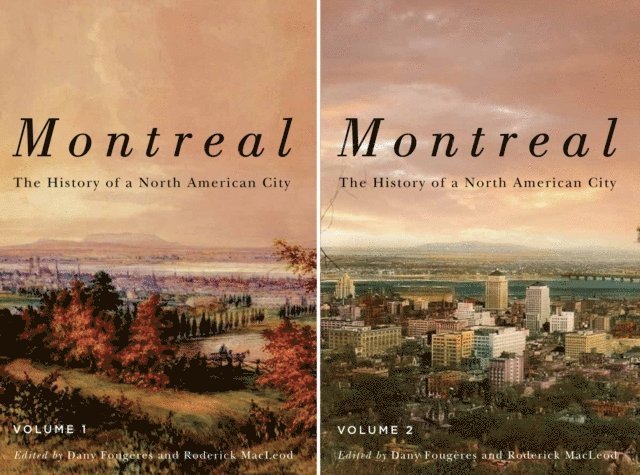
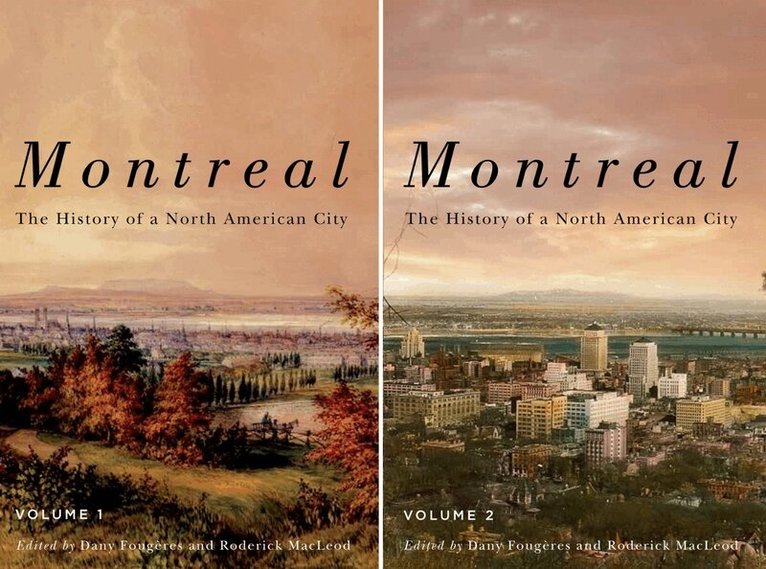
Surrounded by water and located at the heart of a fertile plain, the Island of Montreal has been a crossroads for Indigenous peoples, European settlers, and today''s citizens, and an inland port city for the movement of people and goods into and out of North America. Commemorating the city''s 375th anniversary, Montreal: The History of a North American City is the definitive, two-volume account of this fascinating metropolis and its storied hinterland. This comprehensive collection of essays, filled with hundreds of illustrations, photographs, and maps, draws on human geography and environmental history to show that while certain distinctive features remain unchanged – Mount Royal, the Lachine Rapids of the Saint Lawrence River – human intervention and urban evolution mean that over time Montrealers have had drastically different experiences and historical understandings. Significant issues such as religion, government, social conditions, the economy, labour, transportation, culture and entertainment, and scientific and technological innovation are treated thematically in innovative and diverse chapters to illuminate how people''s lives changed along with the transformation of Montreal. This history of a city in motion presents an entire picture of the changes that have marked the region as it spread from the old city of Ville-Marie into parishes, autonomous towns, boroughs, and suburbs on and off the island. The first volume encompasses the city up to 1930, vividly depicting the lives of First Nations prior to the arrival of Europeans, colonization by the French, and the beginning of British Rule. The crucial roles of waterways, portaging, paths, and trails as the primary means of travelling and trade are first examined before delving into the construction of canals, railways, and the first major roads. Nineteenth-century industrialization created a period of near-total change in Montreal as it became Canada''s leading city and witnessed staggering population growth from less than 20,000 people in 1800 to over one million by 1930. The second volume treats the history of Montreal since 1930, the year that the Jacques Cartier Bridge was opened and allowed for the outward expansion of a region, which before had been confined to the island. From the Great Depression and Montreal''s role as a munitions manufacturing centre during the Second World War to major cultural events like Expo 67, the twentieth century saw Montreal grow into one of the continent''s largest cities, requiring stringent management of infrastructure, public utilities, and transportation. This volume also extensively studies the kinds of political debate with which the region and country still grapple regarding language, nationalism, federalism, and self-determination. Contributors include Philippe Apparicio (INRS), Guy Bellavance (INRS), Laurence Bherer (University of Montreal), Stéphane Castonguay (UQTR), the late Jean-Pierre Collin (INRS), Magda Fahrni (UQAM), the late Jean-Marie Fecteau (UQAM), Dany Fougères (UQAM), Robert Gagnon (UQAM), Danielle Gauvreau (Concordia), Annick Germain (INRS), Janice Harvey (Dawson College), Annie-Claude Labrecque (independent scholar), Yvan Lamonde (McGill), Daniel Latouche (INRS), Roderick MacLeod (independent scholar), Paula Negron-Poblete (University of Montreal), Normand Perron (INRS), Martin Petitclerc (UQAM), Christian Poirier (INRS), Claire Poitras (INRS), Mario Polèse (INRS), Myriam Richard (unaffiliated), Damaris Rose (INRS), Anne-Marie Séguin (INRS), Gilles Sénécal (INRS), Valérie Shaffer (independent scholar), Richard Shearmur (McGill), Sylvie Taschereau (UQTR), Michel Trépanier (INRS), Laurent Turcot (UQTR), Nathalie Vachon (INRS), and Roland Viau (University of Montreal).
E-bok
PDF, Engelska, 2004358 kr
Läs direkt efter köp
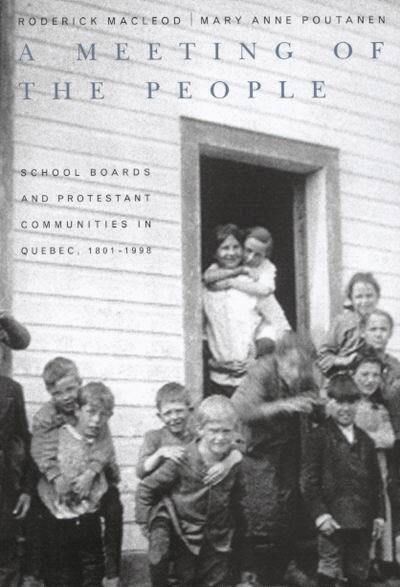
In A Meeting of the People Roderick MacLeod and Mary Anne Poutanen look at the Protestant public education system and the communities that established, and were served by, its schools, from the origins of public education in 1801 to the dissolution of confessional school boards in 1998. They focus on key issues such as class, ethnicity, religion, gender, health and welfare, patriotism, and the nature of local administration, bringing to life the people who attempted to establish and maintain schools and considering relationships between school trustees, parents, teachers, and the wider public. Their analysis shows that communities recognized the importance of providing schooling, despite what were often bleak circumstances. The authors show that Protestant families often had to make a difficult choice between supporting better educational facilities in a central place far away or encouraging the survival of the local community through maintaining one of its key institutions, the local school. They explore the ambiguous nature of Protestant education, at times understood as schooling reserved for a religious minority and at others as a liberal approach similar to public schooling across North America. The Protestant community, begun as a British element within a small colony, has developed into a diverse array of people from across the religious spectrum, periodically redefining itself to meet the needs of a changing Quebec society.
E-bok
PDF, Engelska, 2011523 kr
Läs direkt efter köp
Showing how the SSBFF has balanced its commitments to Jewish charitable causes and to Canadian culture, Spirited Commitment explores how the Foundation dealt with the challenge of respecting the wishes of its famous founders while still making a difference in contemporary Canadian society. A detailed account of the Foundation''s numerous programs over three decades - including the Centre for Cultural Management and the Saidye Bronfman Centre - Spirited Commitment highlights the innovations that SSBFF grants have led to in the arts, community development, and scientific research. An illuminating and vibrant portrait of the personalities, motivations, and strategies behind the Samuel and Saidye Bronfman Family Foundation, Spirited Commitment is a revealing, insightful account of the inner workings of philanthropic foundations.
E-bok
Engelska, 2011523 kr
Läs direkt efter köp
Showing how the SSBFF has balanced its commitments to Jewish charitable causes and to Canadian culture, Spirited Commitment explores how the Foundation dealt with the challenge of respecting the wishes of its famous founders while still making a difference in contemporary Canadian society. A detailed account of the Foundation''s numerous programs over three decades - including the Centre for Cultural Management and the Saidye Bronfman Centre - Spirited Commitment highlights the innovations that SSBFF grants have led to in the arts, community development, and scientific research. An illuminating and vibrant portrait of the personalities, motivations, and strategies behind the Samuel and Saidye Bronfman Family Foundation, Spirited Commitment is a revealing, insightful account of the inner workings of philanthropic foundations.