Rodney G. Downey – författare
Visar alla böcker från författaren Rodney G. Downey. Handla med fri frakt och snabb leverans.
15 produkter
15 produkter
E-bok
PDF, Engelska, 20101 518 kr
Läs direkt efter köp
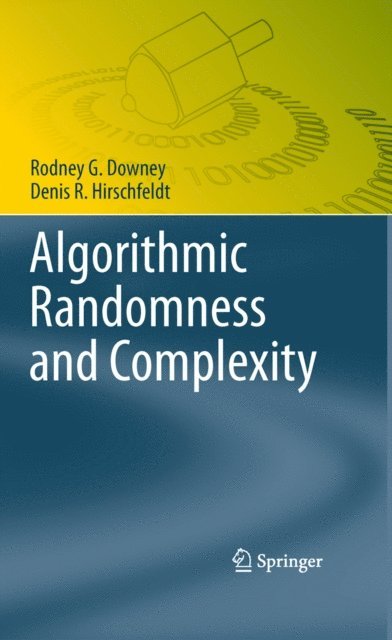
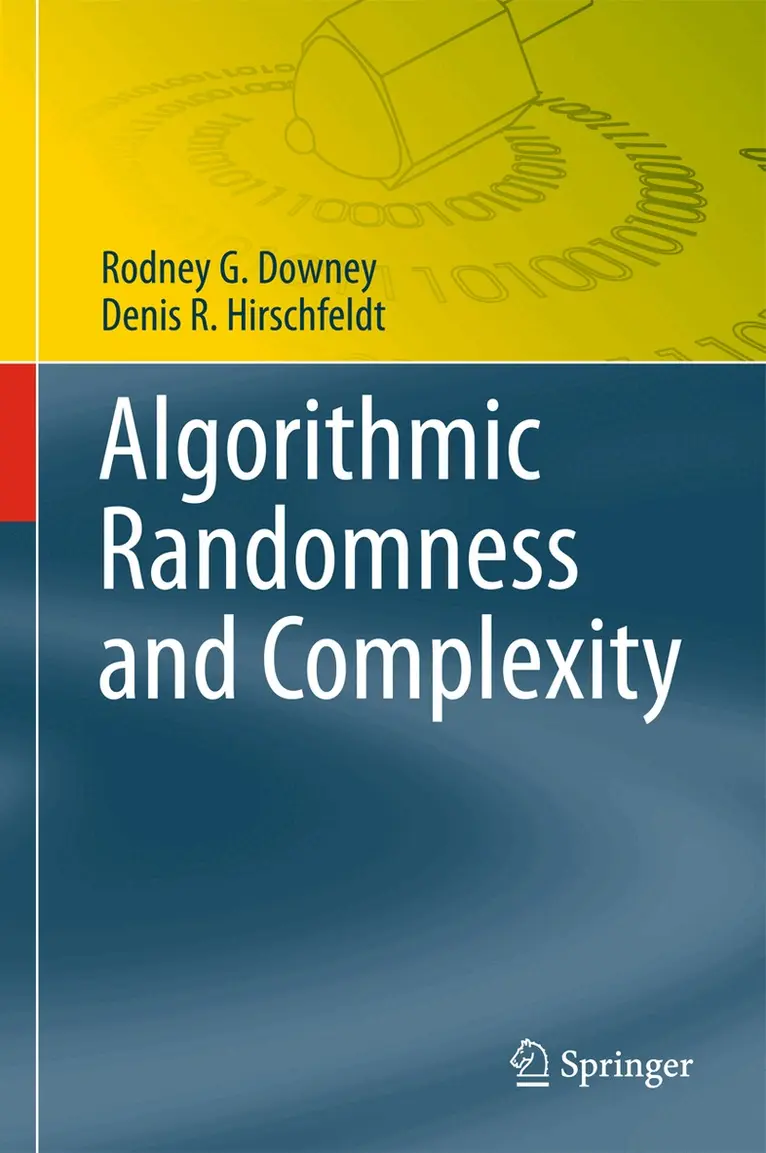
Intuitively, a sequence such as 101010101010101010… does not seem random, whereas 101101011101010100…, obtained using coin tosses, does. How can we reconcile this intuition with the fact that both are statistically equally likely? What does it mean to say that an individual mathematical object such as a real number is random, or to say that one real is more random than another? And what is the relationship between randomness and computational power. The theory of algorithmic randomness uses tools from computability theory and algorithmic information theory to address questions such as these. Much of this theory can be seen as exploring the relationships between three fundamental concepts: relative computability, as measured by notions such as Turing reducibility; information content, as measured by notions such as Kolmogorov complexity; and randomness of individual objects, as first successfully defined by Martin-Löf. Although algorithmic randomness has been studied for several decades, a dramatic upsurge of interest in the area, starting in the late 1990s, has led to significant advances. This is the first comprehensive treatment of this important field, designed to be both a reference tool for experts and a guide for newcomers. It surveys a broad section of work in the area, and presents most of its major results and techniques in depth. Its organization is designed to guide the reader through this large body of work, providing context for its many concepts and theorems, discussing their significance, and highlighting their interactions. It includes a discussion of effective dimension, which allows us to assign concepts like Hausdorff dimension to individual reals, and a focused but detailed introduction to computability theory. It will be of interest to researchers and students in computability theory, algorithmic information theory, and theoretical computer science.
Inbunden, Engelska, 1998
2 716 kr
Skickas inom 10-15 vardagar
The idea for this book was conceived over the second bottle of Villa Maria's Caber net Medot '89, at the dinner of the Australasian Combinatorics Conference held at Palmerston North, New Zealand in December 1990, where the authors first met and discovered they had a number of interests in common. Initially, we embarked on a small project to try to formulate reductions to address the apparent parame terized intractability of DOMINATING SET, and to introduce a structure in which to frame our answers. Having spent several months trying to get the definitions for the reductions right (they now seem so obvious), we turned to our tattered copies of Garey and Johnson's work [239]. We were stunned to find that virtually none of the classical reductions worked in the parameterized setting. We then wondered if we'd be able to find any interesting reductions. Several years, many more bottles, so many papers, and reductions later it [3] seemed that we had unwittingly stumbled upon what we believe is a truly central and new area of complexity theory. It seemed to us that the material would be of great interest to people working in areas where exact algorithms for a small range of parameters are natural and useful (e. g. , Molecular Biology, VLSI design). The tractability theory was rich with distinctive and powerful techniques. The intractability theory seemed to have a deep structure and techniques all of its own.
Inbunden, Engelska, 2010
1 681 kr
Skickas inom 10-15 vardagar
Intuitively, a sequence such as 101010101010101010… does not seem random, whereas 101101011101010100…, obtained using coin tosses, does. How can we reconcile this intuition with the fact that both are statistically equally likely? What does it mean to say that an individual mathematical object such as a real number is random, or to say that one real is more random than another? And what is the relationship between randomness and computational power. The theory of algorithmic randomness uses tools from computability theory and algorithmic information theory to address questions such as these. Much of this theory can be seen as exploring the relationships between three fundamental concepts: relative computability, as measured by notions such as Turing reducibility; information content, as measured by notions such as Kolmogorov complexity; and randomness of individual objects, as first successfully defined by Martin-Löf. Although algorithmic randomness has been studied for several decades, a dramatic upsurge of interest in the area, starting in the late 1990s, has led to significant advances. This is the first comprehensive treatment of this important field, designed to be both a reference tool for experts and a guide for newcomers. It surveys a broad section of work in the area, and presents most of its major results and techniques in depth. Its organization is designed to guide the reader through this large body of work, providing context for its many concepts and theorems, discussing their significance, and highlighting their interactions. It includes a discussion of effective dimension, which allows us to assign concepts like Hausdorff dimension to individual reals, and a focused but detailed introduction to computability theory. It will be of interest to researchers and students in computability theory, algorithmic information theory, and theoretical computer science.
Inbunden, Engelska, 2013
1 416 kr
Skickas inom 10-15 vardagar
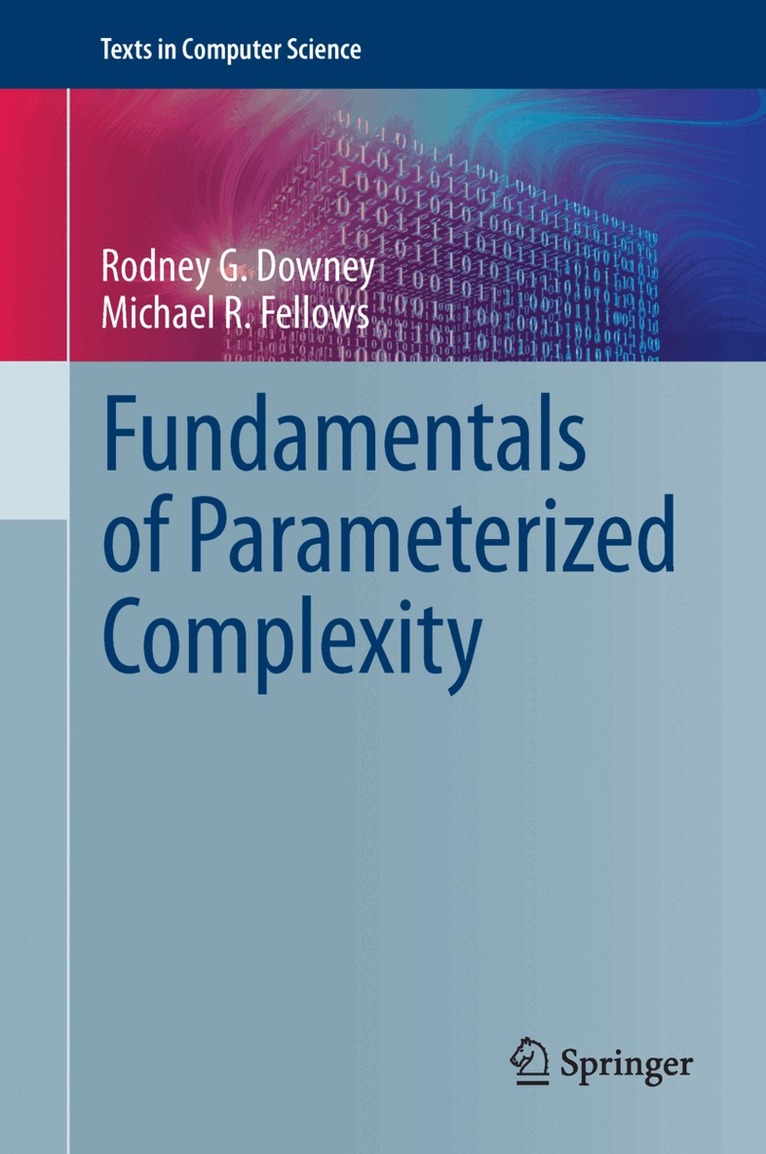
This comprehensive and self-contained textbook presents an accessible overview of the state of the art of multivariate algorithmics and complexity. Increasingly, multivariate algorithmics is having significant practical impact in many application domains, with even more developments on the horizon. The text describes how the multivariate framework allows an extended dialog with a problem, enabling the reader who masters the complexity issues under discussion to use the positive and negative toolkits in their own research. Features: describes many of the standard algorithmic techniques available for establishing parametric tractability; reviews the classical hardness classes; explores the various limitations and relaxations of the methods; showcases the powerful new lower bound techniques; examines various different algorithmic solutions to the same problems, highlighting the insights to be gained from each approach; demonstrates how complexity methods and ideas have evolved over the past 25 years.
E-bok
PDF, Engelska, 20131 214 kr
Läs direkt efter köp
This comprehensive and self-contained textbook presents an accessible overview of the state of the art of multivariate algorithmics and complexity. Increasingly, multivariate algorithmics is having significant practical impact in many application domains, with even more developments on the horizon. The text describes how the multivariate framework allows an extended dialog with a problem, enabling the reader who masters the complexity issues under discussion to use the positive and negative toolkits in their own research. Features: describes many of the standard algorithmic techniques available for establishing parametric tractability; reviews the classical hardness classes; explores the various limitations and relaxations of the methods; showcases the powerful new lower bound techniques; examines various different algorithmic solutions to the same problems, highlighting the insights to be gained from each approach; demonstrates how complexity methods and ideas have evolved over the past 25 years.
Häftad, Engelska, 2016
982 kr
Skickas inom 10-15 vardagar
This comprehensive and self-contained textbook presents an accessible overview of the state of the art of multivariate algorithmics and complexity. Increasingly, multivariate algorithmics is having significant practical impact in many application domains, with even more developments on the horizon. The text describes how the multivariate framework allows an extended dialog with a problem, enabling the reader who masters the complexity issues under discussion to use the positive and negative toolkits in their own research. Features: describes many of the standard algorithmic techniques available for establishing parametric tractability; reviews the classical hardness classes; explores the various limitations and relaxations of the methods; showcases the powerful new lower bound techniques; examines various different algorithmic solutions to the same problems, highlighting the insights to be gained from each approach; demonstrates how complexity methods and ideas have evolved over the past 25 years.
E-bok
PDF, Engelska, 20123 351 kr
Läs direkt efter köp
The idea for this book was conceived over the second bottle of Villa Maria''s Caber net Medot ''89, at the dinner of the Australasian Combinatorics Conference held at Palmerston North, New Zealand in December 1990, where the authors first met and discovered they had a number of interests in common. Initially, we embarked on a small project to try to formulate reductions to address the apparent parame terized intractability of DOMINATING SET, and to introduce a structure in which to frame our answers. Having spent several months trying to get the definitions for the reductions right (they now seem so obvious), we turned to our tattered copies of Garey and Johnson''s work [239]. We were stunned to find that virtually none of the classical reductions worked in the parameterized setting. We then wondered if we''d be able to find any interesting reductions. Several years, many more bottles, so many papers, and reductions later it [3] seemed that we had unwittingly stumbled upon what we believe is a truly central and new area of complexity theory. It seemed to us that the material would be of great interest to people working in areas where exact algorithms for a small range of parameters are natural and useful (e. g. , Molecular Biology, VLSI design). The tractability theory was rich with distinctive and powerful techniques. The intractability theory seemed to have a deep structure and techniques all of its own.
Häftad, Engelska, 2012
2 716 kr
Skickas inom 10-15 vardagar
The idea for this book was conceived over the second bottle of Villa Maria's Caber net Medot '89, at the dinner of the Australasian Combinatorics Conference held at Palmerston North, New Zealand in December 1990, where the authors first met and discovered they had a number of interests in common. Initially, we embarked on a small project to try to formulate reductions to address the apparent parame terized intractability of DOMINATING SET, and to introduce a structure in which to frame our answers. Having spent several months trying to get the definitions for the reductions right (they now seem so obvious), we turned to our tattered copies of Garey and Johnson's work [239]. We were stunned to find that virtually none of the classical reductions worked in the parameterized setting. We then wondered if we'd be able to find any interesting reductions. Several years, many more bottles, so many papers, and reductions later it [3] seemed that we had unwittingly stumbled upon what we believe is a truly central and new area of complexity theory. It seemed to us that the material would be of great interest to people working in areas where exact algorithms for a small range of parameters are natural and useful (e. g. , Molecular Biology, VLSI design). The tractability theory was rich with distinctive and powerful techniques. The intractability theory seemed to have a deep structure and techniques all of its own.
Häftad, Engelska, 2016
1 235 kr
Skickas inom 10-15 vardagar
Intuitively, a sequence such as 101010101010101010… does not seem random, whereas 101101011101010100…, obtained using coin tosses, does. How can we reconcile this intuition with the fact that both are statistically equally likely? What does it mean to say that an individual mathematical object such as a real number is random, or to say that one real is more random than another? And what is the relationship between randomness and computational power. The theory of algorithmic randomness uses tools from computability theory and algorithmic information theory to address questions such as these. Much of this theory can be seen as exploring the relationships between three fundamental concepts: relative computability, as measured by notions such as Turing reducibility; information content, as measured by notions such as Kolmogorov complexity; and randomness of individual objects, as first successfully defined by Martin-Löf. Although algorithmic randomness has been studied for several decades, a dramatic upsurge of interest in the area, starting in the late 1990s, has led to significant advances. This is the first comprehensive treatment of this important field, designed to be both a reference tool for experts and a guide for newcomers. It surveys a broad section of work in the area, and presents most of its major results and techniques in depth. Its organization is designed to guide the reader through this large body of work, providing context for its many concepts and theorems, discussing their significance, and highlighting their interactions. It includes a discussion of effective dimension, which allows us to assign concepts like Hausdorff dimension to individual reals, and a focused but detailed introduction to computability theory. It will be of interest to researchers and students in computability theory, algorithmic information theory, and theoretical computer science.
Inbunden, Engelska, 2025
1 416 kr
Skickas inom 10-15 vardagar
This is the first book which gives a unified theory for countable and uncountable computable structures.The work treats computable linear orderings, graphs, groups and Boolean algebras unified with computable metric and Banach spaces, profinite groups, and the like. Further, it provides the first account of these that exploits effective versions of dualities, such as Stone and Pontryagin dualities. The themes are effective classification and enumeration.Topics and features:· Delivers a self-contained, gentle introduction to priority arguments, directly applying them in algebraic contexts· Includes extensive exercises that both cement and amplify the materials· Provides complete introduction to the basics of computable analysis, particularly in the context of computable structures· Offers the first monograph treatment of computable Polish groups, effective profinite groups via Stone duality, and effective abelian groups via Pontryagin duality· Presents the first book treatment of Friedberg enumerations of structuresThis unique volume is aimed at graduate students and researchers in computability theory, as well as mathematicians seeking to understand the algorithmic content of structure theory. Being self-contained, it provides ample opportunity for self-study.
E-bok
PDF, Engelska, 20251 687 kr
Läs direkt efter köp
This is the first book which gives a unified theory for countable and uncountable computable structures.The work treats computable linear orderings, graphs, groups and Boolean algebras unified with computable metric and Banach spaces, profinite groups, and the like. Further, it provides the first account of these that exploits effective versions of dualities, such as Stone and Pontryagin dualities. The themes are effective classification and enumeration.Topics and features:· Delivers a self-contained, gentle introduction to priority arguments, directly applying them in algebraic contexts· Includes extensive exercises that both cement and amplify the materials· Provides complete introduction to the basics of computable analysis, particularly in the context of computable structures· Offers the first monograph treatment of computable Polish groups, effective profinite groups via Stone duality, and effective abelian groups via Pontryagin duality· Presents the first book treatment of Friedberg enumerations of structuresThis unique volume is aimed at graduate students and researchers in computability theory, as well as mathematicians seeking to understand the algorithmic content of structure theory. Being self-contained, it provides ample opportunity for self-study.
Inbunden, Engelska, 2006
2 104 kr
Skickas inom 5-8 vardagar
This volume is devoted to the main areas of mathematical logic and applications to computer science. There are articles on weakly o-minimal theories, algorithmic complexity of relations, models within the computable model theory, hierarchies of randomness tests, computable numberings, and complexity problems of minimal unsatisfiable formulas. The problems of characterization of the deduction-detachment theorem, Δ1-induction, completeness of Leśniewski's systems, and reduction calculus for the satisfiability problem are also discussed.The coverage includes the answer to Kanovei's question about the upper bound for the complexity of equivalence relations by convergence at infinity for continuous functions. The volume also gives some applications to computer science such as solving the problems of inductive interference of languages from the full collection of positive examples and some negative data, the effects of random negative data, methods of formal specification and verification on the basis of model theory and multiple-valued logics, interval fuzzy algebraic systems, the problems of information exchange among agents on the base topological structures, and the predictions provided by inductive theories.
Inbunden, Engelska, 2013
1 834 kr
Skickas inom 5-8 vardagar
The Asian Logic Conference is the most significant logic meeting outside of North America and Europe, and this volume represents work presented at, and arising from the 12th meeting. It collects a number of interesting papers from experts in the field. It covers many areas of logic.
Inbunden, Engelska, 2003
2 158 kr
Tillfälligt slut
The 7th and the 8th Asian Logic Conferences belong to the series of logic conferences inaugurated in Singapore in 1981. This meeting is held once every three years and rotates among countries in the Asia-Pacific region, with interests in the broad area of logic, including theoretical computer science. It is now considered a major conference in this field and is regularly sponsored by the Association for Symbolic Logic.This book contains papers — many of them surveys by leading experts — of both the 7th meeting (in Hsi-Tou, Taiwan) and the 8th (in Chongqing, China). The volume planned for the 7th meeting was interrupted by the earthquake in Taiwan and the decision was made to combine the two proceedings. The 8th conference is also the ICM2002 Satellite Conference on Mathematical Logic.
Inbunden, Engelska, 2009
1 563 kr
Tillfälligt slut
The 10th Asian Logic Conference is part of the series of logic conferences inaugurated in Singapore in 1981. This meeting is held every three years and rotates among countries in the Asia-Pacific region, with interests in the broad area of logic, including theoretical computer science. It is now considered a major conference in this field and is regularly sponsored by the Association of Symbolic Logic.This volume contains papers from the 10th meeting held in Kobe, Japan.