Roelof W. Bruggeman – författare
Visar alla böcker från författaren Roelof W. Bruggeman. Handla med fri frakt och snabb leverans.
4 produkter
4 produkter
Del 2340 - Lecture Notes in Mathematics
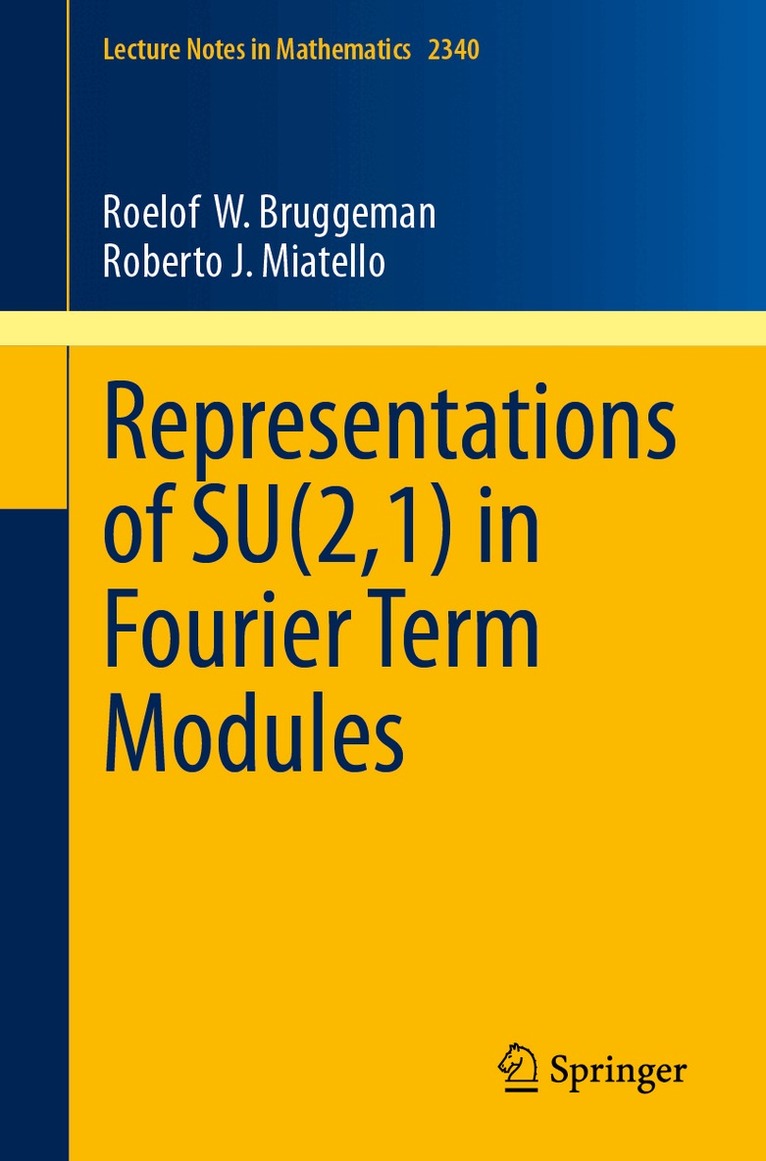
Representations of SU(2,1) in Fourier Term Modules
Häftad, Engelska, 2023
600 kr
Skickas inom 5-8 vardagar
This book studies the modules arising in Fourier expansions of automorphic forms, namely Fourier term modules on SU(2,1), the smallest rank one Lie group with a non-abelian unipotent subgroup. It considers the “abelian” Fourier term modules connected to characters of the maximal unipotent subgroups of SU(2,1), and also the “non-abelian” modules, described via theta functions. A complete description of the submodule structure of all Fourier term modules is given, with a discussion of the consequences for Fourier expansions of automorphic forms, automorphic forms with exponential growth included.These results can be applied to prove a completeness result for Poincaré series in spaces of square integrable automorphic forms.Aimed at researchers and graduate students interested in automorphic forms, harmonic analysis on Lie groups, and number-theoretic topics related to Poincaré series, the book will also serve as a basic reference on spectral expansion with Fourier-Jacobi coefficients. Only a background in Lie groups and their representations is assumed.
E-bok
Engelska, 2023770 kr
Läs direkt efter köp
This book studies the modules arising in Fourier expansions of automorphic forms, namely Fourier term modules on SU(2,1), the smallest rank one Lie group with a non-abelian unipotent subgroup. It considers the “abelian” Fourier term modules connected to characters of the maximal unipotent subgroups of SU(2,1), and also the “non-abelian” modules, described via theta functions. A complete description of the submodule structure of all Fourier term modules is given, with a discussion of the consequences for Fourier expansions of automorphic forms, automorphic forms with exponential growth included.These results can be applied to prove a completeness result for Poincaré series in spaces of square integrable automorphic forms.Aimed at researchers and graduate students interested in automorphic forms, harmonic analysis on Lie groups, and number-theoretic topics related to Poincaré series, the book will also serve as a basic reference on spectral expansion with Fourier-Jacobi coefficients. Only a background in Lie groups and their representations is assumed.
Häftad, Engelska, 2009
549 kr
Skickas inom 10-15 vardagar
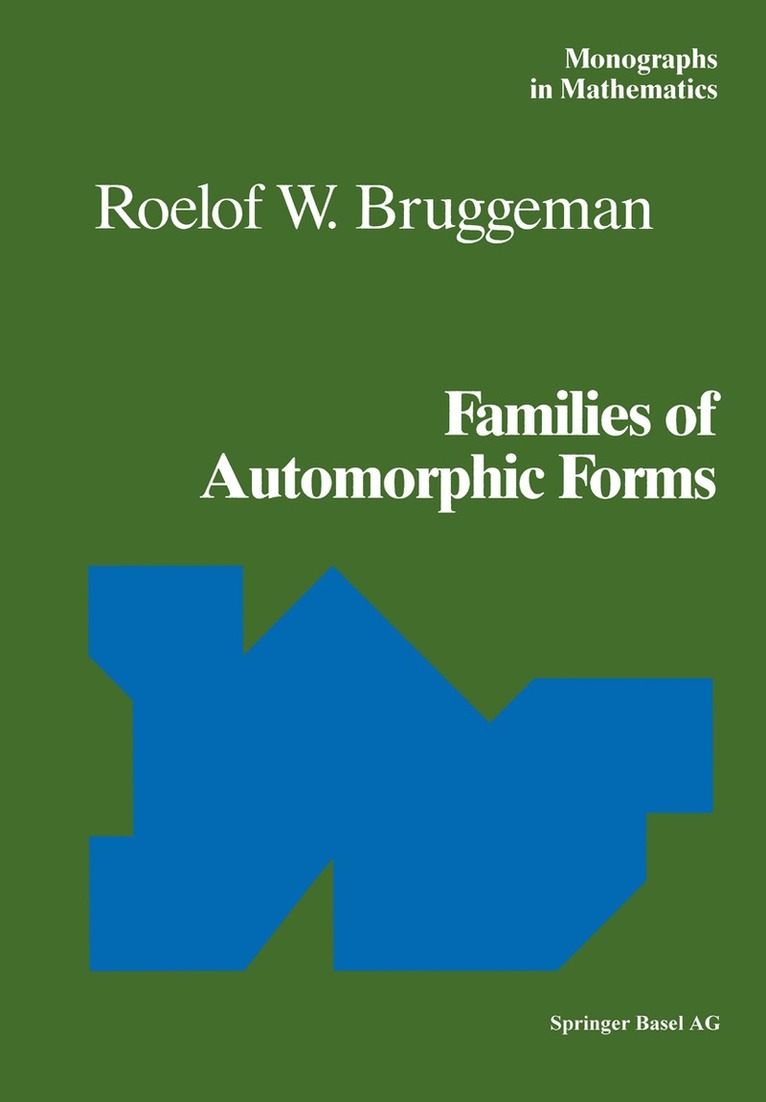
Automorphic forms on the upper half plane have been studied for a long time. Most attention has gone to the holomorphic automorphic forms, with numerous applications to number theory. Maass, [34], started a systematic study of real analytic automorphic forms. He extended Hecke’s relation between automorphic forms and Dirichlet series to real analytic automorphic forms. The names Selberg and Roelcke are connected to the spectral theory of real analytic automorphic forms, see, e. g. , [50], [51]. This culminates in the trace formula of Selberg, see, e. g. , Hejhal, [21]. Automorphicformsarefunctionsontheupperhalfplanewithaspecialtra- formation behavior under a discontinuous group of non-euclidean motions in the upper half plane. One may ask how automorphic forms change if one perturbs this group of motions. This question is discussed by, e. g. , Hejhal, [22], and Phillips and Sarnak, [46]. Hejhal also discusses the e?ect of variation of the multiplier s- tem (a function on the discontinuous group that occurs in the description of the transformation behavior of automorphic forms). In [5]–[7] I considered variation of automorphic forms for the full modular group under perturbation of the m- tiplier system. A method based on ideas of Colin de Verdi` ere, [11], [12], gave the meromorphic continuation of Eisenstein and Poincar´ e series as functions of the eigenvalue and the multiplier system jointly. The present study arose from a plan to extend these results to much more general groups (discrete co?nite subgroups of SL (R)).
E-bok
PDF, Engelska, 2010687 kr
Läs direkt efter köp
Automorphic forms on the upper half plane have been studied for a long time. Most attention has gone to the holomorphic automorphic forms, with numerous applications to number theory. Maass, [34], started a systematic study of real analytic automorphic forms. He extended Hecke’s relation between automorphic forms and Dirichlet series to real analytic automorphic forms. The names Selberg and Roelcke are connected to the spectral theory of real analytic automorphic forms, see, e. g. , [50], [51]. This culminates in the trace formula of Selberg, see, e. g. , Hejhal, [21]. Automorphicformsarefunctionsontheupperhalfplanewithaspecialtra- formation behavior under a discontinuous group of non-euclidean motions in the upper half plane. One may ask how automorphic forms change if one perturbs this group of motions. This question is discussed by, e. g. , Hejhal, [22], and Phillips and Sarnak, [46]. Hejhal also discusses the e?ect of variation of the multiplier s- tem (a function on the discontinuous group that occurs in the description of the transformation behavior of automorphic forms). In [5]–[7] I considered variation of automorphic forms for the full modular group under perturbation of the m- tiplier system. A method based on ideas of Colin de Verdi` ere, [11], [12], gave the meromorphic continuation of Eisenstein and Poincar´ e series as functions of the eigenvalue and the multiplier system jointly. The present study arose from a plan to extend these results to much more general groups (discrete co?nite subgroups of SL (R)).