Rosalba Saija – författare
Visar alla böcker från författaren Rosalba Saija. Handla med fri frakt och snabb leverans.
4 produkter
4 produkter
Inbunden, Engelska, 2006
1 619 kr
Skickas inom 10-15 vardagar
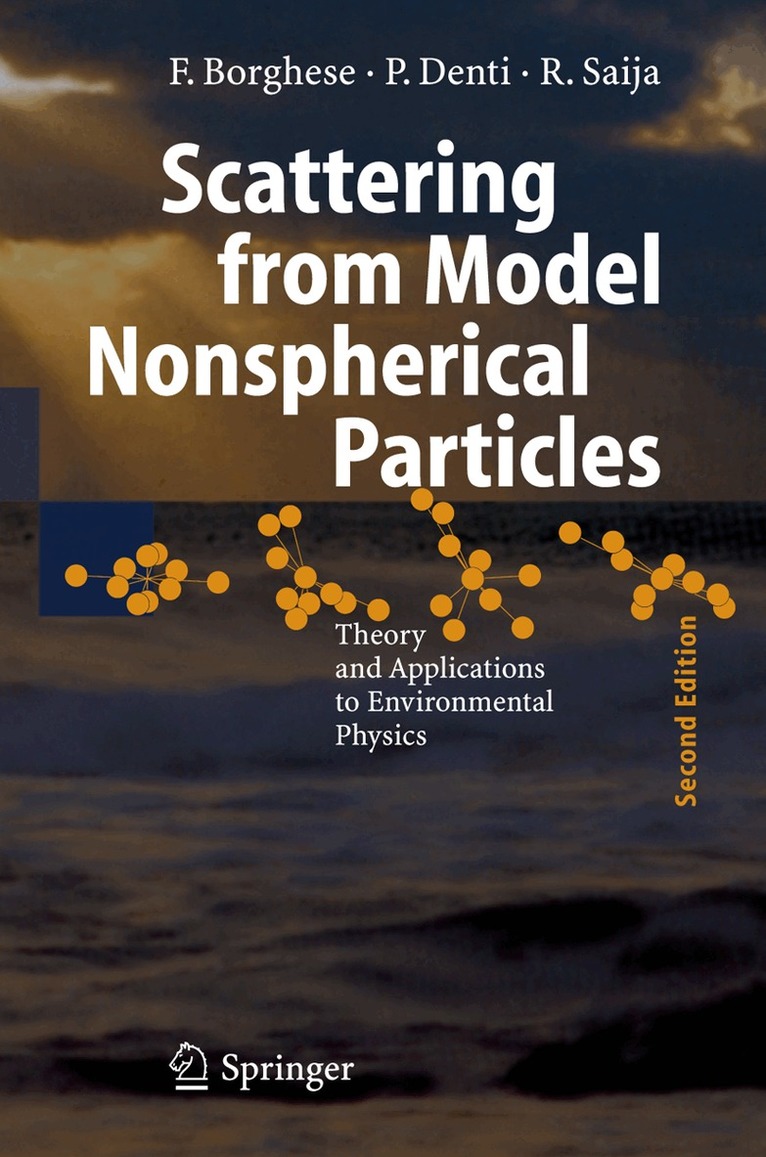
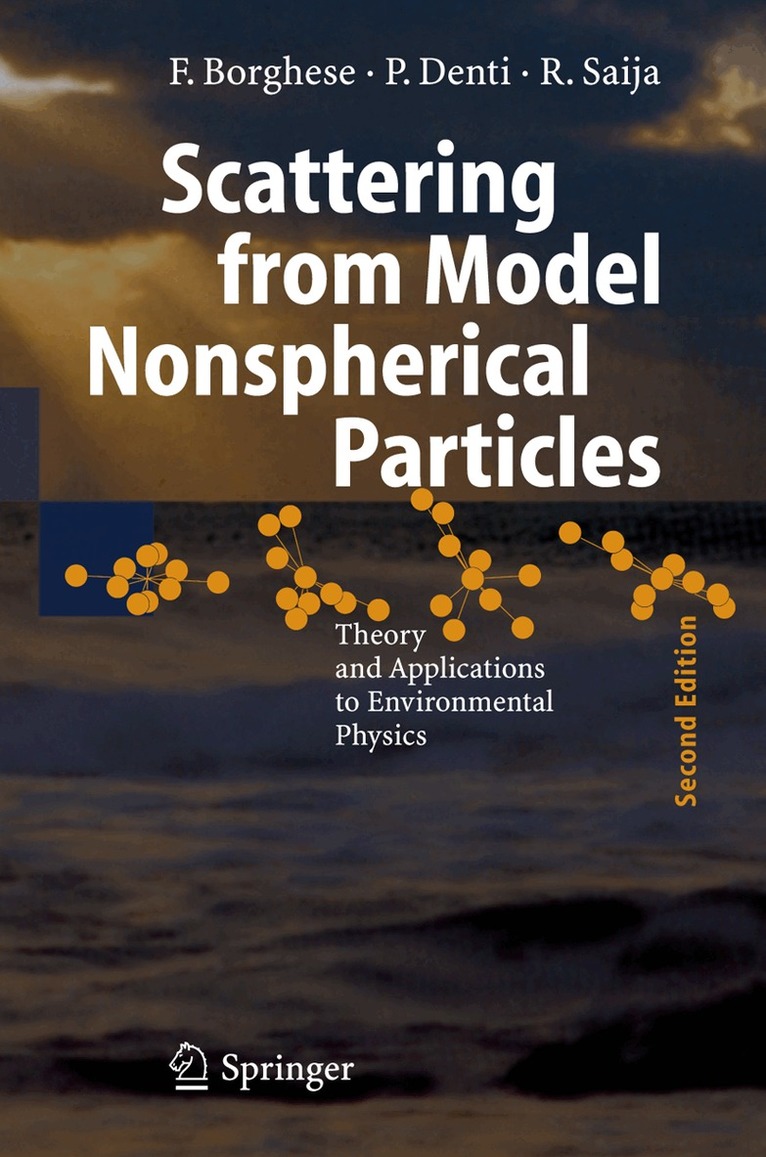
Since the publication of the ?rst edition of this book, we have become deeply involved in astrophysics research, particularly the study of the interstellar medium. Modeling scattering particles as layered spheres or as aggregates of spherical scatterers, expanding the electromagnetic ?eld in a series of vector multipole ?elds, and resorting to the T-matrix approach for averaging over the orientations of a dispersion of nonspherical particles are e?ective tools for studying scattering theory, which we described and extensively applied in the ?rst edition of this book. In fact, these tools also proved to be adequate for studying cosmic dust, even when they must be applied to a new range of current problems. We refer, for example, to the description of mechanical interaction of electromagnetic radiation with cosmic dust grains, which is believed to be of paramount importance in determining the dynamics of the grains. Since this book is conceived as a summary of our work, the desire to encompassallnewtopicsledustorevisebothitscontentanditsstructure. Of course, beyond the changes that we outline below, all chapters were carefully revised. Marginal changes and additions were made in Chap. 1, while Chap. 2 has been substantially revised to cover the light of general polarization and, in particular, with thedescription ofthestate ofpolarization ofelectromagnetic waves of general form. In this chapter we reserved ample space for the r- resentation of the kinematics of the scattering processes both in the plane of scattering and in the meridional planes.
E-bok
PDF, Engelska, 20071 977 kr
Läs direkt efter köp
Since the publication of the ?rst edition of this book, we have become deeply involved in astrophysics research, particularly the study of the interstellar medium. Modeling scattering particles as layered spheres or as aggregates of spherical scatterers, expanding the electromagnetic ?eld in a series of vector multipole ?elds, and resorting to the T-matrix approach for averaging over the orientations of a dispersion of nonspherical particles are e?ective tools for studying scattering theory, which we described and extensively applied in the ?rst edition of this book. In fact, these tools also proved to be adequate for studying cosmic dust, even when they must be applied to a new range of current problems. We refer, for example, to the description of mechanical interaction of electromagnetic radiation with cosmic dust grains, which is believed to be of paramount importance in determining the dynamics of the grains. Since this book is conceived as a summary of our work, the desire to encompassallnewtopicsledustorevisebothitscontentanditsstructure. Of course, beyond the changes that we outline below, all chapters were carefully revised. Marginal changes and additions were made in Chap. 1, while Chap. 2 has been substantially revised to cover the light of general polarization and, in particular, with thedescription ofthestate ofpolarization ofelectromagnetic waves of general form. In this chapter we reserved ample space for the r- resentation of the kinematics of the scattering processes both in the plane of scattering and in the meridional planes.
Häftad, Engelska, 2010
1 619 kr
Skickas inom 10-15 vardagar
Since the publication of the ?rst edition of this book, we have become deeply involved in astrophysics research, particularly the study of the interstellar medium. Modeling scattering particles as layered spheres or as aggregates of spherical scatterers, expanding the electromagnetic ?eld in a series of vector multipole ?elds, and resorting to the T-matrix approach for averaging over the orientations of a dispersion of nonspherical particles are e?ective tools for studying scattering theory, which we described and extensively applied in the ?rst edition of this book. In fact, these tools also proved to be adequate for studying cosmic dust, even when they must be applied to a new range of current problems. We refer, for example, to the description of mechanical interaction of electromagnetic radiation with cosmic dust grains, which is believed to be of paramount importance in determining the dynamics of the grains. Since this book is conceived as a summary of our work, the desire to encompassallnewtopicsledustorevisebothitscontentanditsstructure. Of course, beyond the changes that we outline below, all chapters were carefully revised. Marginal changes and additions were made in Chap. 1, while Chap. 2 has been substantially revised to cover the light of general polarization and, in particular, with thedescription ofthestate ofpolarization ofelectromagnetic waves of general form. In this chapter we reserved ample space for the r- resentation of the kinematics of the scattering processes both in the plane of scattering and in the meridional planes.
E-bok
PDF, Engelska, 20131 100 kr
Läs direkt efter köp
The Mie theory is known to be the first approach to the electromagnetic scattering from homogeneous spheres endowed with all the accuracy of the Maxwell electromagnetic theory. It applies to spheres of arbitrary radius and refractive index and marks, therefore, noticeable progress over the approx imate approach of Rayleigh, which applies to particles much smaller than the wavelength. As a consequence, after the publication of the Mie theory in 1908, several scattering objects, even when their shape was known to be nonspherical, were described in terms of equivalent spherical scatterers. It soon became evident, however, that the morphological details of the actual particles were often too important to be neglected, especially in some wave length ranges. On the other hand, setting aside some particular cases in which the predictions of the Mie theory were acceptable, no viable alternative for the description of scattering from particles of arbitrary shape was at hand. This situation lasted, with no substantial changes, until about 25 years ago, when the exact solution to the problem of dependent scattering from aggregates of spheres was devised. This solution is a real improvement over the Mie theory because several processes that occur, e. g. , in the atmospheric aerosols and in the interstellar medium, can be interpreted in terms of clustering of otherwise spherical scatterers. Moreover, nonspherical particles may be so distributed (both in size and orientation) as to smooth out the individual scattering properties.