Ryan B. Hayward – författare
Visar alla böcker från författaren Ryan B. Hayward. Handla med fri frakt och snabb leverans.
5 produkter
Hex
The Full Story
Av Ryan B. Hayward, Bjarne Toft
Häftad, 2019
545 kr
Lägg i varukorg
Hex: The Full Story is for anyone - hobbyist, professional, student, teacher - who enjoys board games, game theory, discrete math, computing, or history. hex was discovered twice, in 1942 by Piet Hein and again in 1949 by John F. nash. How did this happen? Who created the puzzle for Hein's Danish …
Hex
The Full Story
Av Ryan B. Hayward, Bjarne Toft
Inbunden, 2019
3063 kr
Lägg i varukorg
Hex: The Full Story is for anyone - hobbyist, professional, student, teacher - who enjoys board games, game theory, discrete math, computing, or history. hex was discovered twice, in 1942 by Piet Hein and again in 1949 by John F. nash. How did this happen? Who created the puzzle for Hein's Danish …
Hex
The Full Story
Av Bjarne Toft, Ryan B. Hayward
E-bok, 2019
641 kr
Lägg i varukorg
Hex: The Full Story is for anyone - hobbyist, professional, student, teacher - who enjoys board games, game theory, discrete math, computing, or history. hex was discovered twice, in 1942 by Piet Hein and again in 1949 by John F. nash. How did this happen? Who created the puzzle for Hein''s Danish …
Hex
The Full Story
Av Bjarne Toft, Ryan B. Hayward
E-bok, 2019
641 kr
Lägg i varukorg
Hex: The Full Story is for anyone - hobbyist, professional, student, teacher - who enjoys board games, game theory, discrete math, computing, or history. hex was discovered twice, in 1942 by Piet Hein and again in 1949 by John F. nash. How did this happen? Who created the puzzle for Hein''s Danish …
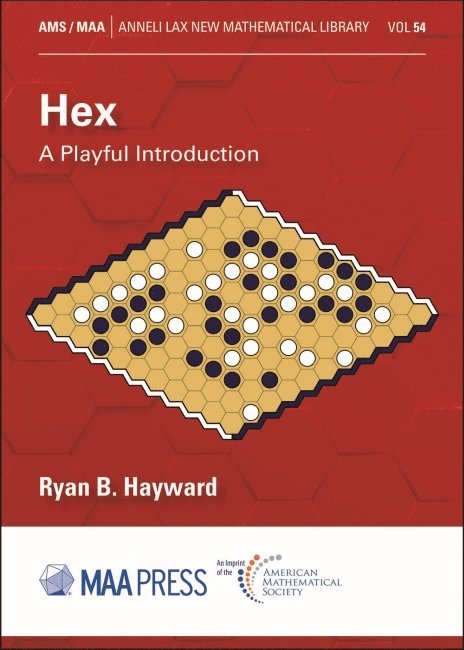
Hex
A Playful Introduction
Häftad, 2022
427 kr
Lägg i varukorg
This book offers a gentle introduction to Hex, the classic board game created by Piet Hein and popularized by John Nash and Martin Gardner. The first three chapters cover rules, basic strategy, and history. The remaining eight chapters cover a variety of topics: mathematical properties (there are …