Ryan S. Olson – författare
Visar alla böcker från författaren Ryan S. Olson. Handla med fri frakt och snabb leverans.
4 produkter
4 produkter
Del 42 - Hellenic Studies Series
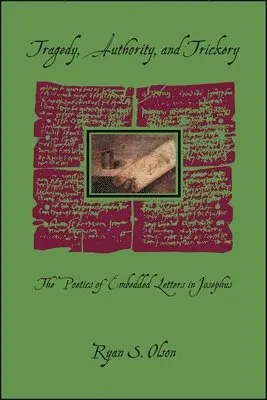
Tragedy, Authority, and Trickery
The Poetics of Embedded Letters in Josephus
Häftad, Engelska, 2010
500 kr
Skickas inom 3-6 vardagar
To prove his sons’ treachery, Herod embellished a letter. To certify his history of Vespasian’s Judaean campaign, Josephus marshaled epistolary testimony. To alleviate a domestic problem, the Israelite king David sent a missive with a man it marks for death. Arguing for the importance of the first-century historian Josephus to the study of classical and Hellenistic literature, Tragedy, Authority, and Trickery investigates letters in Josephus’s texts.Ryan S. Olson breaks new ground by analyzing classical, Hellenistic, and Jewish texts’ use of letters, comparing those texts to Josephus’s narratives, a virtual archive containing hundreds of letters. An external voice similar to speeches, embedded letters raise questions of authority, drive and color dramatic scenes, and function at textual and meta-textual levels to deceive their readers. Josephus, contextualized in a complex intellectual and cultural milieu, sustains and develops epistolarity in important ways that will be of interest to classicists, historians, theologians, and comparatists.
E-bok
Engelska, 2022150 kr
Läs direkt efter köp
For most of America''s history, schools were established to furnish more than just academic training: They were founded to form young people of strong character and civic conscience. We rarely think of our schools that way now. Ironically, we bicker over test scores, graduation rates, and academic standards, even as we are besieged by news stories of gratuitous misconduct and cynical, callous, unethical behavior.Might our schools provide a glimmer of hope? This is precisely the question that a team of talented scholars asked in a landmark study. To explore how American high schools directly and indirectly inculcate moral values in students, these researchers visited a national sample of schools in each of ten sectors: urban public, rural public, charter, evangelical Protestant, Catholic, Jewish, Islamic, prestigious independent, alternative-pedagogy, and home schools. This new, 4-chapter edition is focused on prestigious independent schools and offers new resources for educators and others interested in character education. The findings point to a new model for understanding the moral and civic formation of children and to new ways to prepare young people for responsibility and citizenship in a complex world.
E-bok
Engelska, 2023150 kr
Läs direkt efter köp
For most of America''s history, schools were established to furnish more than just academic training: They were founded to form young people of strong character and civic conscience. We rarely think of our schools that way now. Ironically, we bicker over test scores, graduation rates, and academic standards, even as we are besieged by news stories of gratuitous misconduct and cynical, callous, unethical behavior.Might our schools provide a glimmer of hope? This is precisely the question that a team of talented scholars asked in a landmark study. To explore how American high schools directly and indirectly inculcate moral values in students, these researchers visited a national sample of schools in each of ten sectors: urban public, rural public, charter, evangelical Protestant, Catholic, Jewish, Islamic, prestigious independent, alternative-pedagogy, and home schools. This new, 4-chapter edition is focused on home schools and offers new resources for educators and others interested in character education. The findings point to a new model for understanding the moral and civic formation of children and to new ways to prepare young people for responsibility and citizenship in a complex world.
E-bok
Engelska, 2023150 kr
Läs direkt efter köp
For most of America''s history, schools were established to furnish more than just academic training: They were founded to form young people of strong character and civic conscience. We rarely think of our schools that way now. Ironically, we bicker over test scores, graduation rates, and academic standards, even as we are besieged by news stories of gratuitous misconduct and cynical, callous, unethical behavior. Might our schools provide a glimmer of hope? This is precisely the question that a team of talented scholars asked in a landmark study. To explore how American high schools directly and indirectly inculcate moral values in students, these researchers visited a national sample of schools in each of ten sectors: urban public, rural public, charter, evangelical Protestant, Catholic, Jewish, Islamic, prestigious independent, alternative-pedagogy, and home schools. This new, 4-chapter edition is focused on home schools and offers new resources for educators and others interested in character education. The findings point to a new model for understanding the moral and civic formation of children and to new ways to prepare young people for responsibility and citizenship in a complex world.