Sabina Haber-Pohlmeier - Böcker
Visar alla böcker från författaren Sabina Haber-Pohlmeier. Handla med fri frakt och snabb leverans.
3 produkter
3 produkter
3 616 kr
Skickas inom 5-8 vardagar
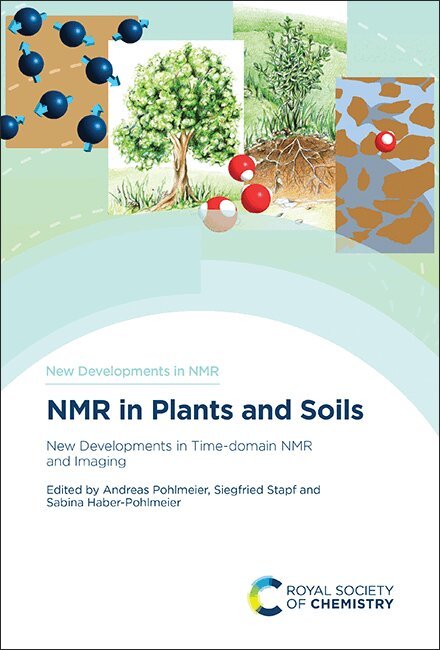
Processes in soils, with special focus on plant–soil interaction, are hot economic and social topics driven by climate change and its impact on human nutrition. Following the pioneering work in the 1980s and early 1990s, nuclear magnetic resonance (NMR), magnetic resonance imaging (MRI) and mobile technologies have become important research methods in this area.This book highlights NMR in the space and time domains as a non-invasive and versatile method for elucidating processes in plants, soils and their interactions. The field is currently undergoing rapid development, driven on the one hand by the increasing pressure to contribute to food security and on the other hand by the increasing availability of new technologies. The book makes the methods accessible to non-NMR specialists and, conversely, promotes the further development of NMR and MRI from the user's perspective. It opens with a section reviewing the essential NMR and MRI basics for plants and soils and revisits the first investigations from the 1980s. Section two then covers NMR and MRI of soils and soil materials while the third section deals with the study of plants and plant products. The focus in both areas is the new development of mobile NMR devices from centimetre to field scale, which enables the investigation of plants and soils in situ. In addition, the coupling of MRI with numerical soil and plant physical models is highlighted. With editors and authors contributing the state of the art of plant and soil NMR and MRI, this book defines the potential applications for researchers looking at how these new topics can enhance their research and understanding in the coming decades.
912 kr
Skickas inom 3-6 vardagar
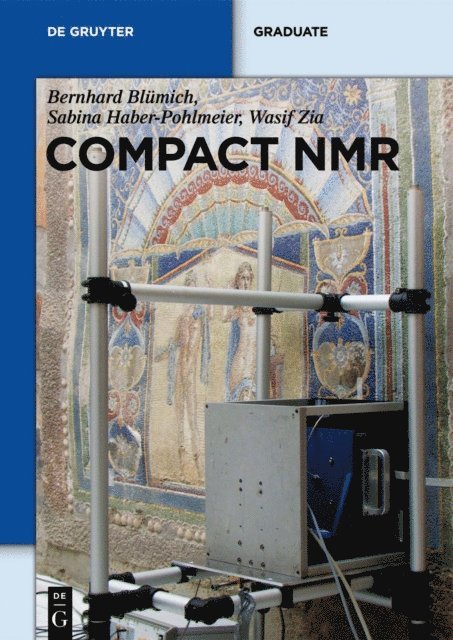
The goal of this book is to provide an introduction to the practical use of mobile NMR at a level as basic as the operation of a smart phone. Each description follows the same didactic pattern: introduction, basic theory, pulse sequences and parameters, beginners-level measurements, advanced-level measurements, and data processing.Nuclear Magnetic Resonance (NMR) spectroscopy is the most popular method for chemists to analyze molecular structures while Magnetic Resonance Imaging (MRI) is a non-invasive diagnostic tool for medical doctors that provides high-contrast images of biological tissue depicting the brain function and the beating heart.In both applications large super-conducting magnets are employed which magnetize atomic nuclei of an object positioned inside the magnet. Their circulating motion is interrogated by radio-frequency waves. Depending on the operating mode, the frequency spectrum provides the chemist with molecular information, the medical doctor with anatomic images, while the materials scientist is interested in NMR relaxation parameters, which scale with material properties and determine the contrast in magnetic resonance images.Recent advances in magnet technology led to a variety of small permanent magnets, by which NMR spectra, images, and relaxation parameters can be measured with mobile and low-cost instruments.
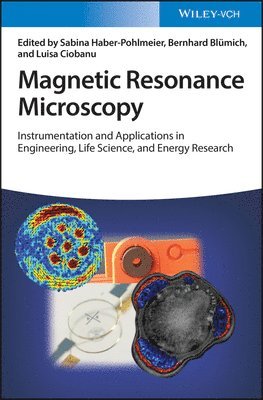
Magnetic Resonance Microscopy
Instrumentation and Applications in Engineering, Life Science, and Energy Research
Inbunden, Engelska, 2022
1 575 kr
Skickas inom 11-20 vardagar
Magnetic Resonance Microscopy Explore the interdisciplinary applications of magnetic resonance microscopy in this one-of-a-kind resource In Magnetic Resonance Microscopy: Instrumentation and Applications in Engineering, Life Science and Energy Research, a team of distinguished researchers delivers a comprehensive exploration of the use of magnetic resonance microscopy (MRM) and similar techniques in an interdisciplinary milieux. Opening with a section on hardware and methodology, the book moves on to consider developments in the field of mobile nuclear magnetic resonance. Essential processes, including filtration, multi-phase flow and transport, and a wide range of systems – from biomarkers via single cells to plants and biofilms – are discussed next. After a fulsome treatment of MRM in the field of energy research, the editors conclude the book with a chapter extoling the virtues of a holistic treatment of theory and application in MRM. Magnetic Resonance Microscopy: Instrumentation and Applications in Engineering, Life Science and Energy Research also includes: A thorough introduction to recent developments in magnetic resonance microscopy hardware and methods, including ceramic coils for MR microscopyComprehensive explorations of applications in chemical engineering, including ultra-fast MR techniques to image multi-phase flow in pipes and reactorsPractical discussions of applications in the life sciences, including MRI of single cells labelled with super paramagnetic iron oxide nanoparticlesIn-depth examinations of new applications in energy research, including spectroscopic imaging of devices for electrochemical storagePerfect for practicing scientists from all fields, Magnetic Resonance Microscopy: Instrumentation and Applications in Engineering, Life Science and Energy Research is an ideal resource for anyone seeking a one-stop guide to magnetic resonance microscopy for engineers, life scientists, and energy researchers.