Saeedeh Rafiei - Böcker
Visar alla böcker från författaren Saeedeh Rafiei. Handla med fri frakt och snabb leverans.
5 produkter
5 produkter
Foundations of Nanotechnology, Volume Two
Nanoelements Formation and Interaction
Inbunden, Engelska, 2014
1 827 kr
Skickas inom 10-15 vardagar
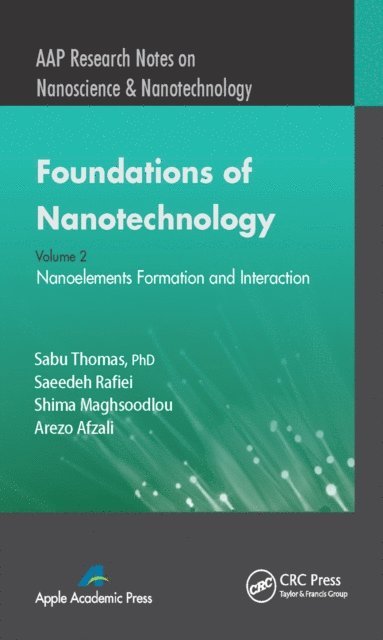
The collection of topics in this book reflects the diversity of recent advances in nanoelements formation and interactions in nanosystems with a broad perspective that is useful for scientists as well as for graduate students and engineers. One of the main tasks in making nanocomposites is building the dependence of the structure and shape of the nanoelements, forming the basis for the composite of their sizes. This is because with an increase or a decrease in the specific size of nanoelements, their physical–mechanical properties such as the coefficient of elasticity, strength, and deformation parameter, vary by over one order. The calculations show that this is primarily due to a significant rearrangement of the atomic structure and the shape of the nanoelement. The investigation of the above parameters of the nanoelements is technically complicated and laborious because of their small sizes. When the characteristics of powder nanocomposites are calculated, it is also very important to take into account the interaction of the nanoelements since the changes in their original shapes and sizes in the interaction process and during the formation of the nanocomposite can lead to a significant change in its properties and a cardinal structural rearrangement. In addition, the studies show the appearance of the processes of the ordering and self-assembling leading to a more organized form of a nanosystem. The above phenomena play an important role in nanotechnological processes. They allow nanotechnologies to be developed for the formation of nanostructures by the self-assembling method (which is based on self-organizing processes) and building up complex spatial nanostructures consisting of different nanoelements. The study of the above dependences based on the mathematical modeling methods requires the solution of the aforementioned problem at the atomic level. This requires large computational aids and computational time, which makes the development of economical calculation methods urgent. The objective of this volume is the development of such a technique in various nanosystems.
1 624 kr
Skickas inom 10-15 vardagar
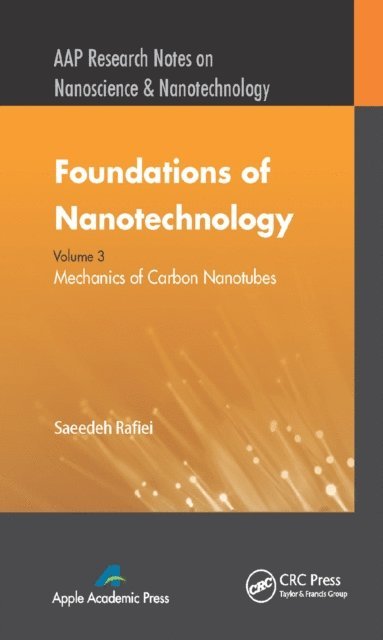
In this research notes book, the modelling of mechanical properties of CNT/polymer nanocomposites is presented. The book begins with the structural and intrinsic mechanical properties of CNTs and then introduces computational methods that have been applied to polymer nanocomposites, covering from molecular scale (molecular dynamics, Monte Carlo), microscale (Brownian dynamics, dissipative particle dynamics, lattice Boltzmann, time-dependent Ginzburg–Landau method, dynamic density functional theory method) to mesoscale and macroscale (micromechanics, equivalent-continuum and self-similar approaches, finite element method). Knowledge of the nature and mechanics of the length and orientation of nanotubes, and load transfer between nanotubes and polymers, is critical for the manufacturing of enhanced carbon nanotube polymer composites. It also enables the tailoring of the interface for specific applications or superior mechanical properties. This book discusses the state of these parameters in mechanics of carbon nanotube polymer composites and presents some directions for future research in this field.The book’s aim is to enhance current knowledge in this area to support researchers in carbon nanotubes and help them choose the appropriate modelling tool for accomplishing their research.
5 730 kr
Skickas inom 10-15 vardagar
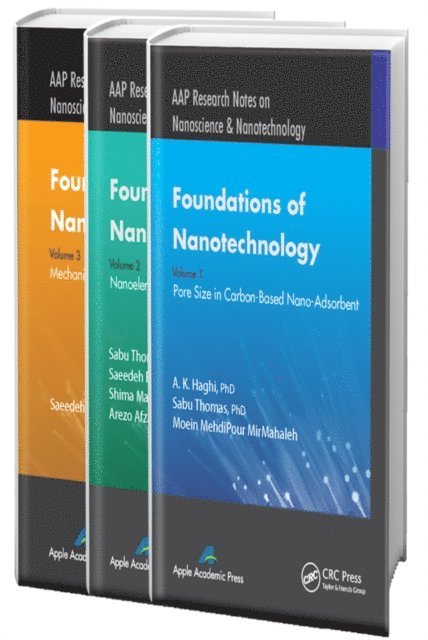
Nanoscale science, engineering, and technology—commonly referred to collectively as nanotechnology—is believed by many to offer extraordinary economic and societal benefits. Nanotechnology is generally defined as the ability to create and use materials, devices, and systems with unique properties at the scale of approximately 1 to 100 nm. Nanotechnology offers society the promise of major benefits, but also raises questions of potential adverse effects. The first volume covers pore size in carbon-based nano-adsorbents, resulting in materials that exhibit unique sorptive properties with a general view of the recent activities on the study of pore structure control. The collection of topics in volume 2 reflects the diversity of recent advances in nanoelements formation and interactions in nanosystems with a broad perspective that will be useful for scientists and engineers as the use of nanotechnology in the consumer and industrial sectors is expected to increase significantly in the future. And the third volume discusses important issues and trends related to research strategy in mechanics of carbon nanotubes.
Foundations of Nanotechnology, Volume Two
Nanoelements Formation and Interaction
Häftad, Engelska, 2021
1 126 kr
Skickas inom 10-15 vardagar
The collection of topics in this book reflects the diversity of recent advances in nanoelements formation and interactions in nanosystems with a broad perspective that is useful for scientists as well as for graduate students and engineers. One of the main tasks in making nanocomposites is building the dependence of the structure and shape of the nanoelements, forming the basis for the composite of their sizes. This is because with an increase or a decrease in the specific size of nanoelements, their physical–mechanical properties such as the coefficient of elasticity, strength, and deformation parameter, vary by over one order. The calculations show that this is primarily due to a significant rearrangement of the atomic structure and the shape of the nanoelement. The investigation of the above parameters of the nanoelements is technically complicated and laborious because of their small sizes. When the characteristics of powder nanocomposites are calculated, it is also very important to take into account the interaction of the nanoelements since the changes in their original shapes and sizes in the interaction process and during the formation of the nanocomposite can lead to a significant change in its properties and a cardinal structural rearrangement. In addition, the studies show the appearance of the processes of the ordering and self-assembling leading to a more organized form of a nanosystem. The above phenomena play an important role in nanotechnological processes. They allow nanotechnologies to be developed for the formation of nanostructures by the self-assembling method (which is based on self-organizing processes) and building up complex spatial nanostructures consisting of different nanoelements. The study of the above dependences based on the mathematical modeling methods requires the solution of the aforementioned problem at the atomic level. This requires large computational aids and computational time, which makes the development of economical calculation methods urgent. The objective of this volume is the development of such a technique in various nanosystems.
1 126 kr
Skickas inom 10-15 vardagar
In this research notes book, the modelling of mechanical properties of CNT/polymer nanocomposites is presented. The book begins with the structural and intrinsic mechanical properties of CNTs and then introduces computational methods that have been applied to polymer nanocomposites, covering from molecular scale (molecular dynamics, Monte Carlo), microscale (Brownian dynamics, dissipative particle dynamics, lattice Boltzmann, time-dependent Ginzburg–Landau method, dynamic density functional theory method) to mesoscale and macroscale (micromechanics, equivalent-continuum and self-similar approaches, finite element method). Knowledge of the nature and mechanics of the length and orientation of nanotubes, and load transfer between nanotubes and polymers, is critical for the manufacturing of enhanced carbon nanotube polymer composites. It also enables the tailoring of the interface for specific applications or superior mechanical properties. This book discusses the state of these parameters in mechanics of carbon nanotube polymer composites and presents some directions for future research in this field.The book’s aim is to enhance current knowledge in this area to support researchers in carbon nanotubes and help them choose the appropriate modelling tool for accomplishing their research.