Salikoko Mufwene – författare
Visar alla böcker från författaren Salikoko Mufwene. Handla med fri frakt och snabb leverans.
6 produkter
6 produkter
Inbunden, Engelska, 2022
1 892 kr
Skickas inom 7-10 vardagar
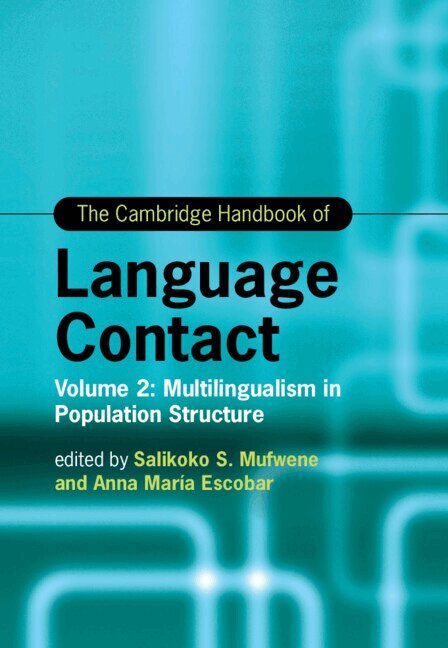
Language contact - the linguistic and social outcomes of two or more languages coming into contact with each other - starts with the emergence of multilingual populations. Multilingualism involving plurilingualism can have various consequences beyond borrowing, interference, and code-mixing and -switching, including the emergence of lingua francas and new language varieties, as well as language endangerment and loss. Bringing together contributions from an international team of scholars, this Handbook - the second in a two-volume set - engages the reader with the manifold aspects of multilingualism and provides state-of-the-art research on the impact of population structure on language contact. It begins with an introduction that presents the history of the scholarship on the subject matter. The chapters then cover various processes and theoretical issues associated with multilingualism embedded in specific population structures worldwide as well as their outcomes. It is essential reading for anybody interested in how people behave linguistically in multilingual or multilectal settings.
Häftad, Engelska, 2025
544 kr
Skickas inom 7-10 vardagar
Language contact - the linguistic and social outcomes of two or more languages coming into contact with each other - starts with the emergence of multilingual populations. Multilingualism involving plurilingualism can have various consequences beyond borrowing, interference, and code-mixing and -switching, including the emergence of lingua francas and new language varieties, as well as language endangerment and loss. Bringing together contributions from an international team of scholars, this Handbook - the second in a two-volume set - engages the reader with the manifold aspects of multilingualism and provides state-of-the-art research on the impact of population structure on language contact. It begins with an introduction that presents the history of the scholarship on the subject matter. The chapters then cover various processes and theoretical issues associated with multilingualism embedded in specific population structures worldwide as well as their outcomes. It is essential reading for anybody interested in how people behave linguistically in multilingual or multilectal settings.
E-bok
Engelska, 2022661 kr
Läs direkt efter köp
Language contact - the linguistic and social outcomes of two or more languages coming into contact with each other - starts with the emergence of multilingual populations. Multilingualism involving plurilingualism can have various consequences beyond borrowing, interference, and code-mixing and -switching, including the emergence of lingua francas and new language varieties, as well as language endangerment and loss. Bringing together contributions from an international team of scholars, this Handbook - the second in a two-volume set - engages the reader with the manifold aspects of multilingualism and provides state-of-the-art research on the impact of population structure on language contact. It begins with an introduction that presents the history of the scholarship on the subject matter. The chapters then cover various processes and theoretical issues associated with multilingualism embedded in specific population structures worldwide as well as their outcomes. It is essential reading for anybody interested in how people behave linguistically in multilingual or multilectal settings.
E-bok
PDF, Engelska, 2022666 kr
Läs direkt efter köp
Language contact - the linguistic and social outcomes of two or more languages coming into contact with each other - starts with the emergence of multilingual populations. Multilingualism involving plurilingualism can have various consequences beyond borrowing, interference, and code-mixing and -switching, including the emergence of lingua francas and new language varieties, as well as language endangerment and loss. Bringing together contributions from an international team of scholars, this Handbook - the second in a two-volume set - engages the reader with the manifold aspects of multilingualism and provides state-of-the-art research on the impact of population structure on language contact. It begins with an introduction that presents the history of the scholarship on the subject matter. The chapters then cover various processes and theoretical issues associated with multilingualism embedded in specific population structures worldwide as well as their outcomes. It is essential reading for anybody interested in how people behave linguistically in multilingual or multilectal settings.
E-bok
Franska, 2014201 kr
Läs direkt efter köp
Qu’en est-il de la vitalité du français face aux pressions de la globalisation ? Des linguistes tentent de répondre à cette question. Salikoko S. Mufwene et Cécile B. Vigouroux commencent par expliquer comment la colonisation est à interpréter par rapport à la globalisation, dont le sens ne doit pas être confondu avec celui de mondialisation. Ils situent la question de la vitalité du français dans ce contexte, qui est à penser en fonction de chaque écologie dans laquelle le français s’est inséré. Claude Hagège souligne que la compétition entre l’anglais et le français a commencé dès l’engagement de l’Angleterre et de la France dans l’expansion coloniale. Il attire aussi l’attention sur le comportement linguistique des Français eux-mêmes qui, selon lui, menacerait la vitalité de notre langue au sein même de l’Hexagone. Robert Chaudenson indique quant à lui que la vitalité du français comme lingua franca internationale repose sur l’Afrique. Cécile B. Vigouroux se focalise sur sa présence en Afrique du Sud, dans la région du Cap, depuis le xviie siècle. Sylvie Dubois se penche sur les évolutions en Louisiane, Julie Auger s’intéresse au Québec à notre époque et Raymond Mougeon à l’Ontario, trois cas bien différents. Douglas Kibbee propose enfin une synthèse sur l’évolution de la langue française considérée comme une norme dans notre pays lui-même. À travers des exemples variés dans l’espace et le temps, les auteurs de cet ouvrage offrent un panorama des différents facteurs qui influencent le destin de notre langue. Salikoko S. Mufwene est distinguished service professor of linguistics and the college à l’Université de Chicago. Il a notamment publié The Ecology of Language Evolution (2001), Créoles, écologie sociale, évolution linguistique (2005) et Language Evolution : Contact, competition and change (2008). Cécile B. Vigouroux est professeure au département de français de l’Université Simon-Fraser, à Vancouver (Canada).
4 514 kr
Tillfälligt slut
Language contact - the linguistic and social outcomes of two or more languages coming into contact with each other - has been pervasive in human history. Whether or not we are aware of it, we as humans always deal with language contact. Bringing together contributions from an international team of scholars, this two-volume Handbook represents the state-of-the-art in the field of language contact. The first volume focuses on population movement and language change, and the second volume looks at multilingualism and population structure. Each of the two volumes start with an introduction outlining the history of the research in the field. They are then organised into thematic parts, and cover the processes, theoretical issues and outcomes involved in a range of language contact situations worldwide. Easy-to-read yet wide-ranging in scope, the Handbook is essential reading for anybody interested in how people behave linguistically in multilingual or multilectal settings.