Samuel Leinhardt – författare
Visar alla böcker från författaren Samuel Leinhardt. Handla med fri frakt och snabb leverans.
2 produkter
2 produkter
E-bok
PDF, Engelska, 2013979 kr
Läs direkt efter köp
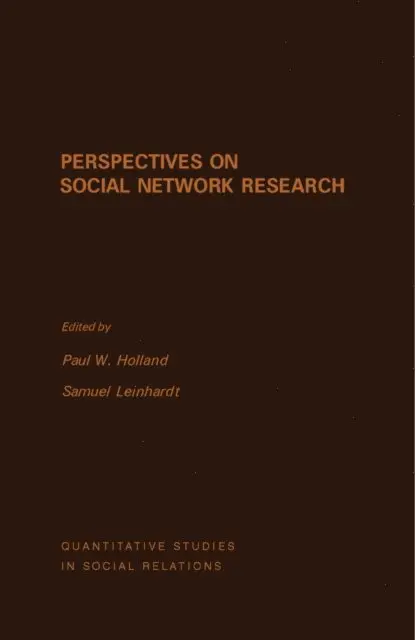
Perspectives on Social Network Research covers the proceedings of the Mathematical Social Science Board''s Advanced Research Symposium on Social Networks held at Dartmouth College, Hanover, New Hampshire, on September 18-21, 1975. This symposium was organized to survey research on social networks as well as review and criticize major research thrusts involving network studies of social behavior. The book covers topics such as the Davis/Holland/Leinhardt studies, structural sociometry, network analysis of the diffusion of innovations, and the deterministic models of social networks. Also covered are topics such as structural control models for group processes, social clusters and opinion clusters, equilibrating processes in social networks, and estimation of population totals by use of snowball samples. The text is recommended for sociologists, anthropologists, and psychologists, especially those who would like to know more about social network and are currently engaged in research in that particular field.
E-bok
PDF, Engelska, 2013979 kr
Läs direkt efter köp
Social Networks: A Developing Paradigm contains studies of the nature and impact of social structure on behavior. It draws together readings from a variety of social science areas that share the basic premise that structure in social relationships can be fruitfully operationalized in terms of networks. It attempts to bring together classic works that opened new research areas and works that contain important statements of perspective, method, or empirical findings. The book is organized into four parts. Part I focuses on the cognitive organization of social relations and the effects of local social structure on individuals. In Part II the authors consider networks of ties in large social agglomerations, and treat a variety of different types of social relationships. The emphasis here is on empirical studies. Specific extant social networks are investigated to test a variety of structural hypotheses. Part III contains studies that address issues more common among social anthropologists than sociologists or social psychologists. The chapters in Part IV, while occasionally containing applications, are primarily methodological. These discuss mathematical and statistical ideas for modeling and analyzing social networks.