Sandro Chignola – författare
Visar alla böcker från författaren Sandro Chignola. Handla med fri frakt och snabb leverans.
8 produkter
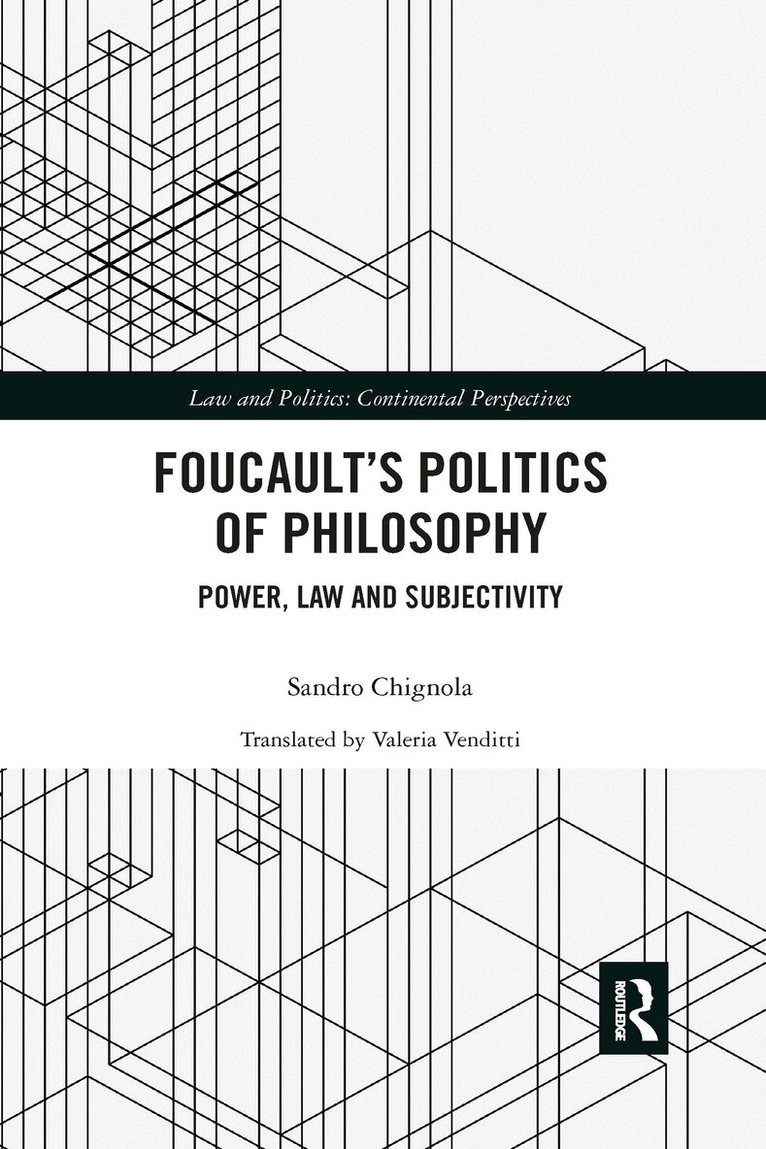
Foucault's Politics of Philosophy
Power, Law, and Subjectivity
Häftad, 2019
720 kr
Lägg i varukorg
Oriented around the theme of a ‘politics of philosophy’, this book tracks the phases in which Foucault’s genealogy of power, law, and subjectivity was reorganized during the 14 years of his teaching at the College de France, as his focus shifted from sovereignty to governance. This theme, Sandro …
Living Law
Politics and Legality Beyond the State
Inbunden, 2024
1962 kr
Lägg i varukorg
This book offers a radical new understanding of law, beyond the confines of its formalization by the state.The book takes off from the late work of Gilles Deleuze and Michel Foucault, for whom law and its institutions came to be liberated from an ideological perspective that had treated them as …
Living Law
Politics and Legality Beyond the State
Häftad, 2025
706 kr
Lägg i varukorg
This book offers a radical new understanding of law, beyond the confines of its formalization by the state.The book takes off from the late work of Gilles Deleuze and Michel Foucault, for whom law and its institutions came to be liberated from an ideological perspective that had treated them as …
Living Law
Politics and Legality Beyond the State
E-bok, 2024
805 kr
Lägg i varukorg
This book offers a radical new understanding of law, beyond the confines of its formalization by the state. The book takes off from the late work of Gilles Deleuze and Michel Foucault, for whom law and its institutions came to be liberated from an ideological perspective that had treated them as …
Living Law
Politics and Legality Beyond the State
E-bok, 2024
831 kr
Lägg i varukorg
This book offers a radical new understanding of law, beyond the confines of its formalization by the state. The book takes off from the late work of Gilles Deleuze and Michel Foucault, for whom law and its institutions came to be liberated from an ideological perspective that had treated them as …
Foucault's Politics of Philosophy
Power, Law, and Subjectivity
Inbunden, 2018
2512 kr
Lägg i varukorg
Oriented around the theme of a ‘politics of philosophy’, this book tracks the phases in which Foucault’s genealogy of power, law, and subjectivity was reorganized during the 14 years of his teaching at the College de France, as his focus shifted from sovereignty to governance. This theme, Sandro …
Foucault's Politics of Philosophy
Power, Law, and Subjectivity
E-bok, 2018
830 kr
Lägg i varukorg
Oriented around the theme of a ‘politics of philosophy’, this book tracks the phases in which Foucault’s genealogy of power, law, and subjectivity was reorganized during the 14 years of his teaching at the College de France, as his focus shifted from sovereignty to governance. This theme, …
Foucault's Politics of Philosophy
Power, Law, and Subjectivity
E-bok, 2018
849 kr
Lägg i varukorg
Oriented around the theme of a ‘politics of philosophy’, this book tracks the phases in which Foucault’s genealogy of power, law, and subjectivity was reorganized during the 14 years of his teaching at the College de France, as his focus shifted from sovereignty to governance. This theme, …