Sanjoy Saha – författare
Visar alla böcker från författaren Sanjoy Saha. Handla med fri frakt och snabb leverans.
5 produkter
5 produkter
Häftad, Engelska, 2010
566 kr
Skickas inom 10-15 vardagar
Advanced Science and Technology, Advanced Communication and Networking, Information Security and Assurance, Ubiquitous Computing and Multimedia Appli- tions are conferences that attract many academic and industry professionals. The goal of these co-located conferences is to bring together researchers from academia and industry as well as practitioners to share ideas, problems and solutions relating to the multifaceted aspects of advanced science and technology, advanced communication and networking, information security and assurance, ubiquitous computing and m- timedia applications. This co-located event included the following conferences: AST 2010 (The second International Conference on Advanced Science and Technology), ACN 2010 (The second International Conference on Advanced Communication and Networking), ISA 2010 (The 4th International Conference on Information Security and Assurance) and UCMA 2010 (The 2010 International Conference on Ubiquitous Computing and Multimedia Applications). We would like to express our gratitude to all of the authors of submitted papers and to all attendees, for their contributions and participation. We believe in the need for continuing this undertaking in the future. We acknowledge the great effort of all the Chairs and the members of advisory boards and Program Committees of the above-listed events, who selected 15% of over 1,000 submissions, following a rigorous peer-review process. Special thanks go to SERSC (Science & Engineering Research Support soCiety) for supporting these - located conferences.
E-bok
PDF, Engelska, 2010734 kr
Läs direkt efter köp
Advanced Science and Technology, Advanced Communication and Networking, Information Security and Assurance, Ubiquitous Computing and Multimedia Appli- tions are conferences that attract many academic and industry professionals. The goal of these co-located conferences is to bring together researchers from academia and industry as well as practitioners to share ideas, problems and solutions relating to the multifaceted aspects of advanced science and technology, advanced communication and networking, information security and assurance, ubiquitous computing and m- timedia applications. This co-located event included the following conferences: AST 2010 (The second International Conference on Advanced Science and Technology), ACN 2010 (The second International Conference on Advanced Communication and Networking), ISA 2010 (The 4th International Conference on Information Security and Assurance) and UCMA 2010 (The 2010 International Conference on Ubiquitous Computing and Multimedia Applications). We would like to express our gratitude to all of the authors of submitted papers and to all attendees, for their contributions and participation. We believe in the need for continuing this undertaking in the future. We acknowledge the great effort of all the Chairs and the members of advisory boards and Program Committees of the above-listed events, who selected 15% of over 1,000 submissions, following a rigorous peer-review process. Special thanks go to SERSC (Science & Engineering Research Support soCiety) for supporting these - located conferences.
Häftad, Engelska, 2021
851 kr
Skickas inom 5-8 vardagar
E-bok
Engelska, 2026248 kr
Läs direkt efter köp
WHY THIS BOOK?A rapidly warming climate is stretching forests beyond historical envelopes: longer fire seasons, flashier floods, synchronized pest outbreaks, and compound extremes that make yesterday's rules unsafe. At the same time, data and computation have leapt ahead: anyone with a laptop can access daily satellite imagery, fuse it with tower cameras and stream gauges, run open-source models, and coordinate crews using offline apps. Yet there is a gap between possibility and practice. Toolkits remain scattered across disciplines; documents assume bandwidth, budgets, or institutional capacity that field teams rarely have; and many plans underplay social license and safety—two determinants of whether good ideas persist.This book aims to bridge science, operations, and governance. It offers a coherent playbook to: Predict—not just map—risk, and act early (fire spread, culvert failure, flood routing, landslide probability, invasive fronts). Repair hydrology before planting, because water and soil are the slow variables that keep fast dynamics stable. Use AI and remote sensing responsibly for monitoring, reporting, and verification (MRV) that lowers transaction costs and invites outcome-based finance. Design portfolios rather than silver bullets: assisted natural regeneration plus enrichment planting; shaded fuel breaks plus cultural burning; riparian buffers plus floodplain reconnection; drones where terrain is dangerous, crews where judgment isessential. Center communities via FPIC, benefit-sharing rules, and participatory mapping, so the people who live with forests are co-owners of decisions and rewards. Operate ethically with role-based access, sensitive-site masking, and explicit human review for high-consequence actions. Iterate with A/B pilots, blameless after-action reviews, and model updates that make each season smarter than the last.We wrote for a world where managers are asked to deliver more with less—and to be simultaneously fast, safe, transparent, and fair. The intention is to compress learning cycles without compromising legitimacy. Target AudienceThis book is for practitioners, students, and decision-makers who meet forests where physics, finance, and politics intersect. Forest managers and restoration leads will find planning templates, SOPs with safety cut-offs, and "e;minimum viable"e; tech stacks that work offline. Policy makers and regulators will find outcome-aligned procurement, transparent MRV, and governance patterns that make permits and enforcement smarter rather than heavier. Community leaders and NGOs can use participatory mapping guides, benefit-sharing designs, and review questions to translate technical options into community choices. Researchers and students gain a cross-disciplinary bridge: process models and AI methods grounded in field constraints, with pointers to open data and standards. Private sector operators—mills, logistics, tourism—will see how traceability and verified outcomes improve market access and reduce risk.We assume basic familiarity with GIS and ecology, but we do not assume high bandwidth or large budgets. Examples and diagrams favor "e;good enough"e; methods that scale in challenging environments.
E-bok
Engelska, 2025253 kr
Läs direkt efter köp
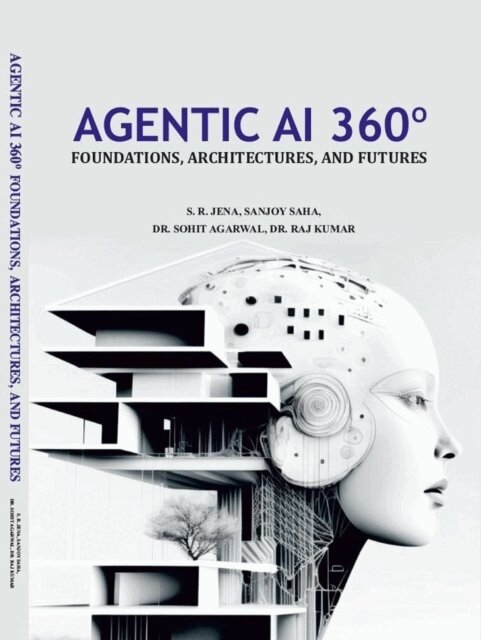
ABOUT THE BOOKThe World is witnessing a remarkable shift in the trajectory of Artificial Intelligence—from systems that merely react to stimuli or process data to agents capable of autonomous decision-making, goal pursuit, moral reasoning, and social interaction. This transformation calls for a new conceptual and practical framework: Agentic AI. The term denotes intelligent systems that operate as agents—autonomous entities with beliefs, desires, intentions, and the ability to act toward achieving objectives within dynamic environments. These agentic systems are not only reactive or predictive but deliberative and proactive. They can plan, adapt, collaborate, and even evolve in ways that mirror cognitive, emotional, and social intelligence.CHAPTERSPREFACEWhy Agentic AI?Scope and Purpose of This BookHow to Use This BookPart I: Foundations of Agentic IntelligenceChapter 1: Introduction to Agentic AIChapter 2: Theoretical UnderpinningsChapter 3: Cognitive Architectures and ModelsChapter 4: Autonomy and EmbodimentPart II: Architectures and Engineering of Agentic SystemsChapter 5: Core Agent ArchitecturesChapter 6: Planning and Goal ManagementChapter 7: Memory and World ModelsChapter 8: Perception and Attention MechanismsChapter 9: Learning in Agentic AIChapter 10: Communication and InteractionPart III: Building Agentic AI in PracticeChapter 11: Frameworks and ToolkitsChapter 12: Agent Simulation and TrainingChapter 13: Ethics and AlignmentChapter 14: Agentic Failure ModesPart IV: Advanced Topics and the Future of Agentic AIChapter 15: Agentic AI and ConsciousnessChapter 16: Agent Societies and Collective IntelligenceChapter 17: Agentic AGI and Existential RiskChapter 18: Agentic AI Applications ABOUT THE AUTHORSMr. Soumya Ranjan Jena is a Designated Partner at SRJX RESEARCH AND INNOVATION LAB LLP. He holds Hon. (Dr.) from Graham International University, USA, and is pursuing a PhD from Suresh Gyan Vihar University, Jaipur, Rajasthan, India and Post-Doctoral Fellowship at NextGen University, USA.Mr. Sanjoy Saha is the Director of Susmita Electronics Private Limited and pursuing PhD from Suresh Gyan Vihar University, Jaipur, Rajasthan, India.Dr. Sohit Agarwal is currently serving as an Associate Professor and Head of the Department of Computer Engineering and Information Technology at Suresh Gyan Vihar University, Jaipur, Rajasthan, India.Dr. Raj Kumar is presently working as an Assistant Professor in Department of Mechanical Engineering at Suresh Gyan Vihar University, Jaipur, Rajasthan, India.