S.C. Singhal – författare
Visar alla böcker från författaren S.C. Singhal. Handla med fri frakt och snabb leverans.
4 produkter
4 produkter
3 359 kr
Läs direkt efter köp
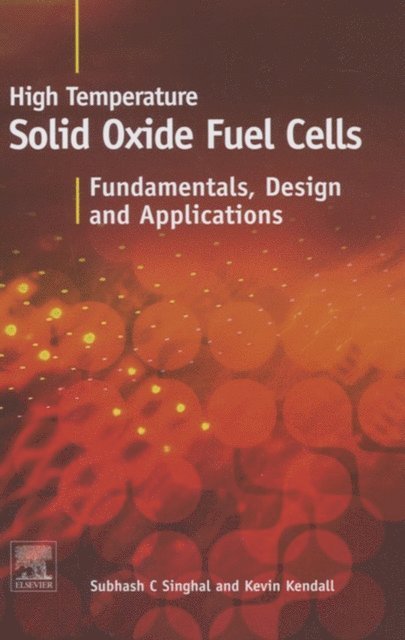
High Temperature Solid Oxide Fuel Cells: Fundamentals, Design and Applications provides a comprehensive discussion of solid oxide fuel cells (SOFCs). SOFCs are the most efficient devices for the electrochemical conversion of chemical energy of hydrocarbon fuels into electricity, and have been gaining increasing attention for clean and efficient distributed power generation. The book explains the operating principle, cell component materials, cell and stack designs and fabrication processes, cell and stack performance, and applications of SOFCs. Individual chapters are written by internationally renowned authors in their respective fields, and the text is supplemented by a large number of references for further information. The book is primarily intended for use by researchers, engineers, and other technical people working in the field of SOFCs. Even though the technology is advancing at a very rapid pace, the information contained in most of the chapters is fundamental enough for the book to be useful even as a text for SOFC technology at the graduate level.
Inbunden, Engelska, 1984
5 421 kr
Skickas inom 10-15 vardagar
Over the last few years there has been increasing need for systematic and straregically designed experiments of surface morphology evolution resulting form ion bombardment induced sputtering. Although there is an impressive number of investi gations {1} concerned with semiconductor materials as a result of immediate applications, the most systematic investigations have been conducted with fcc metals with particular interest on single crystal Cu {2,3}. Evidence now exists that within certain para meters (i. e ion species (Ar+), ion energy (20-44 KeV), substrate 2 temperature (80-550° K), dose rate (100-500 gA cm- ) , residual x 5 9 pressure (5 10- to 5x10- mm Hg) and polar and azimuthal angle of ion incidence {4} reproducible surface morphology (etch pits and pyramids) is achieved on the (11 3 1) specific crystallographic orientation. The temporal development of individual surface features was alsoobserved in this laterstudy {4}, by employing an in situ ion source in the scanning electron microscope at Salford, a technique also empolyed in studies of the influence of polar angle of ion incidence {5} and surface contaminants {6} on the topographyof Ar+ bombarded Si. Studies have also been made on the variation of incident ion species with the (11 3 1) Cu surface and it was fully recognized {7} that residual surface contaminants when present could playa major role in dictating the morhological evolution.
E-bok
PDF, Engelska, 20126 862 kr
Läs direkt efter köp
Over the last few years there has been increasing need for systematic and straregically designed experiments of surface morphology evolution resulting form ion bombardment induced sputtering. Although there is an impressive number of investi gations {1} concerned with semiconductor materials as a result of immediate applications, the most systematic investigations have been conducted with fcc metals with particular interest on single crystal Cu {2,3}. Evidence now exists that within certain para meters (i. e ion species (Ar+), ion energy (20-44 KeV), substrate 2 temperature (80-550° K), dose rate (100-500 gA cm- ) , residual x 5 9 pressure (5 10- to 5x10- mm Hg) and polar and azimuthal angle of ion incidence {4} reproducible surface morphology (etch pits and pyramids) is achieved on the (11 3 1) specific crystallographic orientation. The temporal development of individual surface features was alsoobserved in this laterstudy {4}, by employing an in situ ion source in the scanning electron microscope at Salford, a technique also empolyed in studies of the influence of polar angle of ion incidence {5} and surface contaminants {6} on the topographyof Ar+ bombarded Si. Studies have also been made on the variation of incident ion species with the (11 3 1) Cu surface and it was fully recognized {7} that residual surface contaminants when present could playa major role in dictating the morhological evolution.
Häftad, Engelska, 2011
5 421 kr
Skickas inom 10-15 vardagar
Over the last few years there has been increasing need for systematic and straregically designed experiments of surface morphology evolution resulting form ion bombardment induced sputtering. Although there is an impressive number of investi gations {1} concerned with semiconductor materials as a result of immediate applications, the most systematic investigations have been conducted with fcc metals with particular interest on single crystal Cu {2,3}. Evidence now exists that within certain para meters (i. e ion species (Ar+), ion energy (20-44 KeV), substrate 2 temperature (80-550° K), dose rate (100-500 gA cm- ) , residual x 5 9 pressure (5 10- to 5x10- mm Hg) and polar and azimuthal angle of ion incidence {4} reproducible surface morphology (etch pits and pyramids) is achieved on the (11 3 1) specific crystallographic orientation. The temporal development of individual surface features was alsoobserved in this laterstudy {4}, by employing an in situ ion source in the scanning electron microscope at Salford, a technique also empolyed in studies of the influence of polar angle of ion incidence {5} and surface contaminants {6} on the topographyof Ar+ bombarded Si. Studies have also been made on the variation of incident ion species with the (11 3 1) Cu surface and it was fully recognized {7} that residual surface contaminants when present could playa major role in dictating the morhological evolution.