Sean Richey – författare
2 198 kr
Skickas inom 10-15 vardagar
625 kr
Skickas inom 10-15 vardagar
2 254 kr
Skickas inom 10-15 vardagar
431 kr
Skickas inom 5-8 vardagar
960 kr
Skickas inom 5-8 vardagar
600 kr
Skickas inom 10-15 vardagar
779 kr
Läs direkt efter köp
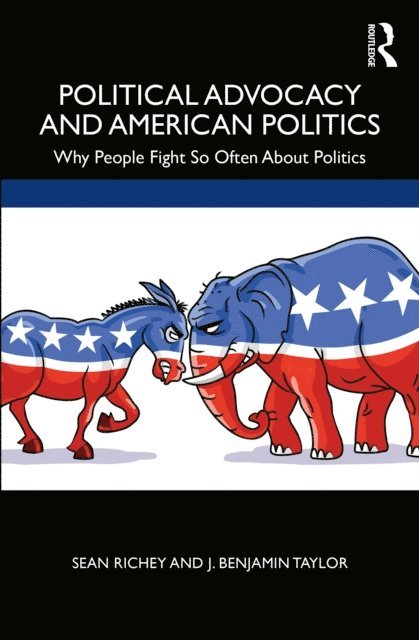
Political Advocacy and American Politics provides a detailed explanation as to why citizens engage in interpersonal advocacy in the United States. Sean Richey and J. Benjamin Taylor eloquently show how the campaigns, social media, and personality and partisanship affect one''s propensity for candidates, which often leads to arguments about politics.
Using original qualitative, survey, and experimental studies, Richey and Taylor demonstrate the causes of political advocacy over time in the political environment and at the individual level. While some worry about the incivility in American politics, Richey and Taylor argue political talk, where conflict is common, is caused by high-activity democratic processes and normatively beneficial individual attributes. Furthermore, Richey and Taylor argue that advocacy—when conceptualized as a democratic "release valve"—is exactly the kind of conflict we might expect in a vibrant democracy.
Political Advocacy and American Politics: Why People Fight So Often About Politics is ideal for university students and researchers, yet it is also accessible to any reader looking to learn more about the role campaigns and personal attributes play in the decision to advocate.
779 kr
Läs direkt efter köp
Political Advocacy and American Politics provides a detailed explanation as to why citizens engage in interpersonal advocacy in the United States. Sean Richey and J. Benjamin Taylor eloquently show how the campaigns, social media, and personality and partisanship affect one''s propensity for candidates, which often leads to arguments about politics.
Using original qualitative, survey, and experimental studies, Richey and Taylor demonstrate the causes of political advocacy over time in the political environment and at the individual level. While some worry about the incivility in American politics, Richey and Taylor argue political talk, where conflict is common, is caused by high-activity democratic processes and normatively beneficial individual attributes. Furthermore, Richey and Taylor argue that advocacy—when conceptualized as a democratic "release valve"—is exactly the kind of conflict we might expect in a vibrant democracy.
Political Advocacy and American Politics: Why People Fight So Often About Politics is ideal for university students and researchers, yet it is also accessible to any reader looking to learn more about the role campaigns and personal attributes play in the decision to advocate.
390 kr
Läs direkt efter köp
The Internet is a hub for political information gathering and accounts for significant political activity, but social interactions online are often disrupted by trolling. As digital democracy continues to evolve, understanding trolling is crucial for developing strategies to foster a healthier online environment conducive to democratic engagement. Understanding the objective of posting deceitful, inflammatory content is crucial.
Trolling Democracy offers both academic and practical insights into one of the most pressing challenges of the digital age. By leveraging theoretical insights, empirical evidence from new surveys, and innovative experiments, J. Benjamin Taylor and Sean Richey offers a comprehensive understanding of trolling''s effect on the public sphere and its implications for democratic processes. Furthermore, they address the broader societal concerns raised by the proliferation of trolling, including the spread of misinformation, the erosion of trust in online platforms, and the exacerbation of political polarization.
Enhancing our knowledge of trolling by bridging gaps in previous research and proposing new avenues for future study, Taylor and Richey equip us with the tools to counteract its negative effects more effectively.
390 kr
Läs direkt efter köp
The Internet is a hub for political information gathering and accounts for significant political activity, but social interactions online are often disrupted by trolling. As digital democracy continues to evolve, understanding trolling is crucial for developing strategies to foster a healthier online environment conducive to democratic engagement. Understanding the objective of posting deceitful, inflammatory content is crucial.
Trolling Democracy offers both academic and practical insights into one of the most pressing challenges of the digital age. By leveraging theoretical insights, empirical evidence from new surveys, and innovative experiments, J. Benjamin Taylor and Sean Richey offers a comprehensive understanding of trolling''s effect on the public sphere and its implications for democratic processes. Furthermore, they address the broader societal concerns raised by the proliferation of trolling, including the spread of misinformation, the erosion of trust in online platforms, and the exacerbation of political polarization.
Enhancing our knowledge of trolling by bridging gaps in previous research and proposing new avenues for future study, Taylor and Richey equip us with the tools to counteract its negative effects more effectively.
792 kr
Skickas inom 10-15 vardagar
763 kr
Läs direkt efter köp
Many who critique democracy as practiced in East Asia suggest that the Confucian political culture of these nations prevents democracy from being the robust participatory type, and limits it to a spectacle designed to create obedience from the public. Certainly some East Asian nations have had elections for decades, but for democracy to be meaningful, a country needs an active public sphere, political tolerance, egalitarian beliefs, and vigorous political participation. The Asian-values debate focuses on whether the creation of this optimal version of democracy in East Asian nations will be hindered by their shared Confucian cultural heritage and at the centre of this debate is whether there is an active political culture in East Asia that allows citizens to freely discuss, debate, and disagree about politics.
With Japan as its focus, this book examines the role of social networks and political discussion in Japanese political culture and asks whether discursive participatory democracy is indeed possible in East Asia. In order to answer this question the authors undertook the largest academic political survey ever conducted in Japan to give the book exceptional empirical credence. This data reveals how the Japanese people interact politically, concluding that through the powerful influence of social networks on Japanese political behaviour, Japan has a more globalized and less hierarchical society where Confucian culture is not dominant and where creation of a vibrant civil society is possible.
This book will be invaluable for students and scholars of Japanese politics, democracy, civil society, and globalization.
763 kr
Läs direkt efter köp
Many who critique democracy as practiced in East Asia suggest that the Confucian political culture of these nations prevents democracy from being the robust participatory type, and limits it to a spectacle designed to create obedience from the public. Certainly some East Asian nations have had elections for decades, but for democracy to be meaningful, a country needs an active public sphere, political tolerance, egalitarian beliefs, and vigorous political participation. The Asian-values debate focuses on whether the creation of this optimal version of democracy in East Asian nations will be hindered by their shared Confucian cultural heritage and at the centre of this debate is whether there is an active political culture in East Asia that allows citizens to freely discuss, debate, and disagree about politics.
With Japan as its focus, this book examines the role of social networks and political discussion in Japanese political culture and asks whether discursive participatory democracy is indeed possible in East Asia. In order to answer this question the authors undertook the largest academic political survey ever conducted in Japan to give the book exceptional empirical credence. This data reveals how the Japanese people interact politically, concluding that through the powerful influence of social networks on Japanese political behaviour, Japan has a more globalized and less hierarchical society where Confucian culture is not dominant and where creation of a vibrant civil society is possible.
This book will be invaluable for students and scholars of Japanese politics, democracy, civil society, and globalization.
665 kr
Skickas inom 10-15 vardagar
2 179 kr
Skickas inom 10-15 vardagar
707 kr
Skickas inom 10-15 vardagar
811 kr
Läs direkt efter köp
For the first time in human history, access to information on almost any topic is accessible through the Internet. A powerful extraction system is needed to disseminate this knowledge, which for most users is Google. Google Search is an extremely powerful and important component to American political life in the twenty-first century, yet its influence is poorly researched or understood.
Sean Richey and J. Benjamin Taylor explore for the first time the influence of Google on American politics, specifically on direct democracy. Using original experiments and nationally representative cross-sectional data, Richey and Taylor show how Google Search returns quality information, that users click on quality information, and gain political knowledge and other contingent benefits. Additionally, they correlate Google usage with real-world voting behavior on direct democracy.
Building a theory of Google Search use for ballot measures, Google and Democracy is an original addition to the literature on the direct democracy, Internet politics, and information technology. An indispensable read to all those wishing to gain new insights on how the Internet has the power to be a normatively valuable resource for citizens.
819 kr
Läs direkt efter köp
For the first time in human history, access to information on almost any topic is accessible through the Internet. A powerful extraction system is needed to disseminate this knowledge, which for most users is Google. Google Search is an extremely powerful and important component to American political life in the twenty-first century, yet its influence is poorly researched or understood.
Sean Richey and J. Benjamin Taylor explore for the first time the influence of Google on American politics, specifically on direct democracy. Using original experiments and nationally representative cross-sectional data, Richey and Taylor show how Google Search returns quality information, that users click on quality information, and gain political knowledge and other contingent benefits. Additionally, they correlate Google usage with real-world voting behavior on direct democracy.
Building a theory of Google Search use for ballot measures, Google and Democracy is an original addition to the literature on the direct democracy, Internet politics, and information technology. An indispensable read to all those wishing to gain new insights on how the Internet has the power to be a normatively valuable resource for citizens.
441 kr
Skickas inom 10-15 vardagar
535 kr
Läs direkt efter köp
What is the impact of patriotism on citizens in democracies? Despite many judging patriotism negatively, we do not know much about its effect on citizenship. Most of the work on patriotism focuses on potential negatives that may derive from patriotism, such as its relationship with bigotry. Crucial debates over whether education should promote patriotism must revolve around a cost-benefit analysis over whether this is worthy of inclusion in pedagogy. This book aims to empirically demonstrate patriotism''s impact on citizenship to determine whether it should be emphasized or abridged fully.
Using data from multiple novel surveys and experiments, Sean Richey shows that patriotism is highly correlated with many normatively beneficial aspects of democratic citizenship and is not associated with unthinking obedience or xenophobia as is often suggested. Patriotism correlates with greater validated voter turnout and civic engagement, fewer incorrect predictions about the economy and conspiracy theory beliefs, and greater political trust, political efficacy, and satisfaction with democracy. This research provides a fuller picture of the impact of patriotism on public opinion and political behavior than has been provided previously in political theory or political psychology. It shows the benefits of patriotism for liberal democratic societies.