Şenol Orakcı - Böcker
Visar alla böcker från författaren Şenol Orakcı. Handla med fri frakt och snabb leverans.
5 produkter
5 produkter
2 664 kr
Skickas inom 5-8 vardagar
Redesigning the Future of Education in the Light of New Theories, Teaching Methods, Learning, and Research
Häftad, Engelska, 2024
583 kr
Skickas inom 7-10 vardagar
Learning used to be confined to a physical place. Now, it’s no longer limited by walls or daylight or location. Learning happens in spaces that transcend these boundaries. These spaces can still have physical elements, but they are no longer defined by a physical footprint and constrained by the limitations of time, space, and matter. Learning can now take place on any device, in any place, and at any time. 21st century skills are one of the concepts we use most frequently when talking about innovative education. We see that the skills, referred to as 21st century skills, include cognitive skills such as creative thinking, problem solving, as well as many different social and emotional skills such as understanding, expressing, empathy and teamwork. Many educators now agree that not only academic knowledge is sufficient, but social-emotional skills play a role as much as academic knowledge in a person's success and happiness. Another accepted fact is the phenomenon of lifelong learning: the fact that education does not start at school but does not end at school, in fact, it is a process that should continue throughout life. While accepting all this, a subject that is not discussed much; how this holistic, lifelong learning is possible in a class in the form of 40 minutes lessons and 10 minutes of break. While we are designing various kinds of education programs for children to gain all these different skill sets in the classroom, do not we actually keep these skills in the easiest way, practically away from the environments they will acquire?In John Dewey's book, “Experience and Education” (1938), information obtained as detached from real life is depicted as wasted time and effort. Most teachers are already aware of this situation. For this reason, they try to explain math problems and literacy by linking them to children's experiences and lives as much as possible, and they do many big and small experiments in social sciences and science lessons. Can't we go one step further than this? Can't we make learning in life a part of our education system, instead of preparing small examples of real life for children? With many justified concerns such as assessment, security, teachers' pedagogical infrastructure, we miss out on the most important opportunities for education just because they are outside the walls of the school? This book aims to open new horizons in the journey of learning beyond the school walls in the world and contribute to the spread of learning in our society. In societies where constant change is the norm, schools today must prepare students to be successful in environments and contexts that may differ greatly from what we experience today. But, are we really thinking about the future?With contributions from seven continents, this book will reveal a ‘snapshot’ of some of our best thinking for building new education futures. Diverse experiences, visions, and ideas are shared to help spark new thinking among educators and policymakers, provoke conversation, and facilitate new ideas for meeting human development needs in a rapidly transforming world.
Redesigning the Future of Education in the Light of New Theories, Teaching Methods, Learning, and Research
Inbunden, Engelska, 2024
1 032 kr
Skickas inom 7-10 vardagar
Learning used to be confined to a physical place. Now, it’s no longer limited by walls or daylight or location. Learning happens in spaces that transcend these boundaries. These spaces can still have physical elements, but they are no longer defined by a physical footprint and constrained by the limitations of time, space, and matter. Learning can now take place on any device, in any place, and at any time. 21st century skills are one of the concepts we use most frequently when talking about innovative education. We see that the skills, referred to as 21st century skills, include cognitive skills such as creative thinking, problem solving, as well as many different social and emotional skills such as understanding, expressing, empathy and teamwork. Many educators now agree that not only academic knowledge is sufficient, but social-emotional skills play a role as much as academic knowledge in a person's success and happiness. Another accepted fact is the phenomenon of lifelong learning: the fact that education does not start at school but does not end at school, in fact, it is a process that should continue throughout life. While accepting all this, a subject that is not discussed much; how this holistic, lifelong learning is possible in a class in the form of 40 minutes lessons and 10 minutes of break. While we are designing various kinds of education programs for children to gain all these different skill sets in the classroom, do not we actually keep these skills in the easiest way, practically away from the environments they will acquire?In John Dewey's book, “Experience and Education” (1938), information obtained as detached from real life is depicted as wasted time and effort. Most teachers are already aware of this situation. For this reason, they try to explain math problems and literacy by linking them to children's experiences and lives as much as possible, and they do many big and small experiments in social sciences and science lessons. Can't we go one step further than this? Can't we make learning in life a part of our education system, instead of preparing small examples of real life for children? With many justified concerns such as assessment, security, teachers' pedagogical infrastructure, we miss out on the most important opportunities for education just because they are outside the walls of the school? This book aims to open new horizons in the journey of learning beyond the school walls in the world and contribute to the spread of learning in our society. In societies where constant change is the norm, schools today must prepare students to be successful in environments and contexts that may differ greatly from what we experience today. But, are we really thinking about the future?With contributions from seven continents, this book will reveal a ‘snapshot’ of some of our best thinking for building new education futures. Diverse experiences, visions, and ideas are shared to help spark new thinking among educators and policymakers, provoke conversation, and facilitate new ideas for meeting human development needs in a rapidly transforming world.
732 kr
Skickas inom 7-10 vardagar
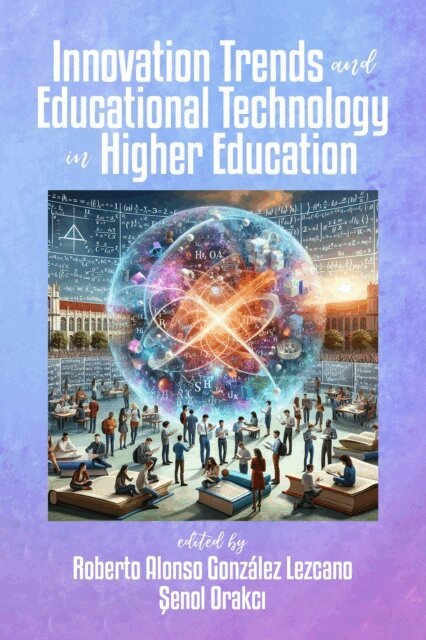
Today, there is a reform in education around the world. The new and advanced technologies brought to our lives by the 21st century and frequently used in our daily lives are now being used for education. They start to come up with different practices in classrooms and schools (Higher Education in Digital Age, 2016). Today, individualized learning methods are rapidly becoming widespread. Sitting comfortably in our home, we can now listen to a teacher who is lecturing anywhere in the world without distances. With the widespread use of the Internet, it is now very easy to access information in a globalizing world. Nowadays, even when mobile phones become a learning tool, it is important to have access to reliable information in the shortest way (Davidson & Goldberg, 2009). Digital transformation in education makes it possible to access information independent of time and space. Education turns into a data-driven and personal experience. With this transformation, new sources of information, mass online open courses, online libraries and even digital universities have started to enter our lives (The 2018 Digital University, 2016). It is clear that technological innovations provide an important opportunity to strengthen the equality of opportunity in higher education in the age of information and communication, and bring high standards of learning to our homes and even to our pockets. The aim of this study is to determine new approaches, theories, teaching methods, and learning styles in digital age in higher education based on theoretical and empirical studies.
1 193 kr
Skickas inom 7-10 vardagar
Today, there is a reform in education around the world. The new and advanced technologies brought to our lives by the 21st century and frequently used in our daily lives are now being used for education. They start to come up with different practices in classrooms and schools (Higher Education in Digital Age, 2016). Today, individualized learning methods are rapidly becoming widespread. Sitting comfortably in our home, we can now listen to a teacher who is lecturing anywhere in the world without distances. With the widespread use of the Internet, it is now very easy to access information in a globalizing world. Nowadays, even when mobile phones become a learning tool, it is important to have access to reliable information in the shortest way (Davidson & Goldberg, 2009). Digital transformation in education makes it possible to access information independent of time and space. Education turns into a data-driven and personal experience. With this transformation, new sources of information, mass online open courses, online libraries and even digital universities have started to enter our lives (The 2018 Digital University, 2016). It is clear that technological innovations provide an important opportunity to strengthen the equality of opportunity in higher education in the age of information and communication, and bring high standards of learning to our homes and even to our pockets. The aim of this study is to determine new approaches, theories, teaching methods, and learning styles in digital age in higher education based on theoretical and empirical studies.