Sergey Khrushchev – författare
Visar alla böcker från författaren Sergey Khrushchev. Handla med fri frakt och snabb leverans.
4 produkter
4 produkter
Del 122 - Encyclopedia of Mathematics and its Applications
Orthogonal Polynomials and Continued Fractions
From Euler's Point of View
Inbunden, Engelska, 2008
2 005 kr
Skickas inom 7-10 vardagar
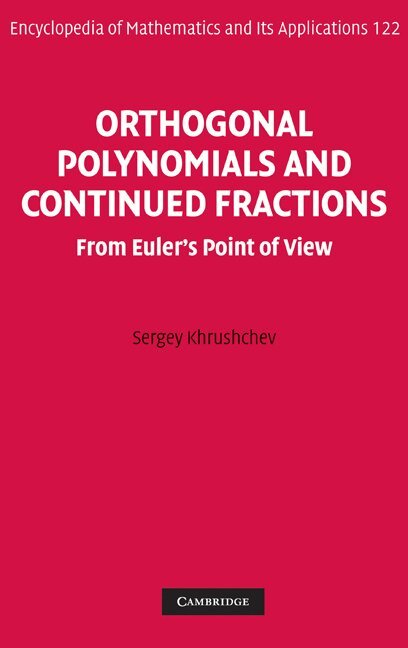
Continued fractions, studied since Ancient Greece, only became a powerful tool in the eighteenth century, in the hands of the great mathematician Euler. This book tells how Euler introduced the idea of orthogonal polynomials and combined the two subjects, and how Brouncker's formula of 1655 can be derived from Euler's efforts in Special Functions and Orthogonal Polynomials. The most interesting applications of this work are discussed, including the great Markoff's Theorem on the Lagrange spectrum, Abel's Theorem on integration in finite terms, Chebyshev's Theory of Orthogonal Polynomials, and very recent advances in Orthogonal Polynomials on the unit circle. As continued fractions become more important again, in part due to their use in finding algorithms in approximation theory, this timely book revives the approach of Wallis, Brouncker and Euler and illustrates the continuing significance of their influence. A translation of Euler's famous paper 'Continued Fractions, Observation' is included as an Addendum.
Inbunden, Engelska, 2024
708 kr
Skickas inom 5-8 vardagar
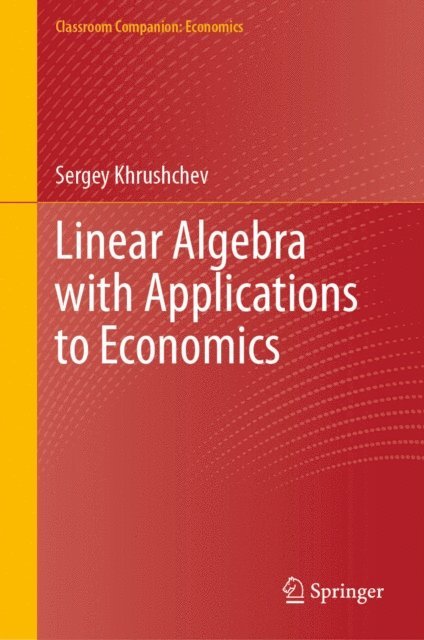
This textbook is intended for students of Mathematical Economics and is based on my lectures on Linear Algebra delivered at Satbayev University in Almaty, Kazakhstan. The program closely aligns with that of the London School of Economics. The textbook extensively utilizes the concept of Gauss-Jordan elimination. Every subspace of the standard coordinate space possesses a unique Gauss basis. This observation significantly clarifies many aspects of Linear Algebra. The covered topics are outlined in the table of contents.
E-bok
PDF, Engelska, 2024840 kr
Läs direkt efter köp
This textbook is intended for students of Mathematical Economics and is based on my lectures on Linear Algebra delivered at Satbayev University in Almaty, Kazakhstan. The program closely aligns with that of the London School of Economics. The textbook extensively utilizes the concept of Gauss-Jordan elimination. Every subspace of the standard coordinate space possesses a unique Gauss basis. This observation significantly clarifies many aspects of Linear Algebra. The covered topics are outlined in the table of contents.
Inbunden, Engelska, 2025
1 085 kr
Skickas inom 5-8 vardagar
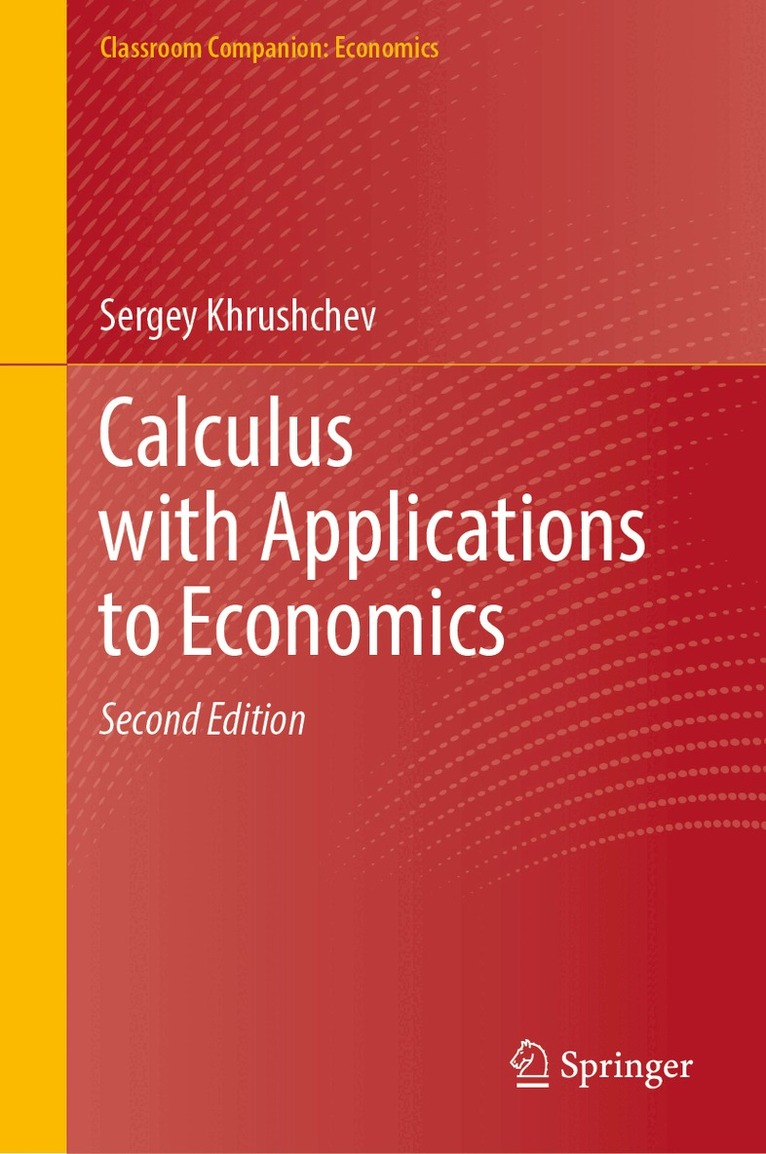
This book presents classical Calculus in a novel way by integrating examples from modern Economics. Drawing inspiration from historical algebra textbooks—rich with buy‐sell problems that once prepared students for the economic challenges of their times—the book offers a modern counterpart designed for today's Calculus students, many of whom will pursue careers in business and management. Readers will discover, for example, why Descartes could not derive a formula for the tangents to logarithmic curves, why banks employ functions that describe explosive growth, and why production functions are often modeled by the Cobb–Douglas form. The book also explains the contrasting shapes of demand curves—why a product with many substitutes has a demand curve that is convex downward, whereas a monopoly’s demand curve is convex upward—and shows how the elasticity of demand can be used to achieve maximum revenue, among many other intriguing insights. Mathematics enthusiasts will appreciate the captivating account of Brouncker’s continued fractions and their role in approximating π to many digits as early as 1655. Meanwhile, students of Economics will benefit from a comprehensive treatment of Optimization Theory, covering topics from single-variable problems to the application of Lagrange’s multipliers and utility theory. By interweaving historical insights with practical applications, this book not only reinforces fundamental concepts of Calculus but also demonstrates their relevance in solving modern economic problems. Each chapter is structured to present a historical narrative that elucidates the development of key mathematical ideas, followed by modern examples that illustrate their application in Economics. This dual approach enhances the learning experience and encourages both critical thinking and creative problem-solving. Ultimately, the book serves as a bridge between the theoretical elegance of classical mathematics and the dynamic challenges of contemporary economic analysis. It is our hope that this work will inspire students and educators alike to explore the rich interplay between Mathematics and Economics, fostering a deeper appreciation for the enduring relevance of classical ideas in today’s rapidly evolving academic and professional landscapes.