S.G.K. Ananthasuresh – författare
Visar alla böcker från författaren S.G.K. Ananthasuresh. Handla med fri frakt och snabb leverans.
3 produkter
3 produkter
Inbunden, Engelska, 2003
1 633 kr
Skickas inom 10-15 vardagar
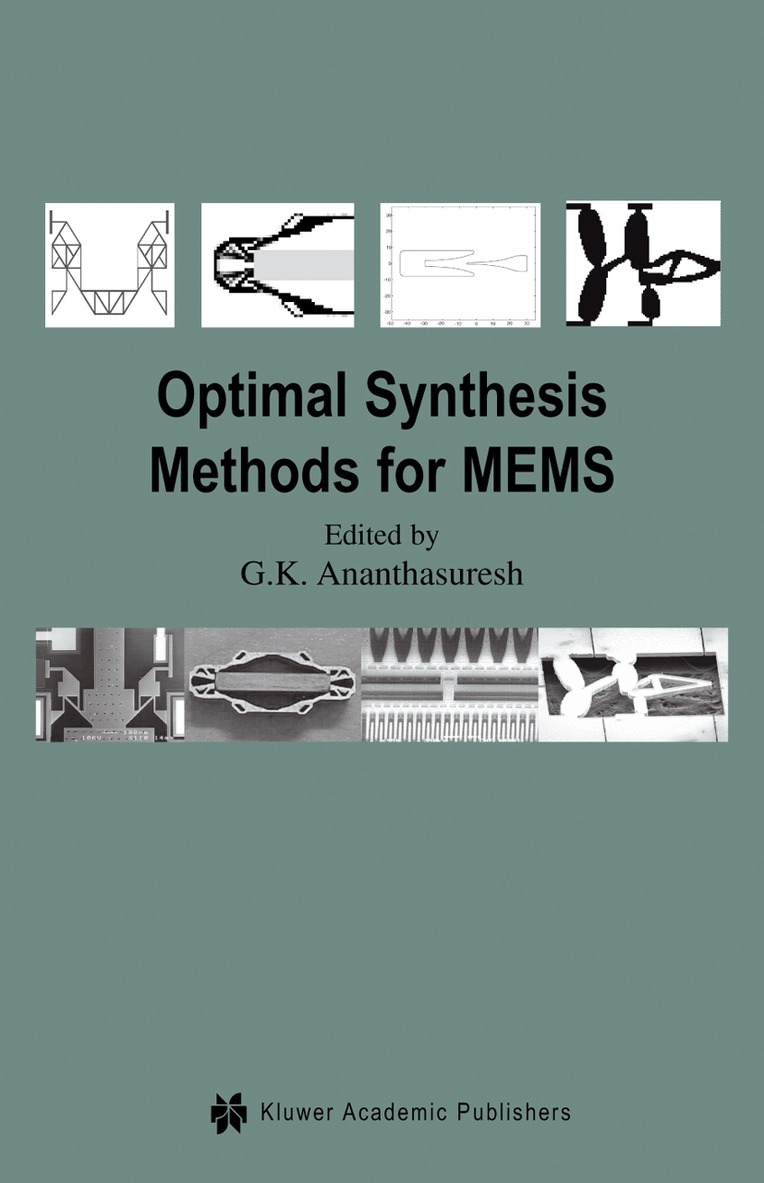
The field of "microelectromechanical systems," or "MEMS," has gradually evolved from a "discipline" populated by a small group of researchers to an "enabling technology" supporting a variety of products in such diverse areas as mechanical and inertial sensors, optical projection displays, telecommunications equipment, and biology and medicine. Critical to the success of these products is the ability to design them, and this invariably involves detailed modeling of proposed designs. Over the past twenty years, such modeling has become increasingly sophisticated, with full suites of MEMS-oriented computer-aided-design tools now available worldwide. But there is another equally important side to the design process In my own book, Microsystem figuring out what to build in the first place. Design, I chose to emphasize the modeling aspect of design. The task of figuring out what to build was defined by a vague step called "creative thinking." I used practical product examples to illustrate the many subtle characteristics of successful designs, but I made no attempt to systematize the generation ofdesign proposals or optimized designs. That systemization is called "synthesis," which is the subjectofthis book.
Del 13 - Microsystems
Optimal Synthesis Methods for MEMS
Häftad, Engelska, 2013
1 633 kr
Skickas inom 10-15 vardagar
The field of "microelectromechanical systems," or "MEMS," has gradually evolved from a "discipline" populated by a small group of researchers to an "enabling technology" supporting a variety of products in such diverse areas as mechanical and inertial sensors, optical projection displays, telecommunications equipment, and biology and medicine. Critical to the success of these products is the ability to design them, and this invariably involves detailed modeling of proposed designs. Over the past twenty years, such modeling has become increasingly sophisticated, with full suites of MEMS-oriented computer-aided-design tools now available worldwide. But there is another equally important side to the design process In my own book, Microsystem figuring out what to build in the first place. Design, I chose to emphasize the modeling aspect of design. The task of figuring out what to build was defined by a vague step called "creative thinking." I used practical product examples to illustrate the many subtle characteristics of successful designs, but I made no attempt to systematize the generation ofdesign proposals or optimized designs. That systemization is called "synthesis," which is the subjectofthis book.
E-bok
PDF, Engelska, 20121 977 kr
Läs direkt efter köp
The field of "microelectromechanical systems," or "MEMS," has gradually evolved from a "discipline" populated by a small group of researchers to an "enabling technology" supporting a variety of products in such diverse areas as mechanical and inertial sensors, optical projection displays, telecommunications equipment, and biology and medicine. Critical to the success of these products is the ability to design them, and this invariably involves detailed modeling of proposed designs. Over the past twenty years, such modeling has become increasingly sophisticated, with full suites of MEMS-oriented computer-aided-design tools now available worldwide. But there is another equally important side to the design process In my own book, Microsystem figuring out what to build in the first place. Design, I chose to emphasize the modeling aspect of design. The task of figuring out what to build was defined by a vague step called "creative thinking." I used practical product examples to illustrate the many subtle characteristics of successful designs, but I made no attempt to systematize the generation ofdesign proposals or optimized designs. That systemization is called "synthesis," which is the subjectofthis book.