Shafi Goldwasser – författare
Visar alla böcker från författaren Shafi Goldwasser. Handla med fri frakt och snabb leverans.
5 produkter
5 produkter
E-bok
PDF, Engelska, 2008712 kr
Läs direkt efter köp
Häftad, Engelska, 1990
560 kr
Skickas inom 10-15 vardagar
Del 671 - Springer International Series in Engineering and Computer Science
Complexity of Lattice Problems
A Cryptographic Perspective
Inbunden, Engelska, 2002
3 106 kr
Skickas inom 10-15 vardagar
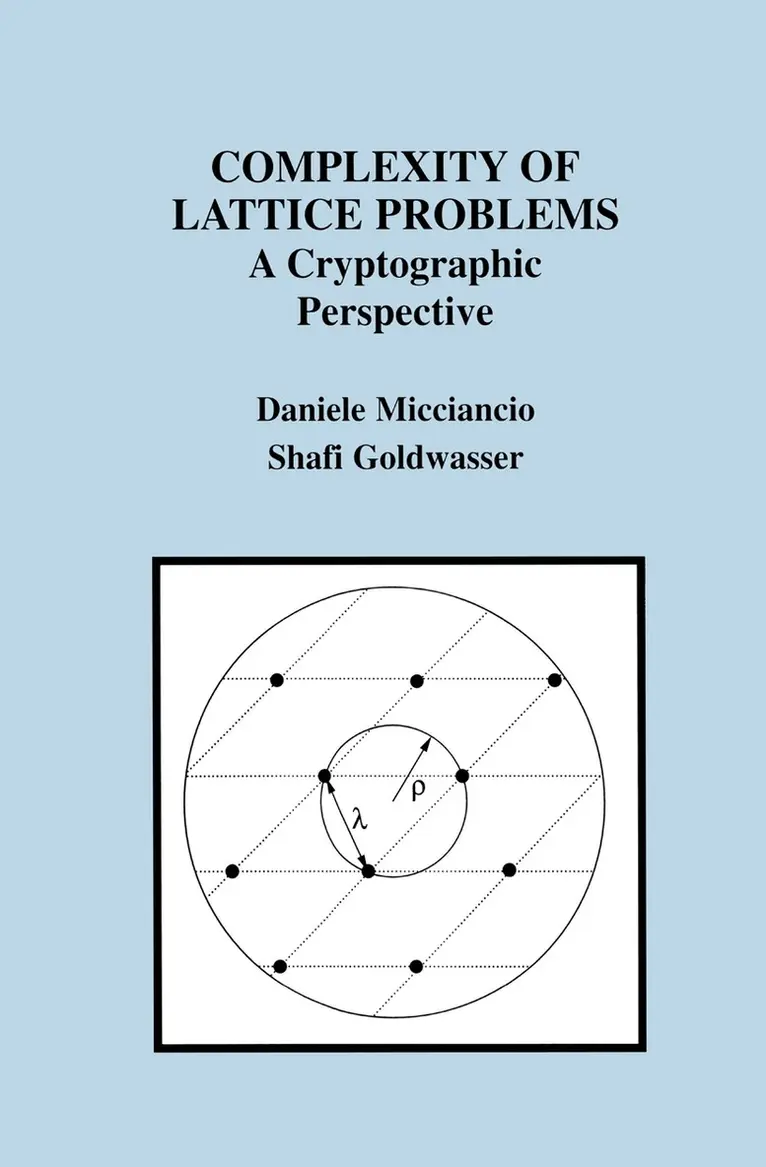
Lattices are geometric objects that can be pictorially described as the set of intersection points of an infinite, regular n-dimensional grid. De spite their apparent simplicity, lattices hide a rich combinatorial struc ture, which has attracted the attention of great mathematicians over the last two centuries. Not surprisingly, lattices have found numerous ap plications in mathematics and computer science, ranging from number theory and Diophantine approximation, to combinatorial optimization and cryptography. The study of lattices, specifically from a computational point of view, was marked by two major breakthroughs: the development of the LLL lattice reduction algorithm by Lenstra, Lenstra and Lovasz in the early 80's, and Ajtai's discovery of a connection between the worst-case and average-case hardness of certain lattice problems in the late 90's. The LLL algorithm, despite the relatively poor quality of the solution it gives in the worst case, allowed to devise polynomial time solutions to many classical problems in computer science. These include, solving integer programs in a fixed number of variables, factoring polynomials over the rationals, breaking knapsack based cryptosystems, and finding solutions to many other Diophantine and cryptanalysis problems.
Del 671 - Springer International Series in Engineering and Computer Science
Complexity of Lattice Problems
A Cryptographic Perspective
Häftad, Engelska, 2012
3 016 kr
Skickas inom 10-15 vardagar
Lattices are geometric objects that can be pictorially described as the set of intersection points of an infinite, regular n-dimensional grid. De spite their apparent simplicity, lattices hide a rich combinatorial struc ture, which has attracted the attention of great mathematicians over the last two centuries. Not surprisingly, lattices have found numerous ap plications in mathematics and computer science, ranging from number theory and Diophantine approximation, to combinatorial optimization and cryptography. The study of lattices, specifically from a computational point of view, was marked by two major breakthroughs: the development of the LLL lattice reduction algorithm by Lenstra, Lenstra and Lovasz in the early 80's, and Ajtai's discovery of a connection between the worst-case and average-case hardness of certain lattice problems in the late 90's. The LLL algorithm, despite the relatively poor quality of the solution it gives in the worst case, allowed to devise polynomial time solutions to many classical problems in computer science. These include, solving integer programs in a fixed number of variables, factoring polynomials over the rationals, breaking knapsack based cryptosystems, and finding solutions to many other Diophantine and cryptanalysis problems.
E-bok
PDF, Engelska, 20123 748 kr
Läs direkt efter köp
Lattices are geometric objects that can be pictorially described as the set of intersection points of an infinite, regular n-dimensional grid. De spite their apparent simplicity, lattices hide a rich combinatorial struc ture, which has attracted the attention of great mathematicians over the last two centuries. Not surprisingly, lattices have found numerous ap plications in mathematics and computer science, ranging from number theory and Diophantine approximation, to combinatorial optimization and cryptography. The study of lattices, specifically from a computational point of view, was marked by two major breakthroughs: the development of the LLL lattice reduction algorithm by Lenstra, Lenstra and Lovasz in the early 80''s, and Ajtai''s discovery of a connection between the worst-case and average-case hardness of certain lattice problems in the late 90''s. The LLL algorithm, despite the relatively poor quality of the solution it gives in the worst case, allowed to devise polynomial time solutions to many classical problems in computer science. These include, solving integer programs in a fixed number of variables, factoring polynomials over the rationals, breaking knapsack based cryptosystems, and finding solutions to many other Diophantine and cryptanalysis problems.