Shay Johnson – författare
Visar alla böcker från författaren Shay Johnson. Handla med fri frakt och snabb leverans.
5 produkter
5 produkter
E-bok
Engelska, 202624 kr
Läs direkt efter köp
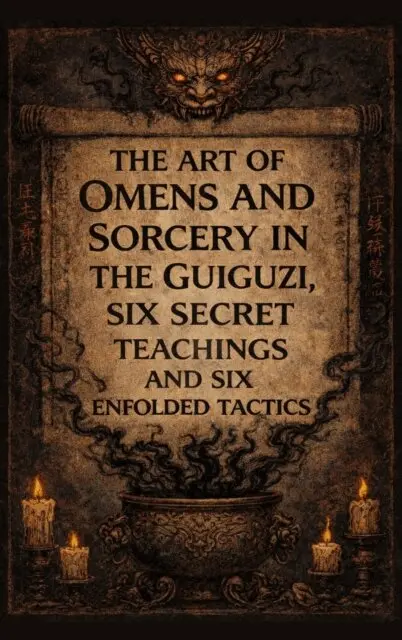
War in early Chinese thought was never confined to the clash of armies. It unfolded across visible and invisible realms at once—shaped by omens in the sky, disturbances in nature, ritual failure, spiritual interference, and the silent movement of fate. Victory was believed to be permitted before it was seized, and defeat often arrived long before a blade was raised.The Art of Omens and Sorcery in the Guiguzi, Six Secret Teachings and Six Enfolded Tactics is a rigorous interpretive study of this worldview. Drawing from eight foundational classical sources, this book examines how ancient Chinese strategists understood warfare as a phenomenon governed not only by force and planning, but by unseen forces that judged, warned, and intervened.At its core, the book explores three primary esoteric military traditions: the Guiguzi, a doctrine of invisible influence and psychological domination; the Six Secret Teachings, attributed to the Taigong tradition and concerned with ritual preparation, Heaven's mandate, and cosmological timing; and the Six Enfolded Tactics, a fragmentary but deeply fatalistic doctrine focused on fate-reading, subtle signals, and withdrawal before inevitable collapse.These core texts are examined alongside five additional classical works that preserve and expand the supernatural logic of warfare: the Lüshi Chunqiu, which records natural portents as causes of defeat; the I Ching, the formal system of divination used to question Heaven before action; the Zuo Zhuan, which chronicles possession, panic, and spirit interference as historical fact; the Baopuzi, revealing talismans, demonology, and spiritual protection during times of chaos; and the Huainanzi, which unifies these beliefs within a cosmology of resonance, fate cycles, and the limits of human control.This book is not a translation, not a manual, and not a revival of ancient practices. It is a modern analytical synthesis that treats omens, sorcery, divination, spirits, and fate as they were understood historically: as operative realities that shaped real decisions, restrained power, legitimized withdrawal, and explained catastrophe.Through a structured thematic progression, the reader is guided from the invisible dimensions of warfare, through doctrines of persuasion and ritual, into fate-reading, geomancy, divination, spirit belief, and finally cosmic transformation. Across these traditions, a single conclusion emerges: in early Chinese strategy, war was judged long before it was fought.Scholarly in tone yet accessible in presentation, The Art of Omens and Sorcery offers a rare and unsettling perspective on how ancient civilizations understood power, uncertainty, and the unseen forces believed to govern human conflict.
E-bok
Engelska, 202626 kr
Läs direkt efter köp
Sun Tzu on the School of Hard Knocks reframes life's harshest experiences through the lens of strategy. Where others see failure, humiliation, or injustice, this book reveals structure, pattern, and opportunity. Drawing on the principles of classical warfare, it shows how moments of chagrin are not random setbacks, but encounters with conditions that were misunderstood—and therefore the starting point of real strength.In the tradition of Sun Tzu, this is not a book about comfort or motivation. It is about clarity. Each chapter translates the timeless doctrines of strategy into practical insight for navigating modern environments—workplace conflict, social dynamics, personal setbacks, and psychological pressure. It teaches how to recognize distortion, contain emotional fallout, read people and situations accurately, and reposition yourself before conditions turn against you.At its core is a simple but powerful idea: hardship is not what breaks you—it is what reveals where you were unprepared. Through concepts aligned with the ancient principle of "e;eating bitterness,"e; this book demonstrates how enduring pressure, misjudgment, and adversity forges composure, discipline, and internal command. The goal is not to avoid hard knocks, but to extract their value and convert them into strategic advantage.For those who have felt stuck in cycles of overthinking, frustration, or misinterpretation, this work offers a way out. It shows how to end internal conflict, cut off rumination, and move forward with precision rather than reaction. The past is not erased—it is finalized, understood, and placed where it belongs: behind you, but fully integrated into how you operate.This is a manual for those who have been through the fire and are ready to come out sharper, not scarred.
E-bok
Engelska24 kr
Läs direkt efter köp
E-bok
Engelska, 202624 kr
Läs direkt efter köp
The Wei Liaozi is one of the most uncompromising works to emerge from China's Warring States period—a severe and unsentimental manual on how a state must be governed if it is to survive war.Unlike battlefield-focused texts that emphasize tactics or deception, the Wei Liaozi addresses a more fundamental problem: how political order, law, discipline, and social organization determine military success long before armies ever meet. It argues that victory is not produced by clever generals alone, but by governance capable of imposing order, enforcing authority, and eliminating internal weakness.This work belongs to the Legalist–military tradition. It treats law as an instrument of control rather than moral instruction, views reward and punishment as the primary drivers of human behavior, and regards softness, indulgence, and inconsistency as precursors to collapse. In the Wei Liaozi, war is not an aberration but a test—an audit that exposes the true condition of a state's institutions, discipline, and leadership.This modern interpretation reorganizes the text's doctrines into a clear, coherent structure, guiding the reader through its core principles:– Governance as the root of military power– Law and authority as foundations of order– Reward and punishment as mechanisms of control– The militarization of civil society– Discipline, readiness, and command reliability– War as the ultimate measure of governance– Corruption, decay, and the logic of collapseThe result is not a romanticized philosophy of war, but a hard blueprint for state survival under pressure. The Wei Liaozi does not ask whether its methods are pleasant. It asks whether they work.The Wei LiaoziWei's Military Manual of Governance & War is essential reading for those interested in ancient strategy, political power, Legalist thought, and the foundations of authority that precede victory—or defeat.
E-bok
Engelska, 202623 kr
Läs direkt efter köp
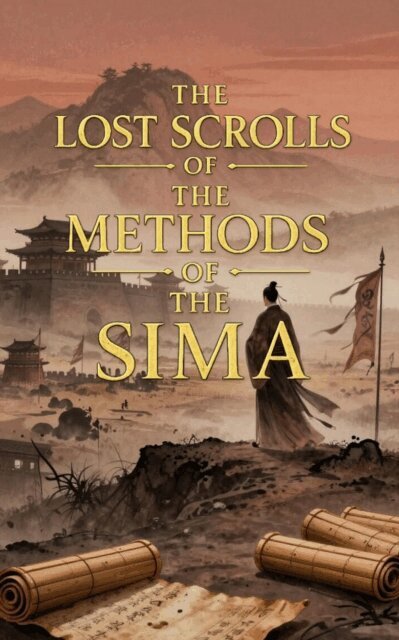
The Lost Scrolls of The Methods of the Sima offers a disciplined interpretive examination of what is absent from one of early China's most institutional approaches to warfare. While the surviving remnants of the Sima Fa outline a doctrine grounded in command authority, order, and moral governance, historical references and structural cues suggest that significant portions of the original work were lost over time.This volume does not claim to restore or reproduce missing manuscripts. Instead, it presents a reasoned exploration of what the lost sections were likely concerned with, drawing on surviving passages, parallel strategic traditions, historical records, and the internal logic of the Sima system itself. Topics examined include military administration, mobilization, training, command responsibility, and the relationship between civil authority and martial order.Written for readers of classical military philosophy, The Lost Scrolls of The Methods of the Sima approaches absence with restraint and rigor, treating lost material not as speculation but as a problem of structure, coherence, and historical inference. The result is a thoughtful companion to the surviving text, offering insight into how the Sima tradition may once have functioned as a complete and systematic doctrine of war.