Sidney J Segalowitz – författare
Visar alla böcker från författaren Sidney J Segalowitz. Handla med fri frakt och snabb leverans.
2 produkter
2 produkter
Inbunden, Engelska, 2007
1 157 kr
Skickas inom 7-10 vardagar
Until now, individuals interested in measuring biological signals non-invasively from typically developing children had few places to turn to find an overview of theory, methods, measures, and applications related to psychophysiology recordings in children. This volume briefly surveys the primary methods of psychophysiology that have been applied to developmental psychology research, what they have accomplished, and where the future lies. It outlines the practical issues that active developmental psychophysiology laboratories encounter and some solutions to deal with them. Developmental psychophysiology holds the key to forming the interface between structure and function necessary for the growth of developmental psychology.
E-bok
PDF, Engelska, 2014807 kr
Läs direkt efter köp
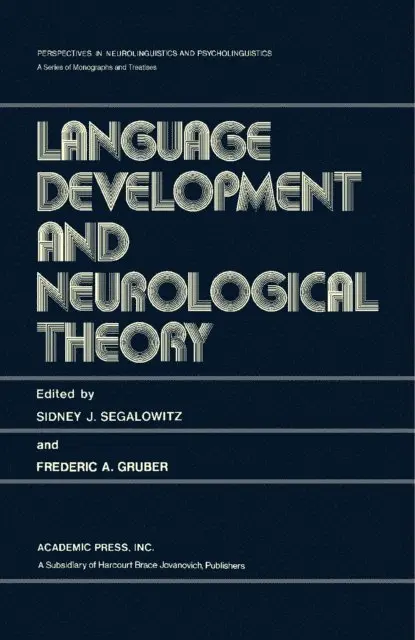
Language Development and Neurological Theory presents a neuropsychological theory of language development. The discussions are organized around the following themes: cerebral specialization for language in normal and brain-damaged individuals; development of cerebral dominance; and speech perception. Much emphasis is placed on the issue of cerebral specialization, or lateralization. Comprised of 20 chapters, this volume begins with a review of some of the methods used to correlate neurophysiological and behavioral functions, as well as some of the issues involved in trying to unite the empirical science of neuropsychology and the rationalist science of linguistics. The next chapter deals with lateralization for speech sounds shown by young infants and possible factors in the sound signal responsible for the differentiation. Subsequent chapters focus on asymmetries in young children during continuous verbal-nonvisual and visual-nonverbal story tasks; the effects of multi-language elementary school program on the degree of lateralization for language; intramodal and cross-modal pattern perception in stroke patients with lateralized lesions; and visual half-field asymmetries in deaf and hearing children. Several hypotheses as to why language is lateralized to the left hemisphere rather than to the right are also examined. This book is addressed to researchers and students of the neuropsychology of language, whether they call themselves psychologists, neuropsychologists, neurologists, or linguists.