Simon Heffer - Böcker
Visar alla böcker från författaren Simon Heffer. Handla med fri frakt och snabb leverans.
13 produkter
13 produkter
153 kr
Skickas
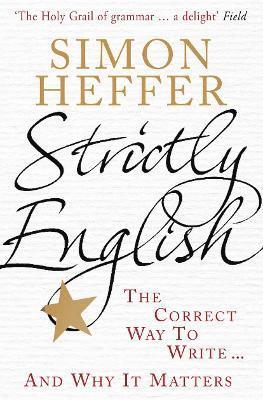
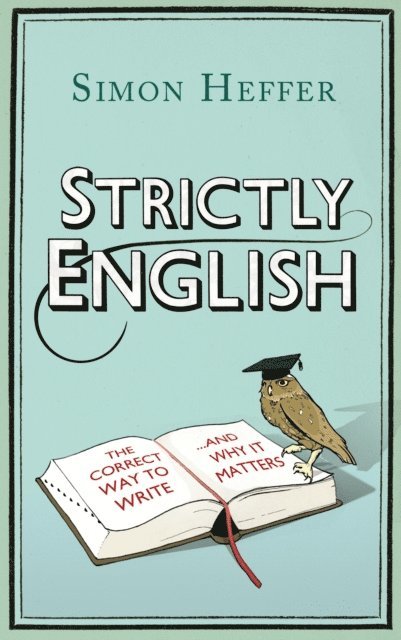
"Be in no doubt: the beer was drunk but the man drank the beer.""We must avoid vulgarities like 'front up'. If someone is 'fronting up' a television show, then he is presenting it."Simon Heffer's incisive and amusingly despairing emails to colleagues at the The Daily Telegraph about grammatical mistakes and stylistic slips have attracted a growing band of ardent fans over recent years. Now, in his new book Strictly English, he makes an impassioned case for an end to the sloppiness that has become such a hallmark of everyday speech and writing, and shows how accuracy and clarity are within the grasp of anyone who is prepared to take the time to master a few simple rules.If you wince when you see "different than" in print, or are offended by people who think that "infer" and "imply" mean the same thing, then this book will provide reassurance that you are not alone. And if you believe that precise and elegant English really does matter, then it will prove required reading.
163 kr
Skickas
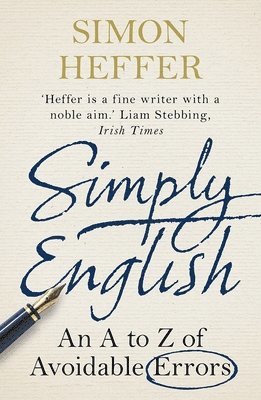
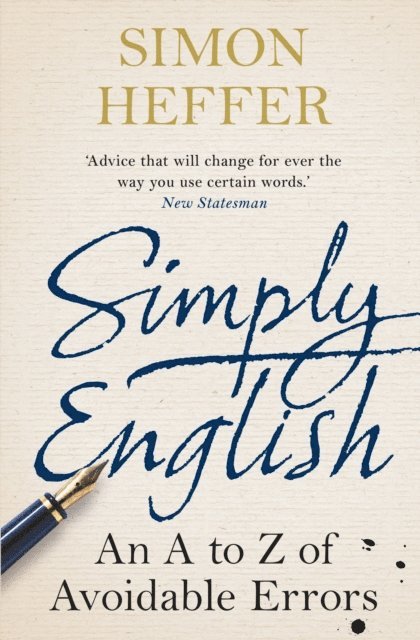
In his best-selling Strictly English Simon Heffer explained how to write and speak our language well. In Simply English he offers an entertaining and supremely useful A–Z guide to frequent errors, common misunderstandings and stylistic howlers. What is the difference between amend and emend, between imply and infer, and between uninterested and disinterested? When should one put owing to rather than due to? Why should the temptation to write actually, basically or at this moment in time always be strenuously resisted? How does one use an apostrophe correctly, ensure that one understands what alibi really means, and avoid the perils of the double negative?With articles on everything from punctuation to tabloid English to adverbs and adjectives, Simply English is the essential companion for anyone who cares about the language and wants to use it correctly.
214 kr
Skickas
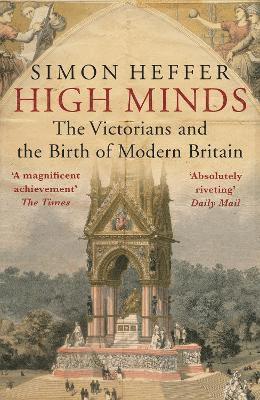
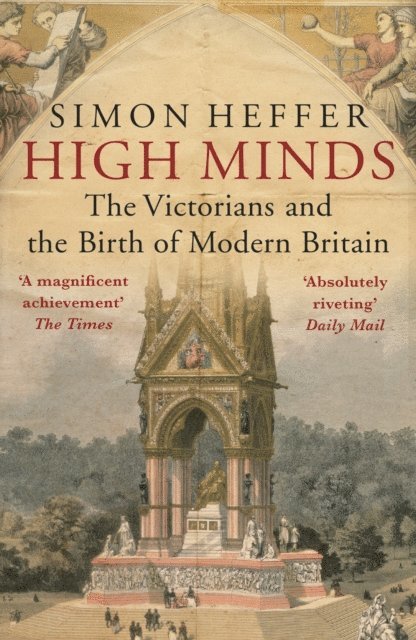
Simon Heffer's new book forms an ambitious exploration of the making of the Victorian age and the Victorian mind.Britain in the 1840s was a country wracked by poverty, unrest and uncertainty, where there were attempts to assassinate the Queen and her prime minister, and the ruling class lived in fear of riot and revolution. By the 1880s it was a confident nation of progress and prosperity, transformed not just by industrialisation but by new attitudes to politics, education, women and the working class. That it should have changed so radically was very largely the work of an astonishingly dynamic and high-minded group of people – politicians and philanthropists, writers and thinkers – who in a matter of decades fundamentally remade the country, its institutions and its mindset, and laid the foundations for modern society. It traces the evolution of British democracy and shows how early laissez-faire attitudes to the lot of the less fortunate turned into campaigns to improve their lives and prospects. It analyses the birth of new attitudes to education, religion and science. And it shows how even such aesthetic issues as taste in architecture were swept in to broader debates about the direction that the country should take. In the process, Simon Heffer looks at the lives and deeds of major politicians, from the devout and principled Gladstone to the unscrupulous Disraeli; at the intellectual arguments that raged among writers and thinkers such as Matthew Arnold, Thomas Carlyle, and Samuel Butler; and at the 'great projects' of the age, from the Great Exhibition to the Albert Memorial. Drawing heavily on previously unpublished documents, he offers a superbly nuanced insight into life in an extraordinary era, populated by extraordinary people – and how our forebears’ pursuit of perfection gave birth to modern Britain.
183 kr
Skickas
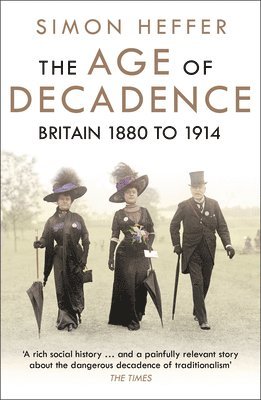
‘A riveting account of the pre-First World War years . . . The Age of Decadence is an enormously impressive and enjoyable read.’ Dominic Sandbrook, Sunday Times‘A magnificent account of a less than magnificent epoch.’ Jonathan Meades, Literary Review The folk-memory of Britain in the years before the Great War is of a powerful, contented, orderly and thriving country. She commanded a vast empire. She bestrode international commerce. Her citizens were living longer, profiting from civil liberties their grandparents only dreamt of, and enjoying an expanding range of comforts and pastimes. The mood of pride and self-confidence is familiar from Elgar’s Pomp and Circumstance marches, newsreels of George V’s coronation and the London’s great Edwardian palaces.Yet things were very different below the surface. In The Age of Decadence Simon Heffer exposes the contradictions of late-Victorian and Edwardian Britain. He explains how, despite the nation’s massive power, a mismanaged war against the Boers in South Africa created profound doubts about her imperial destiny. He shows how attempts to secure vital social reforms prompted the twentieth century’s gravest constitutional crisis and coincided with the worst industrial unrest in British history. He describes how politicians who conceded the vote to millions more men disregarded women so utterly that female suffragists’ public protest bordered on terrorism. He depicts a ruling class that fell prey to degeneracy and scandal. He analyses a national psyche that embraced the motor-car, the sensationalist press and the science fiction of H. G. Wells, but also the Arts and Crafts of William Morris and the nostalgia of A. E. Housman. And he concludes with the crisis that in the summer of 1914 threatened the existence of the United Kingdom – a looming civil war in Ireland.He lights up the era through vivid pen-portraits of the great men and women of the day – including Gladstone, Parnell, Asquith and Churchill, but also Mrs Pankhurst, Beatrice Webb, Baden-Powell, Wilde and Shaw – creating a richly detailed panorama of a great power that, through both accident and arrogance, was forced to face potentially fatal challenges.‘A devastating critique of prewar Britain . . . disturbingly relevant to the world in which we live.’ Gerard DeGroot, The Times‘You won’t put it down . . . A really riveting read.’ Rana Mitter, BBC Radio 3 Free Thinking
232 kr
Skickas inom 10-15 vardagar
A tweedy purveyor of folklore; too many larks ascending and too much Linden Lea: no composer's work has ever been more cruelly stereotyped than that of Ralph Vaughan Williams. The truth could hardly have been more different: that folksy feel masked the highest sophistication, that countrified air the most audacious experimentation. If, unlike his Germanizing contemporary Elgar, Vaughan Williams did indeed open the way to a distinctively English Music, his was an Englishness which owed nothing to narrow-mindedness or lack of artistic enterprise. Fifty years after his death in 1958, Vaughan Williams' reputation is greater than ever before and there is a resurgence of interest in his music. Re-issued to coincide with this anniversary, Simon Heffer's perceptive book lends weight to the increasingly compelling case for Vaughan Williams' recognition as the most important English composer of the twentieth century. 'A vivid and appealing picture of an irresistibly likeable figure ... I enjoyed this little book enormously.'Spectator'An affectionate, accurate and shrewd account of Vaughan Williams' life ... the author's astute commentary on it betokens close and knowledgeable acquaintance.' Sunday Telegraph
169 kr
Skickas inom 7-10 vardagar
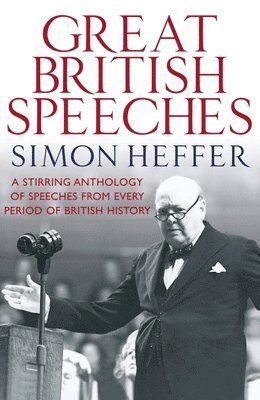
50 speeches from every period of British history from the medieval era to the present and a fascinating dip-in history title that will both inspire readers and give them a greater understanding of British history. The speechmakers are: King Henry V; Queen Elizabeth I; King Charles I; Oliver Cromwell; Earl of Shelburne; Edmund Burke (3); Charles James Fox (2); William Pitt (2); Warren Hastings; William Wilberforce; R.B. Sheridan; Robert Peel; Charles Grey; Thomas Carlyle; Lord Palmerston; John Bright (2); Benjamin Disraeli; William Gladstone; James Campbell-Bannerman; F.E. Smith; David Lloyd George (2); Stanley Baldwin; King Edward VIII; King George VI; Winston Churchill (4); Aneurin Bevan; Harold Macmillan (2); Hugh Gaitskell (2); Nigel Birch; Harold Wilson; Enoch Powell (2); Michael Foot; Margaret Thatcher (2); Neil Kinnock; Geoffrey Howe; Charles Spencer; Tony Blair.
183 kr
Skickas
The English language has evolved throughout its history, and usually for good reasons. However, in recent years, egged on by social media and the ubiquity and velocity of the internet, it has been subject to some grave assaults. There appear no longer to be any rules, in an era when, thanks to the web (another word to have changed its meaning) everyone can be a published author, completely unedited and unregulated. This often has dire consequences for the English tongue.Simon Heffer's A to Z runs though a whole litany of common confusions ('flaunt' and 'flout', 'imply' and 'infer', 'uninterested' and 'disinterested'), unidiomatic English ('fed up of', 'focus around', the use of 'impacted' in such construction as 'the loss impacted him badly'), and lazy expressions (these days every extended activity is an '-athon', every scandal is a 'Something-gate'). It bemoans some truly awful neologisms, 'infotainment' and 'funwashing' among them. And it registers the horror of those of us who do not believe that you can answer the question 'How are you?' with the words 'I'm good'.Trenchant and sprinkled with dry wit, Scarcely English is both a chamber of horrors of bad and lazy English and a plea for accuracy, clear thinking and elegance.
174 kr
Skickas
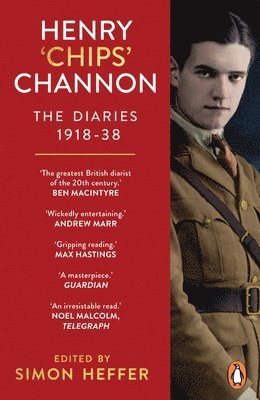
The Sunday Times bestselling edition of Chips Channon's remarkable diaries.'The greatest British diarist of the 20th century. An astonishing achievement. By turns frivolous and profound.' Ben Macintyre, The Times'Wickedly entertaining. Genuinely shocking, and still revelatory.' Andrew Marr, New Statesman'An irresistible, saucy read . . . One of the most impressive editions of our time.' The Telegraph'They're among the most glittering and enjoyable diaries ever written' Observer____________________________________Born in Chicago in 1897, 'Chips' Channon settled in England after the Great War, married into the immensely wealthy Guinness family, and served as Conservative MP for Southend-on-Sea from 1935 until his death in 1958. His career was unremarkable. His diaries are quite the opposite.Elegant, gossipy and bitchy by turns, they are the unfettered observations of a man who went everywhere and who knew everybody. Whether describing the antics of London society in the interwar years, or the growing scandal surrounding his close friends Edward VIII and Wallis Simpson during the abdication crisis, or the mood in the House of Commons in the lead up to the Munich crisis, his sense of drama and his eye for the telling detail are unmatched. These are diaries that bring a whole epoch vividly to life.________________________________'Fascinating and sometimes a key historical record. And the man could write.' Daily Mirror'Fascinating stuff.' The Spectator'Gripping reading.' The Sunday Times'Chips perfectly embodied the qualities vital to the task: a capacious ear for gossip, a neat turn of phrase, a waspish desire to tell all, and easy access to the highest social circles across Europe.' Jesse Norman, Financial Times'A masterpiece of storytelling and character assassination.' Guardian
248 kr
Skickas inom 3-6 vardagar
183 kr
Skickas
_______________________________'A brilliant history: The first serious and really wide-ranging history of the Home Front during the Great War for decades. Scholarly, objective and extremely well-written. Filled with surprising revelations and empathy. Heffer’s eye for the telling detail is evident on almost every page. A remarkable intellectual and literary achievement.' – ANDREW ROBERTS, TELEGRAPH_______________________________A major new work of history on the profound changes in British society during the First World WarThe Great War saw millions of men volunteer for or be recruited into the Army, their lives either cut short or overturned. Women were bereaved, enlisted to work in agriculture, government and engineering, yet still expected to hold together homes and families. But while the conflict caused social, economic and political devastation, it also provoked revolutionary change on the home front.Simon Heffer uses vivid portraits to present a nuanced picture of a pivotal era. While the Great War caused loss on an appalling scale, it also advanced the emancipation of women, brought notions of better health care and education, and pointed the way to a less deferential, more democratic future._____________________________'Staring at God is a vast compendium of atrocious political conduct. Refreshing. A trenchant history.' – GERARD DE GROOT, THE TIMES'A magisterial history' – MELANIE MCDONAGH, DAILY MAIL‘Gloriously rich and spirited […] it zips along, leavened by so many wonderful cultural and social details.’ – DOMINIC SOUTHBROOK, SUNDAY TIMES‘Ambitious in its scope, content and approach. Masterly.’ – CHARLES VYVYAN, STANDPOINT‘Fascinating stuff.’ – SPECTATOR‘Possibly the finest, most comprehensive analysis of the home front in the Great War ever produced.’ – LITERARY REVIEW‘Every bit as good as its two predecessors. Illuminating.’ – EXPRESS‘Absorbing’ – NEW STATESMAN
130 kr
Skickas
The English language has evolved throughout its history, and usually for good reasons. However, in recent years, egged on by social media and the ubiquity and velocity of the internet, it has been subject to some grave assaults. There appear no longer to be any rules, in an era when, thanks to the web (another word to have changed its meaning) everyone can be a published author, completely unedited and unregulated. This often has dire consequences for the English tongue.Simon Heffer's A to Z runs though a whole litany of common confusions ('flaunt' and 'flout', 'imply' and 'infer', 'uninterested' and 'disinterested'), unidiomatic English ('fed up of', 'focus around', the use of 'impacted' in such construction as 'the loss impacted him badly'), and lazy expressions (these days every extended activity is an '-athon', every scandal is a 'Something-gate'). It bemoans some truly awful neologisms, 'infotainment' and 'funwashing' among them. And it registers the horror of those of us who do not believe that you can answer the question 'How are you?' with the words 'I'm good'.Trenchant and sprinkled with dry wit, Scarcely English is both a chamber of horrors of bad and lazy English and a plea for accuracy, clear thinking and elegance.
214 kr
Skickas
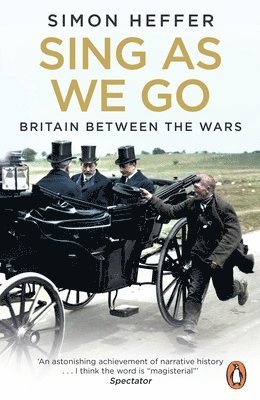
‘An epic new history . . . a work of epic scholarship, breathtaking range, and piercing originality’ Daily Express‘An astonishing achievement of narrative history . . . I think the word is "magisterial".’ Spectator‘Excellent, thorough, detailed and combatively argued.’ Sunday Times______________________________________Sing As We Go is an astonishingly ambitious overview of the political, social and cultural history of the country from 1919 to 1939.It explores and explains the politics of the period, and puts such moments of national turmoil as the General Strike of 1926 and the Abdication Crisis of 1936 under the microscope. It offers pen portraits of the era's most significant figures. It traces the changing face of Britain as cars made their first mass appearance, the suburbs sprawled, and radio and cinema became the means of mass entertainment. And it probes the deep divisions that split the nation: between the haves and have-nots, between warring ideological factions, and between those who promoted accommodation with fascism in Europe and those who bitterly opposed it.__________________________________________'Magisterial . . . an extraordinary achievement.’ Literary Review‘A masterful portrayal of political, social and cultural upheaval between the wars.’ Daily Mail
181 kr
Skickas
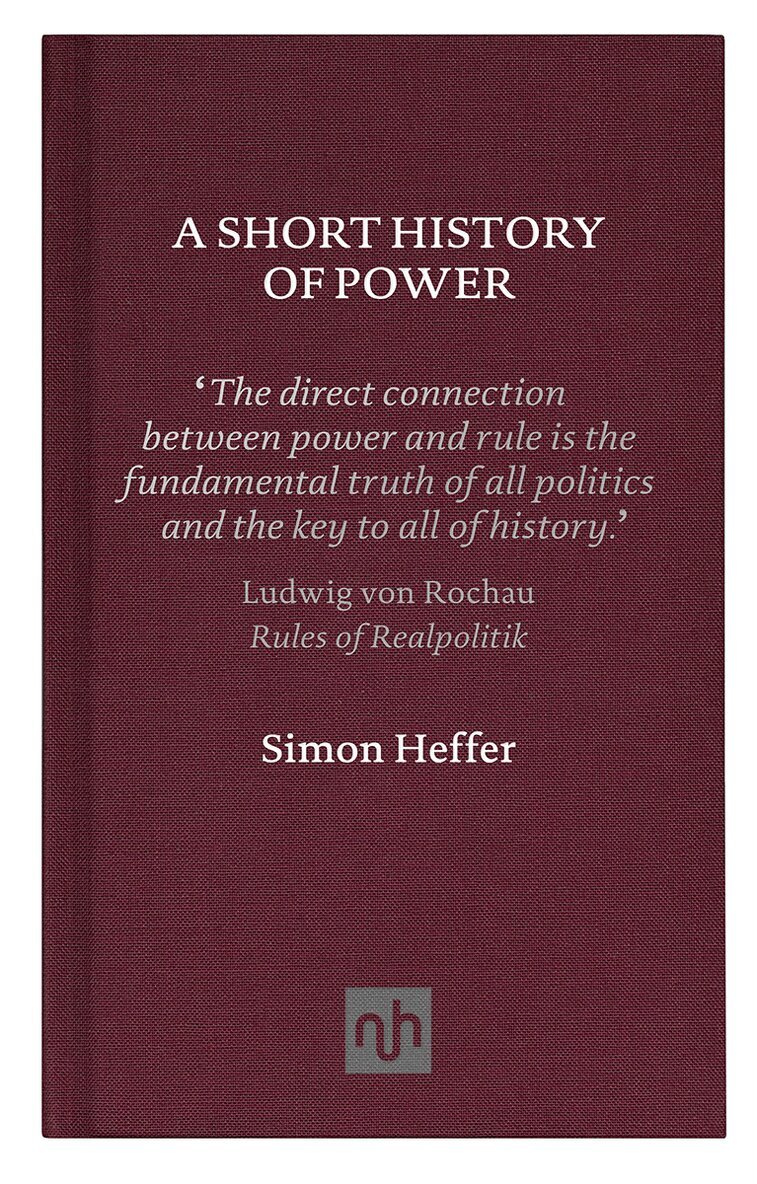
From Macaulay in the 19th century to Fukuyama in the late 20th, historians have often been lulled into thinking that things can only get better. Such belief in progress, argues leading political commentator Simon Heffer, may be typical of times of plenty, but it ignores a less palatable truth: that, since the beginnings of recorded history, the major events in international relations can be attributed to a single cause, the desire by rulers to assert or protect their power.