Simon Penny – författare
Visar alla böcker från författaren Simon Penny. Handla med fri frakt och snabb leverans.
5 produkter
5 produkter
Häftad, Engelska, 1995
435 kr
Skickas inom 5-8 vardagar
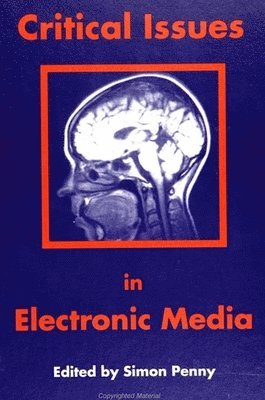
Offers new critical perspectives on the practice of electronic media art, a field that has sparse critical and theoretical literature. It addresses the relationship between technological change and cultural change and between contemporary theory and contemporary technology.Critical Issues in Electronic Media is an interdisciplinary sourcebook that offers new critical perspectives directly related to, or arising from, the practice of electronic media art. It sketches the changing topology of culture as it enters electronic space and specifically addresses questions of art practice in that space. Some of the contributions focus on the dynamics of specific emerging media such as interactive media, while others look at the cultural conditions formed by, and forming around, new technological complexes. Still others examine contemporary technocultural manifestations against a background of social and technological history.The contributors are professionally and geographically diverse, representing professional fields such as computer graphics, video, sound, drama, and visual arts as well as media, cultural and literary theory, and the social sciences. Together, these essays provide a rich survey of contemporary technological critique and offer a perspective on creative practice in technological media.
Häftad, Engelska, 2026
708 kr
Kommande
This book challenges the conventional binary skill vs intelligence and seeks to revalue skill as part of cognition. It seeks an explanation of skill that is experientially, philosophically, and scientifically satisfactory, arguing that skill is a form of intelligence rooted in embodied, sensorimotor experience rather than abstract mental processes. Questioning the basic tenets of the Western Enlightenment world view, it is stubbornly interdisciplinary, drawing upon philosophy, psychology, anthropology, cognitive science, and neuroscience among other fields.The book begins with a philosophical historiography revealing the culturally contingent and historically constructed nature of conventional philosophical ideas of skill - Cartesian dualism, notions of mind, consciousness, cognition, and mental capacities. It then uses contemporary neuroscience and cognitive anthropology to develop an alternative: a holistic, non-dualist understanding of cognition that places skilled bodily practice at its center. Armed with this theorisation of skill, an exploration of artisanal and other skilled practice is pursued, drawing upon situated, distributed, embodied and enactive approaches to cognition which focus on the role of tools, structured spaces and cognitive ecologies. This leads into a discussion of pedagogies for skilled practices and the place of skilled practices in broader pedagogical contexts. Finally, it applies this framework to digital environments and artificial intelligence, questioning dominant narratives about cognition and technology.Grounded in a lifetime of embodied practice and interdisciplinary inquiry, this work introduces the concept of neurophysiological holism and offers a new way of understanding skill. It is a must read for students and researchers from all backgrounds interested in expanding their knowledge of embodied approaches to cognition.
Inbunden, Engelska, 2026
2 225 kr
Kommande
This book challenges the conventional binary skill vs intelligence and seeks to revalue skill as part of cognition. It seeks an explanation of skill that is experientially, philosophically, and scientifically satisfactory, arguing that skill is a form of intelligence rooted in embodied, sensorimotor experience rather than abstract mental processes. Questioning the basic tenets of the Western Enlightenment world view, it is stubbornly interdisciplinary, drawing upon philosophy, psychology, anthropology, cognitive science, and neuroscience among other fields.The book begins with a philosophical historiography revealing the culturally contingent and historically constructed nature of conventional philosophical ideas of skill - Cartesian dualism, notions of mind, consciousness, cognition, and mental capacities. It then uses contemporary neuroscience and cognitive anthropology to develop an alternative: a holistic, non-dualist understanding of cognition that places skilled bodily practice at its center. Armed with this theorisation of skill, an exploration of artisanal and other skilled practice is pursued, drawing upon situated, distributed, embodied and enactive approaches to cognition which focus on the role of tools, structured spaces and cognitive ecologies. This leads into a discussion of pedagogies for skilled practices and the place of skilled practices in broader pedagogical contexts. Finally, it applies this framework to digital environments and artificial intelligence, questioning dominant narratives about cognition and technology.Grounded in a lifetime of embodied practice and interdisciplinary inquiry, this work introduces the concept of neurophysiological holism and offers a new way of understanding skill. It is a must read for students and researchers from all backgrounds interested in expanding their knowledge of embodied approaches to cognition.
Inbunden, Engelska, 2017
338 kr
Tillfälligt slut
Häftad, Engelska, 2019
338 kr
Tillfälligt slut