So-Jeong Park – författare
Visar alla böcker från författaren So-Jeong Park. Handla med fri frakt och snabb leverans.
3 produkter
3 produkter
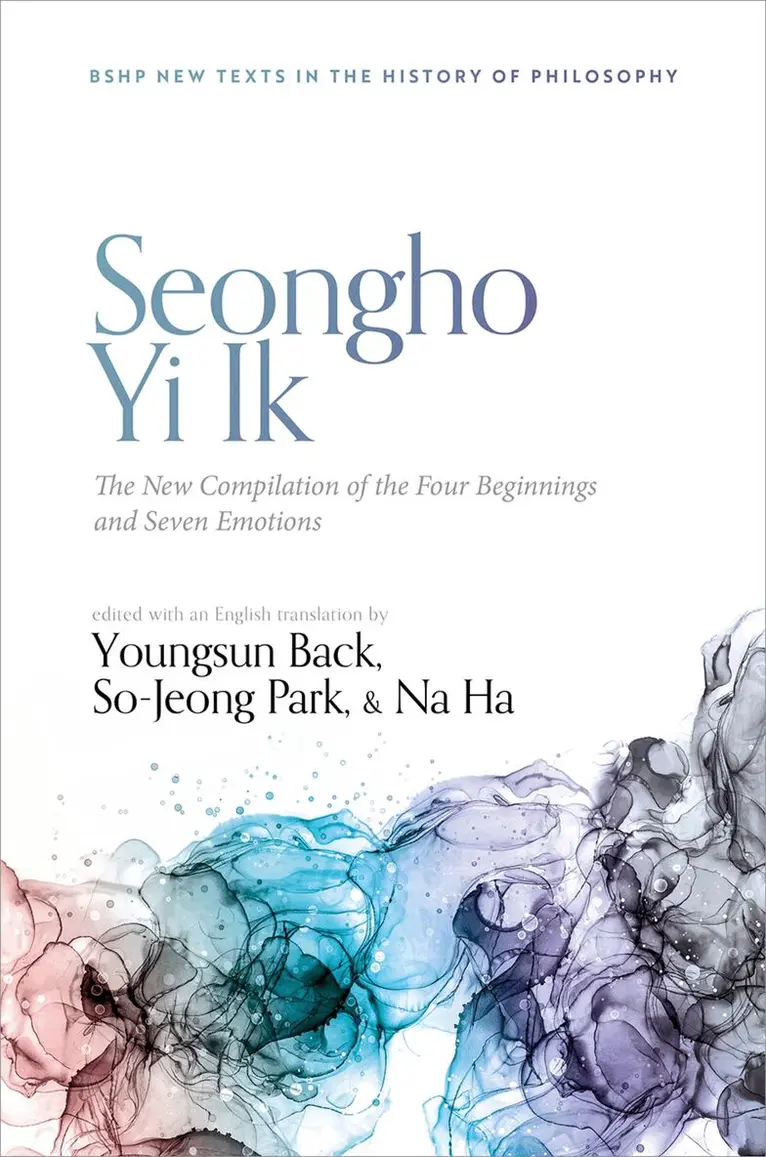
Seongho Yi Ik: The New Compilation of the Four Beginnings and Seven Emotions
Inbunden, Engelska, 2026
1 099 kr
Kommande
Seongho Yi Ik: The New Compilation of the Four Beginnings and Seven Emotions is the first complete English translation of Sachil sinpyeon, a seminal work by the eighteenth-century Korean philosopher Seongho Yi Ik (1681–1763). This influential text offers a rich reinterpretation of the longstanding Four-Seven Debate—the philosophical discourse on the relationship between moral emotions (the Four Beginnings) and personal emotions (the Seven Emotions). Comprising a preface, sixteen main essays, and six supplementary essays, Seongho's New Compilation presents clear definitions, compelling arguments, conceptual innovations, vivid analogies, and original diagrams that illuminate the intricacies of Confucian moral psychology. This work offers enduring insights into the nature of human emotions and practical guidance for moral cultivation. In addition to a carefully annotated translation, this volume includes a comprehensive introduction and interpretive essay that clarify his typology of emotions and his reimagining of core Confucian concepts. Designed to support both specialist and general readers, it fills a crucial gap in English-language scholarship on Korean Confucianism and serves as an ideal gateway to Seongho's broader philosophical thought. With its interdisciplinary significance, this work will appeal to scholars of East Asian philosophy, moral psychology, virtue ethics, and comparative philosophy. Anyone interested in the ethics of emotion and the cultivation of moral character will find in this volume a powerful account of emotional life—one that resonates across cultures and centuries with the moral challenges we continue to face today.
1 434 kr
Kommande
This open access book is an essential companion for anyone looking to understand Korean philosophy from a Korean perspective.So Jeong Park begins by tracing the formation of the cultural identity called Korea across history. She covers how oral and literary language became the core element of this identity, explaining how religions introduced from outside transformed into something Korean and strengthened internal solidarity. By highlighting the fusion of multiple identities, we see the impact Indian and Chinese traditions had upon Korea through the arrival of Buddhism and Confucianism. We travel through issues of human morality, the relationship between everyday feelings and moral emotions, the distinction between sages and ordinary people, the species differences between humans and animals, and human nature in the state with no interference. Park explores “becoming a good person", a core goal that runs through Korean philosophy, and the concepts central to contemporary Korean aesthetic thought including “Uri,” “Maum” and “Heung”.By fleshing out the uniqueness of “Korean” ways of thinking, this is the first book to answer the question of what is Korean in Korean philosophy. It is a rare analysis of Korean philosophical thinking that reveals how it permeates and shapes the language and culture. Here is a chance to delve into, encounter, and explore the intricacies associated with this powerful living tradition.The ebook editions of this book are available open access under a CC BY-NC-ND 4.0 licence on bloomsburycollections.com. Open access was funded by the Center of K-Academic Expansion Project at Sungkyunkwan University, South Korea.
445 kr
Kommande
This open access book is an essential companion for anyone looking to understand Korean philosophy from a Korean perspective.So Jeong Park begins by tracing the formation of the cultural identity called Korea across history. She covers how oral and literary language became the core element of this identity, explaining how religions introduced from outside transformed into something Korean and strengthened internal solidarity. By highlighting the fusion of multiple identities, we see the impact Indian and Chinese traditions had upon Korea through the arrival of Buddhism and Confucianism. We travel through issues of human morality, the relationship between everyday feelings and moral emotions, the distinction between sages and ordinary people, the species differences between humans and animals, and human nature in the state with no interference. Park explores “becoming a good person", a core goal that runs through Korean philosophy, and the concepts central to contemporary Korean aesthetic thought including “Uri,” “Maum” and “Heung”.By fleshing out the uniqueness of “Korean” ways of thinking, this is the first book to answer the question of what is Korean in Korean philosophy. It is a rare analysis of Korean philosophical thinking that reveals how it permeates and shapes the language and culture. Here is a chance to delve into, encounter, and explore the intricacies associated with this powerful living tradition.The ebook editions of this book are available open access under a CC BY-NC-ND 4.0 licence on bloomsburycollections.com. Open access was funded by the Center of K-Academic Expansion Project at Sungkyunkwan University, South Korea.