Sophia Braun – författare
Visar alla böcker från författaren Sophia Braun. Handla med fri frakt och snabb leverans.
5 produkter
5 produkter
Del 91 - Zivilrechtliche Schriften
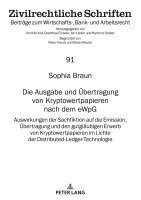
Ausgabe und Uebertragung von Kryptowertpapieren nach dem eWpG
Auswirkungen der Sachfiktion auf die Emission, Uebertragung und den gutglaeubigen Erwerb von Kryptowertpapieren im Lichte der Distributed-Ledger-Technologie
Inbunden, Tyska, 2026
530 kr
Skickas inom 5-8 vardagar
E-bok
PDF, Engelska, 2012171 kr
Läs direkt efter köp
Essay from the year 2012 in the subject Politics - Topic: European Union, grade: 68%, Dublin City University, course: Introduction to Modern Ireland, language: English, abstract: Especially in the late 20th century, Ireland has undergone substantial changes in its economy, politics (including education), and society, which can be described as an overall modernisation. An important aspect in analysing this process is to examine how big the influence of the European Union, which Ireland joined in 19731 after its first application in 19612, was and is. Is European integration a key aspect of Ireland s rise to prosperity, or did national policy making play the main role? How important is the EU to Ireland s development nowadays and what is to be expected in the future?
Häftad, Tyska, 2014
394 kr
Skickas inom 3-6 vardagar
Häftad, Tyska, 2015
378 kr
Skickas inom 3-6 vardagar
E-bok
PDF, Engelska, 2018177 kr
Läs direkt efter köp
Scientific Essay from the year 2018 in the subject Politics - Environmental Policy, grade: 1,3, The University of Sydney (Government and International Relations), course: Global Environmental Politics, language: English, abstract: This essay seeks to describe, analyze and evaluate Germany's climate policy in order to argue that it is effective and progressive on a global scale, but also subject to trade-offs as Germany is a highly industrialized economy. Germany is chosen as it is an especially interesting case in the apparent conflict of environmentalism and economic growth. The essay firstly outlines a literature review. An overview of the state of climate policy in Germany is given, major current policies are explained, and (geo)political, economic and cultural factors that influence climate policy are described. Within the literature review, the researcher decides to focus on policies related to renewable energies, energy efficiency, information campaigns and innovation. Germany's membership in the European Union (EU) was identified as major geopolitical influence, local governance structures and the German green party as influencing political factors, and the fossil fuels, automotive, machinery and equipment as well as the cattle farming industries as influencing economic factors. In the absence of a proper research body on the relationship of German culture and its climate policy, cultural factors were deducted from the aforementioned sub-sections. Subsequently, the essay attempts to answer the question why Germany's climate policy is designed the way it is and evaluates its performance. Finally, a conclusion is drawn. The researcher finds that Germany s climate policy is indeed successful, however especially the fossil fuel, automotive and cattle farming industries have substantial influence. These sectors are still subsidized and not directly tackled in the interest of climate policy, even though their contributions to greenhouse gas emission are substantial.