Stefaan Walgrave – författare
Visar alla böcker från författaren Stefaan Walgrave. Handla med fri frakt och snabb leverans.
8 produkter
8 produkter
E-bok
PDF, Engelska, 20221 117 kr
Läs direkt efter köp
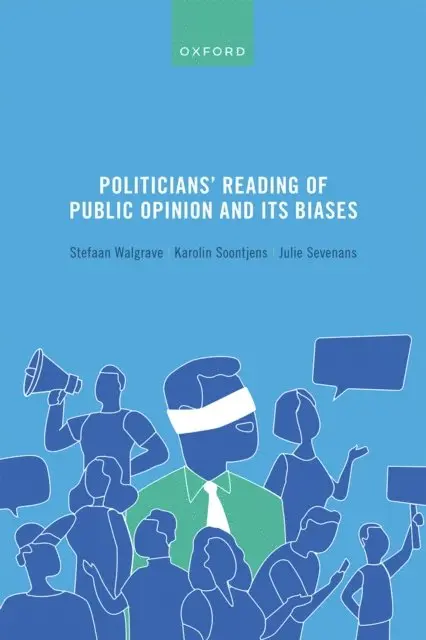
Examining a central assumption widely accepted as being crucial in making democracy work - that politicians form a more or less accurate image of public opinion and take that perception into account when representing citizens - Politicians'' Reading of Public Opinion and its Biases presents a paradox of representation. On the one hand, politicians invest enormously in reading public opinion. They are committed to finding out what the people want and public opinion is a key consideration in many of their undertakings. Yet, on the other hand, politicians'' perceptions of public opinion are surprisingly inaccurate. Politicians are hardly better at estimating public opinion than ordinary citizens are. Their perceptions are distorted by social projection, in the sense that politicians'' own opinion affects their estimations, and on top of that, there seems to be a systematic right-wing bias in these perceptions. The findings imply that one of the main paths to responsive policy-making is flawed. Even though politicians do the best they can to learn about people''s preferences, skewed perceptions put them on the wrong track. From a democratic perspective, the central findings of the book are quite sobering. The high hopes that many authors had with regard to politicians'' ability to adequately ''consult'' or ''sense'' public opinion appear to be vain. The book puts forward a plausible driver of the slippage between the public and politics. Politicians are less responsive to people''s preferences than they could be, not because they do not want to be responsive but because they base themselves on erroneous public opinion perceptions.
E-bok
Engelska, 20221 157 kr
Läs direkt efter köp
Examining a central assumption widely accepted as being crucial in making democracy work - that politicians form a more or less accurate image of public opinion and take that perception into account when representing citizens - Politicians'' Reading of Public Opinion and its Biases presents a paradox of representation. On the one hand, politicians invest enormously in reading public opinion. They are committed to finding out what the people want and public opinion is a key consideration in many of their undertakings. Yet, on the other hand, politicians'' perceptions of public opinion are surprisingly inaccurate. Politicians are hardly better at estimating public opinion than ordinary citizens are. Their perceptions are distorted by social projection, in the sense that politicians'' own opinion affects their estimations, and on top of that, there seems to be a systematic right-wing bias in these perceptions. The findings imply that one of the main paths to responsive policy-making is flawed. Even though politicians do the best they can to learn about people''s preferences, skewed perceptions put them on the wrong track. From a democratic perspective, the central findings of the book are quite sobering. The high hopes that many authors had with regard to politicians'' ability to adequately ''consult'' or ''sense'' public opinion appear to be vain. The book puts forward a plausible driver of the slippage between the public and politics. Politicians are less responsive to people''s preferences than they could be, not because they do not want to be responsive but because they base themselves on erroneous public opinion perceptions.
Inbunden, Engelska, 2022
1 295 kr
Skickas inom 5-8 vardagar
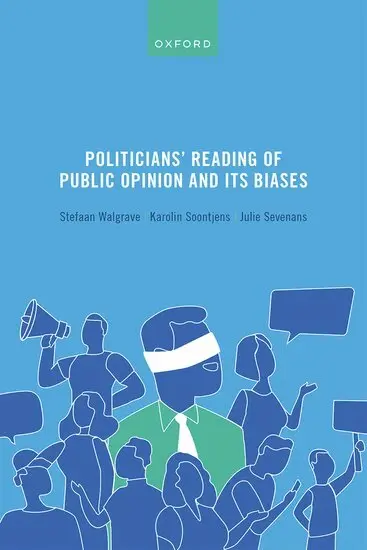
Examining a central assumption widely accepted as being crucial in making democracy work - that politicians form a more or less accurate image of public opinion and take that perception into account when representing citizens - Politicians' Reading of Public Opinion and its Biases presents a paradox of representation. On the one hand, politicians invest enormously in reading public opinion. They are committed to finding out what the people want and public opinion is a key consideration in many of their undertakings. Yet, on the other hand, politicians' perceptions of public opinion are surprisingly inaccurate. Politicians are hardly better at estimating public opinion than ordinary citizens are. Their perceptions are distorted by social projection, in the sense that politicians' own opinion affects their estimations, and on top of that, there seems to be a systematic right-wing bias in these perceptions. The findings imply that one of the main paths to responsive policy-making is flawed. Even though politicians do the best they can to learn about people's preferences, skewed perceptions put them on the wrong track. From a democratic perspective, the central findings of the book are quite sobering. The high hopes that many authors had with regard to politicians' ability to adequately 'consult' or 'sense' public opinion appear to be vain. The book puts forward a plausible driver of the slippage between the public and politics. Politicians are less responsive to people's preferences than they could be, not because they do not want to be responsive but because they base themselves on erroneous public opinion perceptions.
Häftad, Engelska, 2014
257 kr
Skickas inom 5-8 vardagar
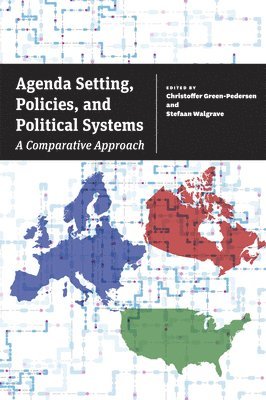
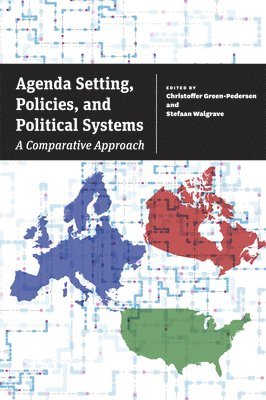
Before making significant policy decisions, political actors and parties must first craft an agenda designed to place certain issues at the center of political attention. The agenda-setting approach in political science holds that the amount of attention devoted by the various actors within a political system to issues like immigration, health care, and the economy can inform our understanding of its basic patterns and processes. While there has been considerable attention to how political systems process issues in the United States, Christoffer Green-Pedersen and Stefaan Walgrave demonstrate the broader applicability of this approach by extending it to other countries and their political systems. Agenda Setting, Policies, and Political Systems brings together essays on eleven countries and two broad themes. Contributors to the first section analyze the extent to which party and electoral changes and shifts in the partisan composition of government have led-or not led-to policy changes in the United States, the United Kingdom, the Netherlands, Denmark, Switzerland, and France.The second section turns the focus on changing institutional structures in Germany, Italy, Belgium, Spain, and Canada, including the German reunification and the collapse of the Italian party system. Together, the essays make clear the efficacy of the agenda-setting approach for understanding not only how policies evolve, but also how political systems function.
Häftad, Engelska, 2010
297 kr
Skickas inom 10-15 vardagar
On February 15, 2003, the largest one-day protest in human history took place as millions of people in hundreds of cities marched in the streets, rallying against the imminent invasion of Iraq. This was activism on an unprecedented scale. The World Says No to War strives to understand who spoke out, why they did, and how so many people were mobilized for a global demonstration. Using surveys collected by researchers from eight countries-Belgium, Britain, Germany, Italy, the Netherlands, Spain, Switzerland, and the United States-The World Says No to War analyzes how the new tools of the Internet were combined with more conventional means of mobilization to rally millions, many with little experience in activism, around common goals and against common targets. Contributors: W. Lance Bennett, U of Washington; Michelle Beyeler, U Bern; Christian Breunig, U of Toronto; Mario Diani, U of Trento; Terri E. Givens, U of Texas, Austin; Bert Klandermans, Free U Amsterdam; Donatella della Porta, European U Institute; Wolfgang RÜdig, U of Strathclyde; Sidney Tarrow, Cornell U; Peter Van Aelst, U of Antwerp.
Inbunden, Engelska, 2017
1 633 kr
Skickas inom 10-15 vardagar
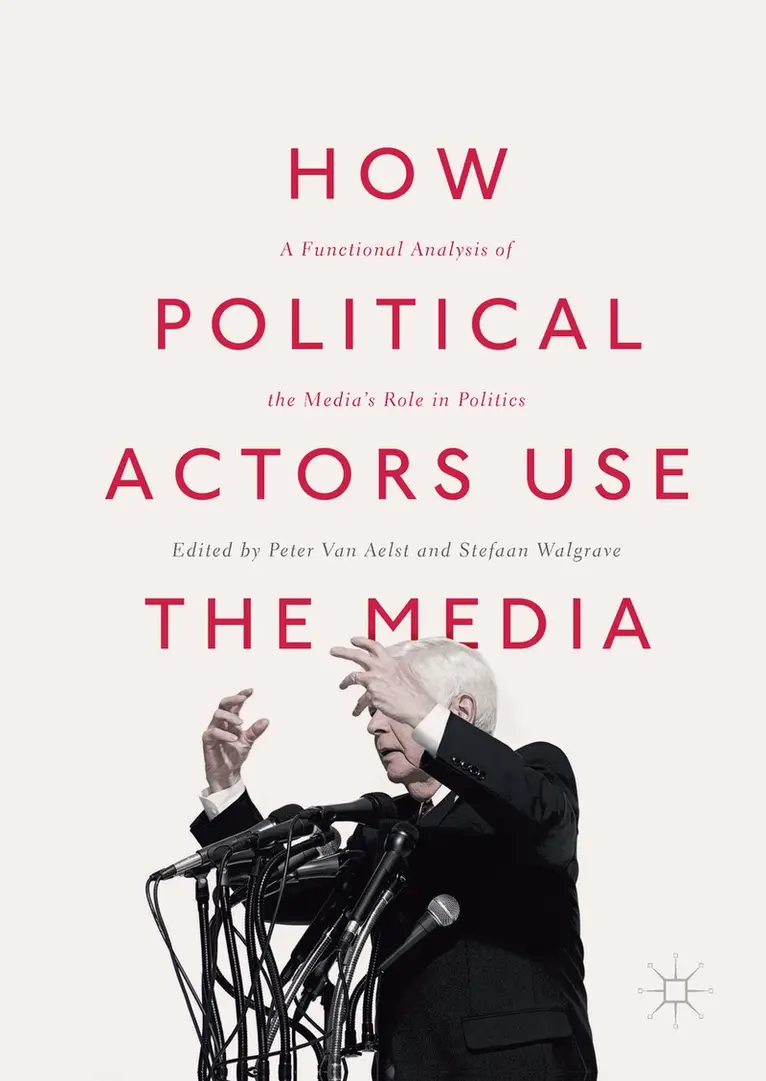
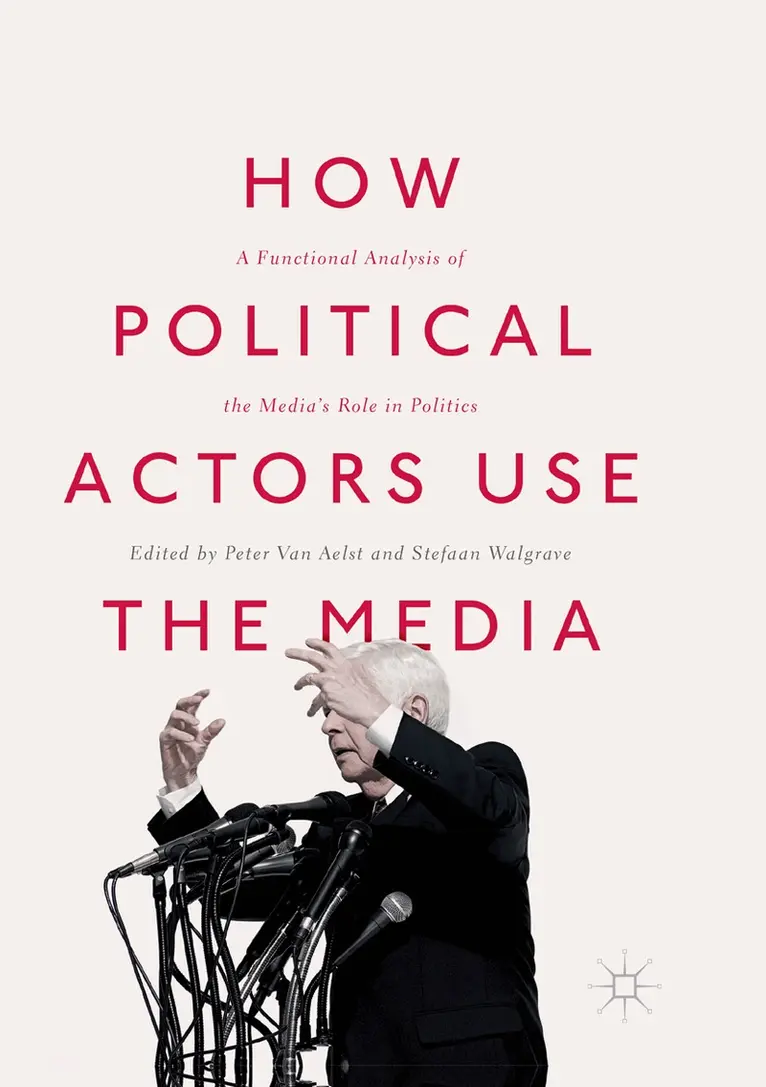
This book investigates how individual politicians and political parties strategically make use of the media to reach their political goals. Looking beyond a purely Americentric viewpoint, the chapters present data from more than ten Western democracies to argue that the media are both a source of information and an arena for political communication. This double functional role of the media is examined from both a theoretical and an empirical perspective, including chapters dealing with different aspects of politics - from campaigning to law making - and within different political contexts. The role of the news media is discussed from the perspective of the political actor, focusing on both the opportunities and the constraints the news media provide, resulting in a multidisciplinary text that will appeal to students and scholars of both communication and political science.
E-bok
Engelska, 20171 977 kr
Läs direkt efter köp
This book investigates how individual politicians and political parties strategically make use of the media to reach their political goals. Looking beyond a purely Americentric viewpoint, the chapters present data from more than ten Western democracies to argue that the media are both a source of information and an arena for political communication. This double functional role of the media is examined from both a theoretical and an empirical perspective, including chapters dealing with different aspects of politics - from campaigning to law making - and within different political contexts. The role of the news media is discussed from the perspective of the political actor, focusing on both the opportunities and the constraints the news media provide, resulting in a multidisciplinary text that will appeal to students and scholars of both communication and political science.
Häftad, Engelska, 2018
1 633 kr
Skickas inom 10-15 vardagar
This book investigates how individual politicians and political parties strategically make use of the media to reach their political goals. Looking beyond a purely Americentric viewpoint, the chapters present data from more than ten Western democracies to argue that the media are both a source of information and an arena for political communication. This double functional role of the media is examined from both a theoretical and an empirical perspective, including chapters dealing with different aspects of politics - from campaigning to law making - and within different political contexts. The role of the news media is discussed from the perspective of the political actor, focusing on both the opportunities and the constraints the news media provide, resulting in a multidisciplinary text that will appeal to students and scholars of both communication and political science.