Stefan Leue - Böcker
Visar alla böcker från författaren Stefan Leue. Handla med fri frakt och snabb leverans.
4 produkter
4 produkter
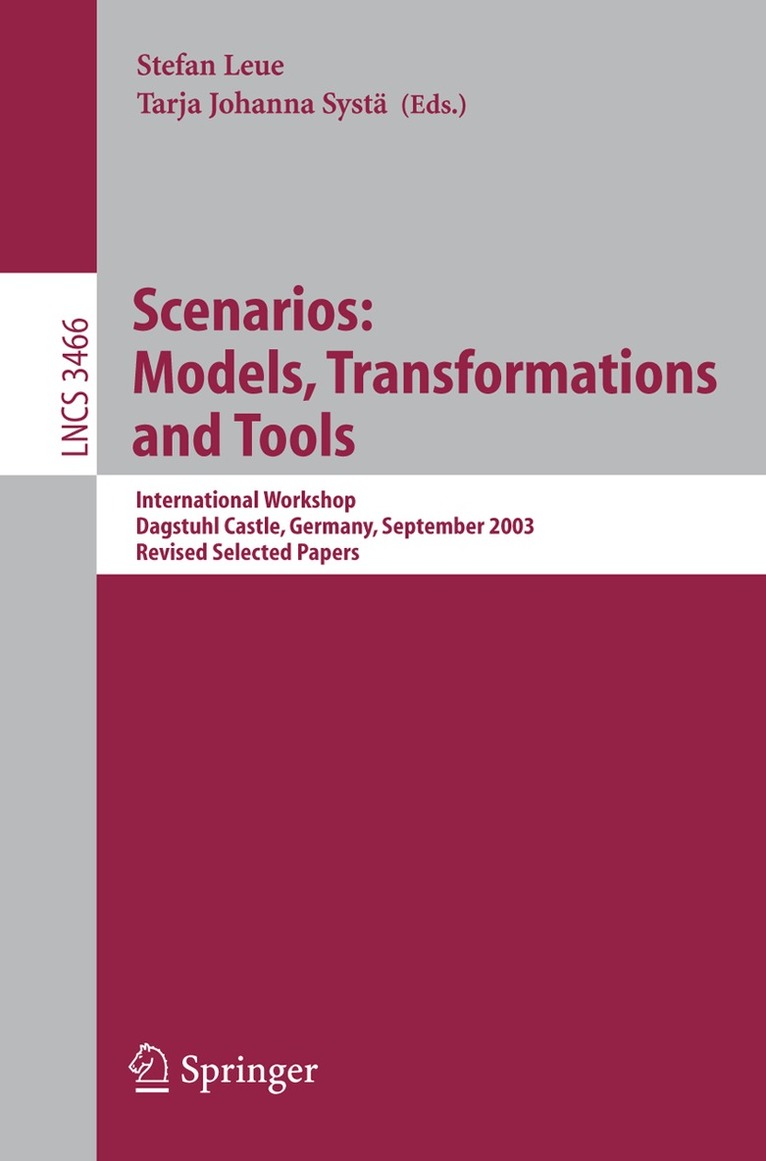
Scenarios: Models, Transformations and Tools
International Workshop, Dagstuhl Castle, Germany, September 7-12, 2003, Revised Selected Papers
Häftad, Engelska, 2005
552 kr
Skickas inom 10-15 vardagar
Visual notations and languages continue to play a pivotal role ˆ in the design of complex software systems. In many cases visual notations are used to - scribe usage or interaction scenarios of software systems or their components. While representing scenarios using a visual notation is not the only possibility, a vast majority of scenario description languages is visual. Scenarios are used in telecommunications as Message Sequence Charts, in object-oriented system design as Sequence Diagrams, in reverse engineering as execution traces, and in requirements engineering as, for example, Use Case Maps or Life Sequence Charts. These techniques are used to capture requirements, to capture use cases in system documentation, to specify test cases, or to visualize runs of existing systems. They are often employed to represent concurrent systems that int- act via message passing or method invocation. In telecommunications, for more than 15 years the International Telecommunication Union has standardized the Message Sequence Charts (MSCs) notation in its recommendation Z. 120. More recently, with the emergence of UML as a predominant software design meth- ology, there has been special interest in the development of the sequence d- gram notation. As a result, the most recent version, 2. 0, of UML encompasses the Message Sequence Chart notation, including its hierarchical modeling f- tures. Other scenario-?avored diagrams in UML 2. 0 include activity diagrams and timing diagrams.
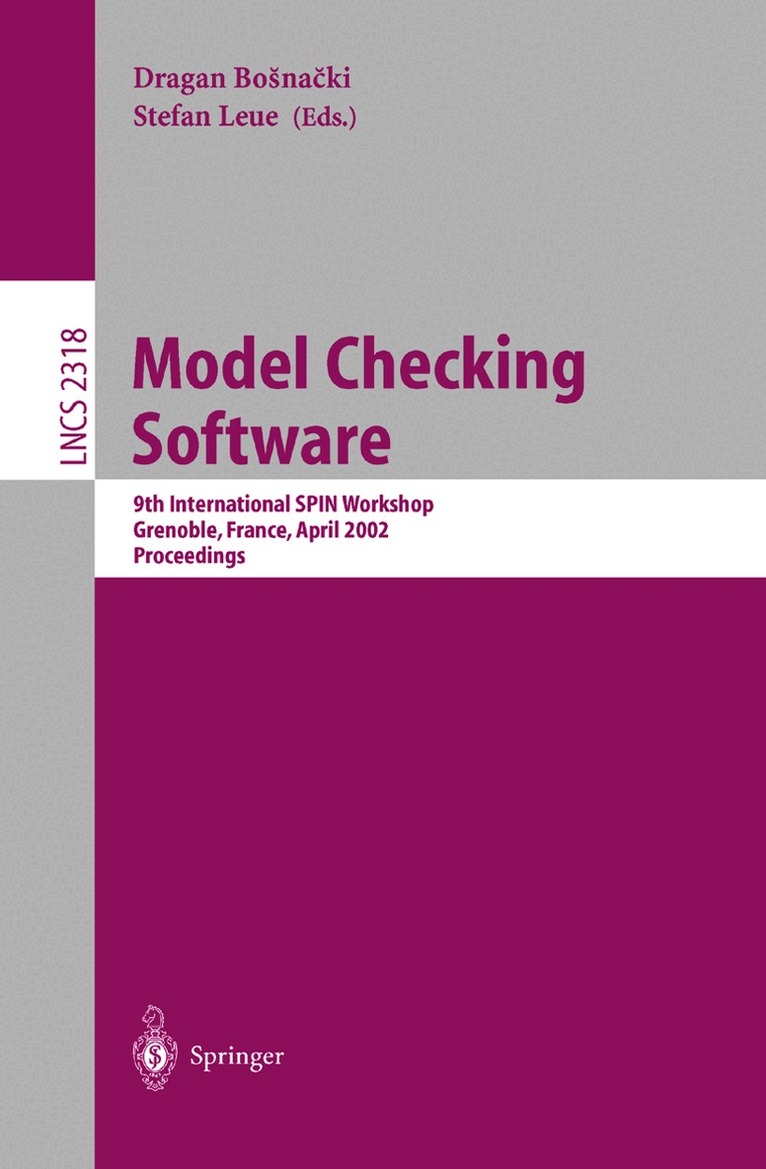
Model Checking Software
9th International SPIN Workshop Grenoble, France, April 11-13, 2002 Proceedings
Häftad, Engelska, 2002
552 kr
Skickas inom 10-15 vardagar
This book constitutes the refereed proceedings of the 9th International SPIN Workshop on Model Checking Software, held in Grenoble, France in April 2002 as a satellite event of ETAPS 2002. The 10 revised full research papers presented together with the abstracts of four invited papers or tutorials, three reports on work in progress, three invited industrial presentations, and four SPIN model checking tool descriptions were carefully reviewed and selected from 20 submissions. The book presents state-of-the-art results on the analysis and verifications of distributed and concurrent systems using the SPIN model checker as one of the most powerful and popular such system.
Theoretical and Practical Aspects of SPIN Model Checking
5th and 6th International SPIN Workshops, Trento, Italy, July 5, 1999, Toulouse, France, September 21 and 24, 1999, Proceedings
Häftad, Engelska, 1999
552 kr
Skickas inom 10-15 vardagar
This book constitutes the refereed proceedings of the 5th and 6th international SPIN workshops on SPIN Model Checking, held as a satellite workshop of the Federated Logics Conference, FLoC'99, in Trento, Italy, July 1999, and as a user group meeting at the Formal Methods World Congress, FM'99, in Toulouse, France, in September 1999 respectively.Finite-state model checking, as it is supported by the explicit-state model checker SPIN, is enjoying constantly increasing popularity in automated property validation of concurrent, message based systems. This book presents up-to-date research results centered around SPIN as well as valuable surveys and summaries of application experience.
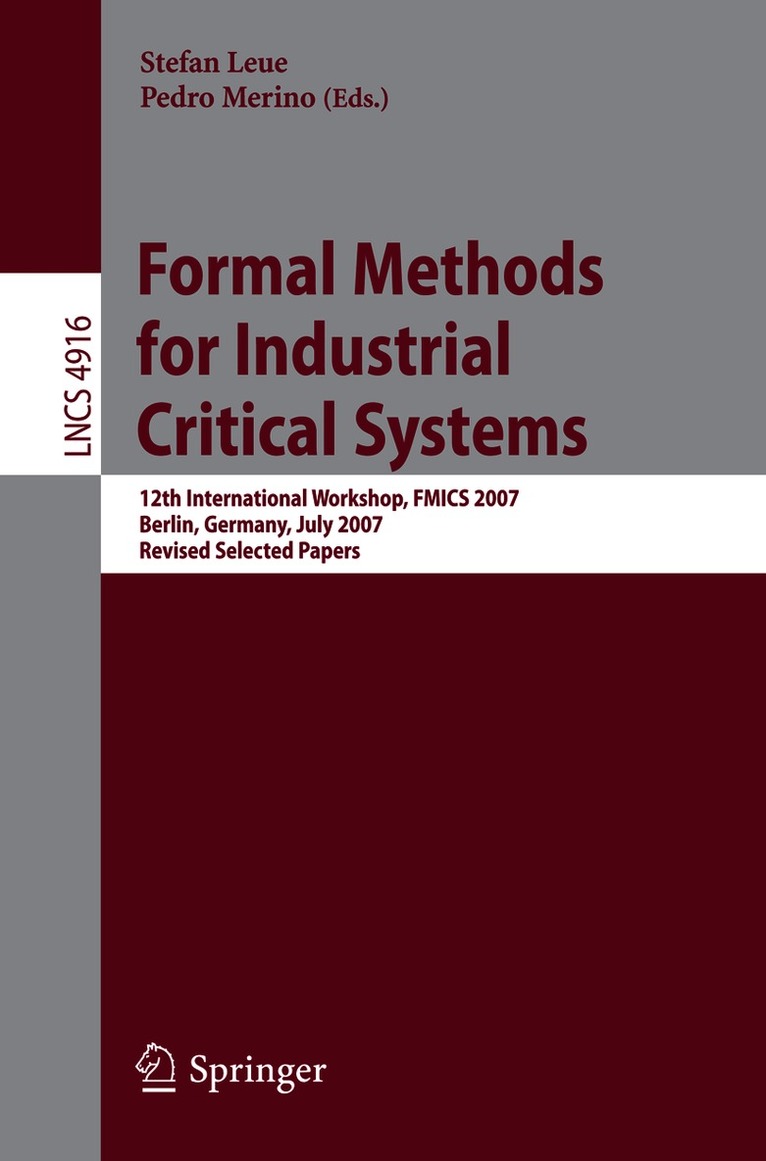
Formal Methods for Industrial Critical Systems
12th International Workshop, FMICS 2007, Berlin, Germany, July 1-2, 2007, Revised Selected Papers
Häftad, Engelska, 2008
552 kr
Skickas inom 10-15 vardagar
This book constitutes the thoroughly refereed post-workshop proceedings of the 12th International Workshop on Formal Methods for Industrial Critical Systems, FMICS 2007, held in Berlin, Germany, in July 2007 - colocated with CAV 2007, the 19th International Conference on Computer Aided Verification. The 15 revised full papers presented together with the abstracts of 2 invited lectures were carefully selected during two rounds of reviewing and improvement from 31 initial submissions. The papers strive to promote research and development for the improvement of formal methods and tools for industrial applications and they are organized in topical sections on control systems, scheduling and time, verification, software, and testing.