Stefano Tinti – författare
Visar alla böcker från författaren Stefano Tinti. Handla med fri frakt och snabb leverans.
5 produkter
5 produkter
Del 1 - Advances in Natural and Technological Hazards Research
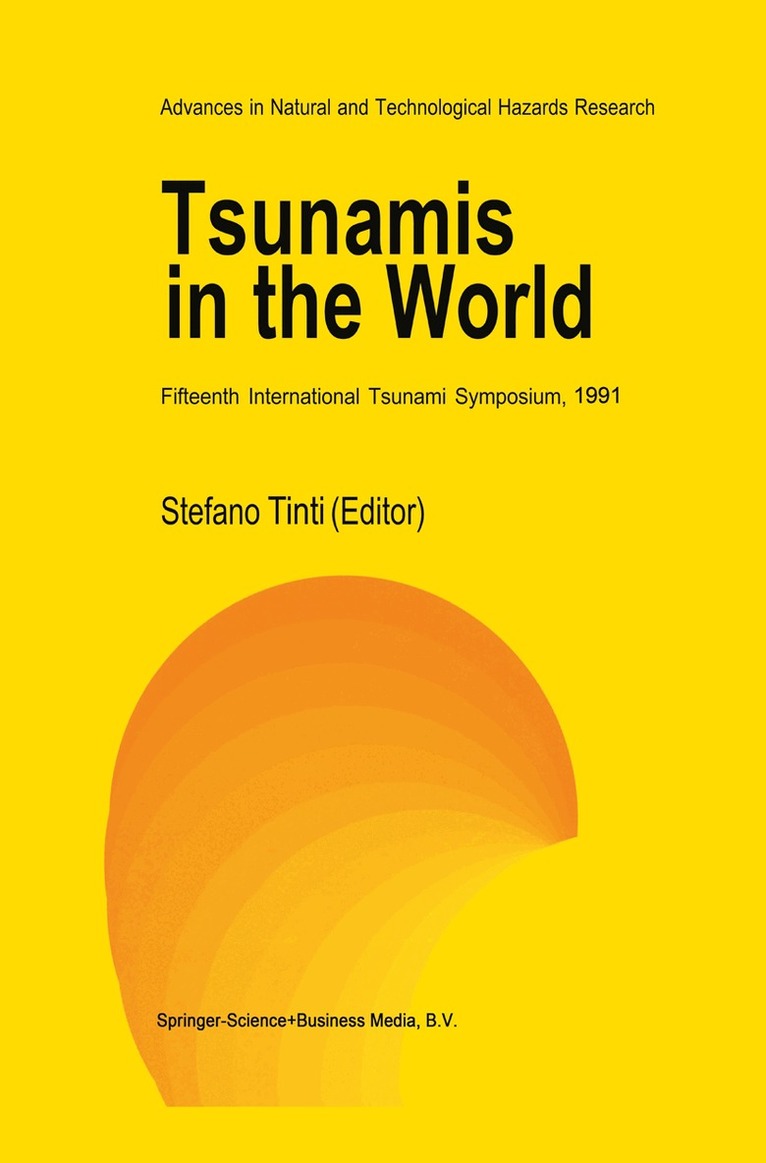
Tsunamis in the World
Fifteenth International Tsunami Symposium, 1991
Inbunden, Engelska, 1993
1 091 kr
Skickas inom 10-15 vardagar
estimate tsunami potential by computing seismic moment. This system holds promise for a new generation of local tsunami warning systems. Shuto (Japan) described his conversion of !ida's definition of tsunami magnitude to local tsunami efforts. For example, i l = 2 would equal 4 m local wave height, which would destroy wooden houses and damage most fishing boats. SimOes (Portugal) reported on a seamount-based seismic system that was located in the tsunami source area for Portugal. In summary, the risk of tsunami hazard appears to be more widespread than the Pacific Ocean Basin. It appears that underwater slumps are an important component in tsunami generation. Finally, new technologies are emerging that would be used in a new generation of tsunami warning systems. These are exciting times for tsunami researchers. OBSERVATIONS TSUNAMI DISPERSION OBSERVED IN THE DEEP OCEAN F. I. GONZALEZl and Ye. A. KULIKOV2 Ipacific Marine Environmental Laboratory, NOAA 7600 Sand Point Way, N. E. , Seattle, W A 98115 USA 2State Oceanographic Institute Kropotkinskey per. 6 Moscow 119034, Russia CIS The amplitude and frequency modulation observed in bottom pressure records of the 6 March 1988 Alaskan Bight tsunami are shown to be due to dispersion as predicted by linear wave theory. The simple wave model developed for comparison with the data is also consistent with an important qualitative feature of the sea floor displacement pattern which is predicted by a seismic fault plane deformation model, i. e. the existence of a western-subsidence/eastern-uplift dipole.
Häftad, Engelska, 2011
549 kr
Skickas inom 10-15 vardagar
The Tsunami from the 1960 Chilean earthquake affected the entire Pacific Ocean and motivated the international coordination on tsunami research and warning systems around the Pacific. However, the 2004 Indian Ocean tsunami affected the entire world, and reminded that tsunamis are not a local or regional problem but a global issue. This volume contains 18 papers, mostly presented at the 24th International Tsunami Symposium held in 14-16 July 2009. They reflect the current state of tsunami science, including case studies of earthquake-generated tsunamis, tsunami forecasting and hazard assessments, and theoretical and computational modeling of tsunami generation, propagation and coastal behavior.
Häftad, Engelska, 2012
549 kr
Skickas inom 10-15 vardagar
The tsunami from the 1960 Chilean earthquake affected the entire Pacific Ocean and motivated the international coordination of tsunami research and warning systems around the Pacific. However, the 2004 Indian Ocean tsunami affected the entire world, and reminded that tsunamis are not a local or regional problem but a global issue. This volume contains 15 papers, mostly presented at the 24th International Tsunami Symposium held on 14-16 July 2009 in Novosibirsk, Russia. They reflect the current state of tsunami science, including studies of recent tsunamis, tsunami statistics and warning, and modeling tsunami runup and inundation.
Del 1 - Advances in Natural and Technological Hazards Research
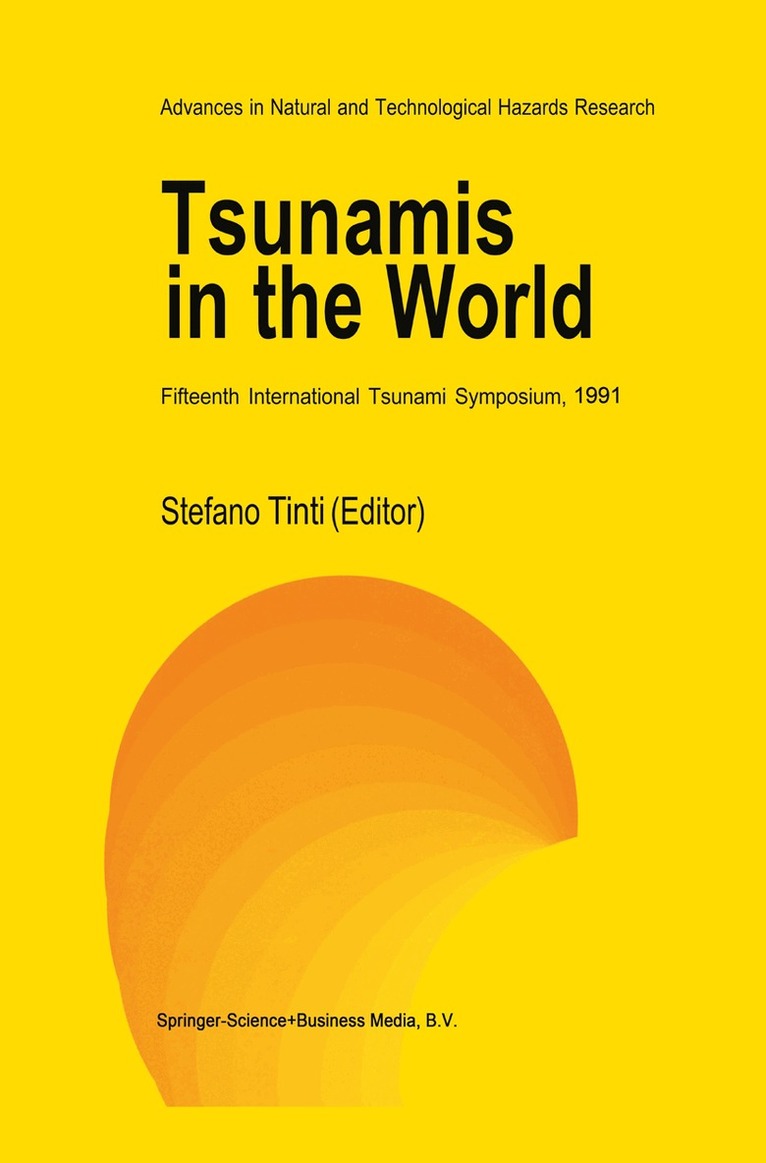
Tsunamis in the World
Fifteenth International Tsunami Symposium, 1991
Häftad, Engelska, 2010
1 091 kr
Skickas inom 10-15 vardagar
estimate tsunami potential by computing seismic moment. This system holds promise for a new generation of local tsunami warning systems. Shuto (Japan) described his conversion of !ida's definition of tsunami magnitude to local tsunami efforts. For example, i l = 2 would equal 4 m local wave height, which would destroy wooden houses and damage most fishing boats. SimOes (Portugal) reported on a seamount-based seismic system that was located in the tsunami source area for Portugal. In summary, the risk of tsunami hazard appears to be more widespread than the Pacific Ocean Basin. It appears that underwater slumps are an important component in tsunami generation. Finally, new technologies are emerging that would be used in a new generation of tsunami warning systems. These are exciting times for tsunami researchers. OBSERVATIONS TSUNAMI DISPERSION OBSERVED IN THE DEEP OCEAN F. I. GONZALEZl and Ye. A. KULIKOV2 Ipacific Marine Environmental Laboratory, NOAA 7600 Sand Point Way, N. E. , Seattle, W A 98115 USA 2State Oceanographic Institute Kropotkinskey per. 6 Moscow 119034, Russia CIS The amplitude and frequency modulation observed in bottom pressure records of the 6 March 1988 Alaskan Bight tsunami are shown to be due to dispersion as predicted by linear wave theory. The simple wave model developed for comparison with the data is also consistent with an important qualitative feature of the sea floor displacement pattern which is predicted by a seismic fault plane deformation model, i. e. the existence of a western-subsidence/eastern-uplift dipole.
E-bok
PDF, Engelska, 20131 339 kr
Läs direkt efter köp
estimate tsunami potential by computing seismic moment. This system holds promise for a new generation of local tsunami warning systems. Shuto (Japan) described his conversion of !ida''s definition of tsunami magnitude to local tsunami efforts. For example, i l = 2 would equal 4 m local wave height, which would destroy wooden houses and damage most fishing boats. SimOes (Portugal) reported on a seamount-based seismic system that was located in the tsunami source area for Portugal. In summary, the risk of tsunami hazard appears to be more widespread than the Pacific Ocean Basin. It appears that underwater slumps are an important component in tsunami generation. Finally, new technologies are emerging that would be used in a new generation of tsunami warning systems. These are exciting times for tsunami researchers. OBSERVATIONS TSUNAMI DISPERSION OBSERVED IN THE DEEP OCEAN F. I. GONZALEZl and Ye. A. KULIKOV2 Ipacific Marine Environmental Laboratory, NOAA 7600 Sand Point Way, N. E. , Seattle, W A 98115 USA 2State Oceanographic Institute Kropotkinskey per. 6 Moscow 119034, Russia CIS The amplitude and frequency modulation observed in bottom pressure records of the 6 March 1988 Alaskan Bight tsunami are shown to be due to dispersion as predicted by linear wave theory. The simple wave model developed for comparison with the data is also consistent with an important qualitative feature of the sea floor displacement pattern which is predicted by a seismic fault plane deformation model, i. e. the existence of a western-subsidence/eastern-uplift dipole.