Steven Seegel – författare
Visar alla böcker från författaren Steven Seegel. Handla med fri frakt och snabb leverans.
6 produkter
6 produkter
Inbunden, Engelska, 2018
495 kr
Skickas inom 5-8 vardagar
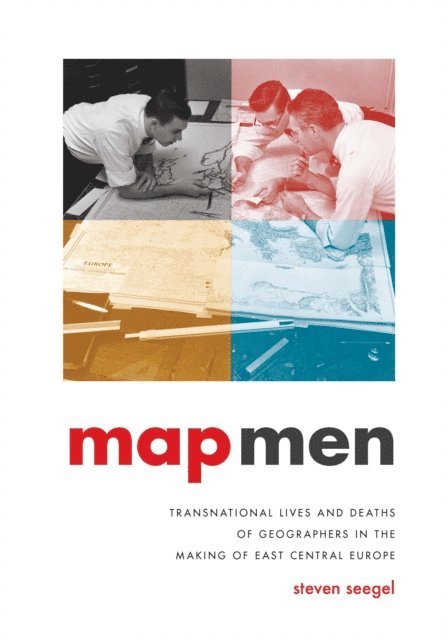
More than just colorful clickbait or pragmatic city grids, maps are often deeply emotional tales: of political projects gone wrong, budding relationships that failed, and countries that vanished. In Map Men, Steven Seegel takes us through some of these historical dramas with a detailed look at the maps that made and unmade the world of East Central Europe through a long continuum of world war and revolution. As a collective biography of five prominent geographers between 1870 and 1950--Albrecht Penck, Eugeniusz Romer, Stepan Rudnyts'kyi, Isaiah Bowman, and Count Pal Teleki--Map Men reexamines the deep emotions, textures of friendship, and multigenerational sagas behind these influential maps. Taking us deep into cartographical archives, Seegel recreates the public and private worlds of these five mapmakers, who interacted with and influenced one another even as they played key roles in defining and redefining borders, territories, nations--and, ultimately, the interconnection of the world through two World Wars. Throughout, he examines the transnational nature of these processes and addresses weighty questions about the causes and consequences of the World Wars, the rise of Nazism and Stalinism, and the reasons why East Central Europe became the fault line of these worldchanging developments. At a time when East Central Europe has surged back into geopolitical consciousness, Map Men offers a timely and important look at the historical origins of how the region was defined--and the key people who helped define it.
E-bok
Engelska, 2018998 kr
Läs direkt efter köp
More than just colorful clickbait or pragmatic city grids, maps are often deeply emotional tales: of political projects gone wrong, budding relationships that failed, and countries that vanished. In Map Men, Steven Seegel takes us through some of these historical dramas with a detailed look at the maps that made and unmade the world of East Central Europe through a long continuum of world war and revolution. As a collective biography of five prominent geographers between 1870 and 1950—Albrecht Penck, Eugeniusz Romer, Stepan Rudnyts’kyi, Isaiah Bowman, and Count Pál Teleki—Map Men reexamines the deep emotions, textures of friendship, and multigenerational sagas behind these influential maps. Taking us deep into cartographical archives, Seegel re-creates the public and private worlds of these five mapmakers, who interacted with and influenced one another even as they played key roles in defining and redefining borders, territories, nations—and, ultimately, the interconnection of the world through two world wars. Throughout, he examines the transnational nature of these processes and addresses weighty questions about the causes and consequences of the world wars, the rise of Nazism and Stalinism, and the reasons East Central Europe became the fault line of these world-changing developments. At a time when East Central Europe has surged back into geopolitical consciousness, Map Men offers a timely and important look at the historical origins of how the region was defined—and the key people who helped define it.
E-bok
PDF, Engelska, 20121 231 kr
Läs direkt efter köp
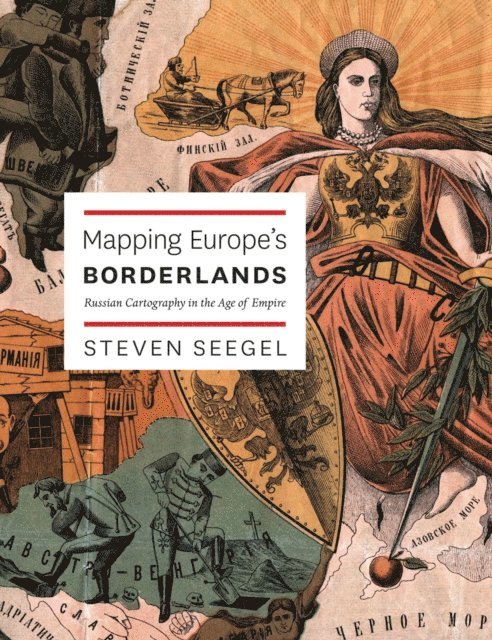
The simplest purpose of a map is a rational one: to educate, to solve a problem, to point someone in the right direction. Maps shape and communicate information, for the sake of improved orientation. But maps exist for states as well as individuals, and they need to be interpreted as expressions of power and knowledge, as Steven Seegel makes clear in his impressive and important new book. Mapping Europe’s Borderlands takes the familiar problems of state and nation building in eastern Europe and presents them through an entirely new prism, that of cartography and cartographers. Drawing from sources in eleven languages, including military, historical-pedagogical, and ethnographic maps, as well as geographic texts and related cartographic literature, Seegel explores the role of maps and mapmakers in the East Central European borderlands from the Enlightenment to the Treaty of Versailles. For example, Seegel explains how Russia used cartography in the aftermath of the Napoleonic Wars and, later, formed its geography society as a cover for gathering intelligence. He also explains the importance of maps to the formation of identities and institutions in Poland, Ukraine, and Lithuania, as well as in Russia. Seegel concludes with a consideration of the impact of cartographers’ regional and socioeconomic backgrounds, educations, families, career options, and available language choices.
Del 80 - Harvard Ukrainian Research Institute Publications
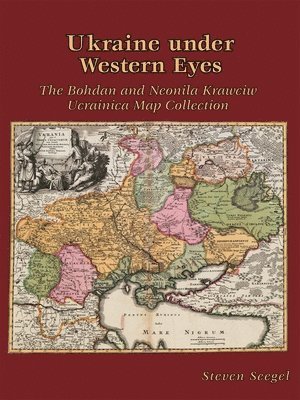
Ukraine under Western Eyes
The Bohdan and Neonila Krawciw Ucrainica Map Collection
Inbunden, Engelska, 2013
859 kr
Skickas inom 5-8 vardagar
From the Renaissance to the Enlightenment, the geopolitical placement of Ukraine drew the attention of some of Europe’s most influential cartographers. Many of these maps, including ones of exceptional rarity, were collected by the Ukrainian scholar and journalist Bohdan Krawciw. Krawciw traced the physical and aesthetic depiction of Ukraine across its changing borders as a means of self-recognition and as a cultural and political history of the contested nation and its peoples. Of special interest are his maps of Ukraine from the nineteenth and twentieth centuries, at the crossroads of four empires: Habsburg, Ottoman, Russian, and Soviet. As part of his personal archive, Krawciw’s maps were bequeathed to Harvard University upon his death in 1975. This book serves as both a catalog of his collection and a description of how the maps he collected serve as an invaluable source for Ukraine’s history and a symbol of Ukrainian national identity. The book contains nearly 100 examples from the collection, many in full color, as well as indices listing maps by cartographer and by place name.
Inbunden, Ryska, 2024
433 kr
Skickas inom 5-8 vardagar
ENGMore than just colorful clickbait or pragmatic city grids, maps are often deeply emotional tales: of political projects gone wrong, budding relationships that failed, and countries that vanished. In Map Men, Steven Seegel takes us through some of these historical dramas with a detailed look at the maps that made and unmade the world of East Central Europe.RUSГеографические карты – это не просто яркие картинки или сухие топологические визуализации. Зачастую это глубоко эмоциональные истории: о неудачных политических проектах, не сложившихся отношениях и исчезнувших странах. В своей книге Стивен Сигел проводит нас через такие исторических драмы, подробно рассматривая карты, показывающие реальный и воображаемый мир Восточно-Центральной Европы на протяжении периода мировых войн и революций. В коллективной биографии пяти выдающихся географов 1870-1950 годов – Альбрехта Пенка, Эугениуша Ромера, Степана Рудницкого, Исайи Боумана и графа Паля Телеки – Сигел заново исследует эмоции, социальные связи и трагедии нескольких поколений людей, стоящих за этими влиятельными картами.
E-bok
PDF, Ryska, 2024836 kr
Läs direkt efter köp
ENGMore than just colorful clickbait or pragmatic city grids, maps are often deeply emotional tales: of political projects gone wrong, budding relationships that failed, and countries that vanished. In Map Men, Steven Seegel takes us through some of these historical dramas with a detailed look at the maps that made and unmade the world of East Central Europe.RUS . : , . , , - . 1870-1950 , , , , , .