Stuart H Rubin – författare
2 233 kr
Skickas inom 5-8 vardagar
873 kr
Skickas inom 10-15 vardagar
974 kr
Läs direkt efter köp
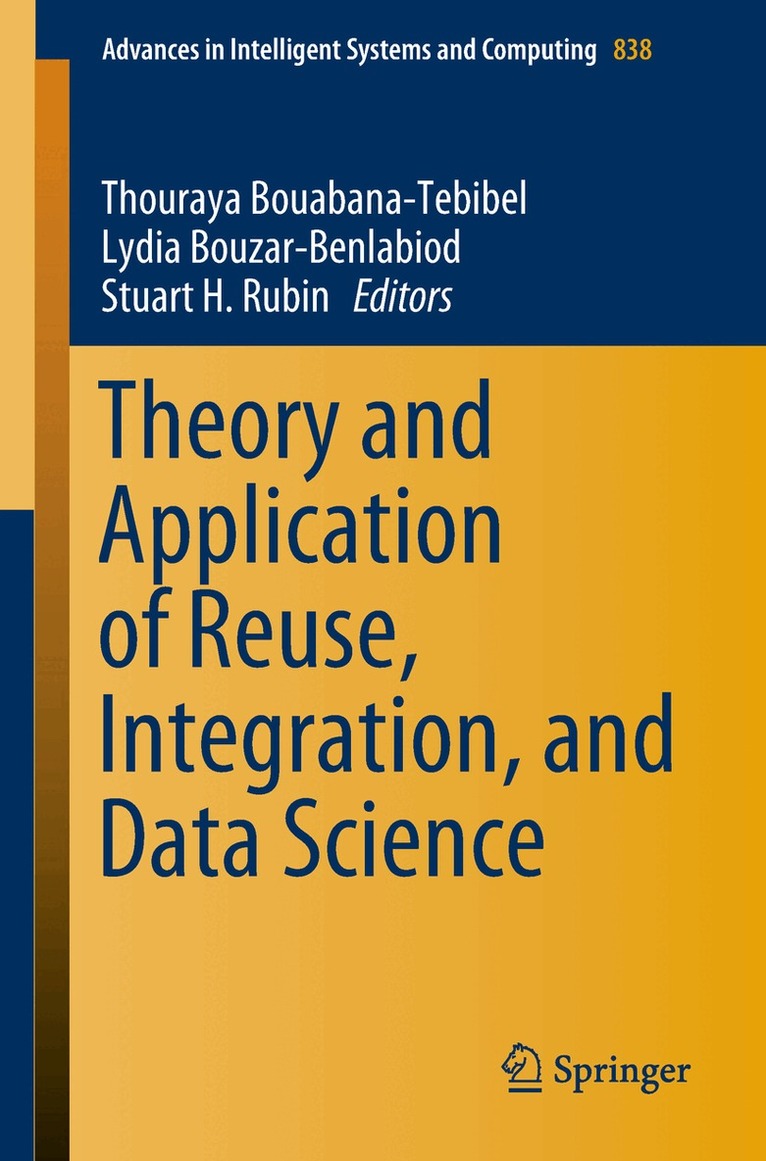
The book is based on the best papers of IEEE IRI 2018 and IEEE FMI 2018, Salt Lake City, July, 2018. They have been enhanced and modified suitably for publication. The book comprises recent works covering several aspects of reuse in intelligent systems – including Scientific Theory and Technology-Based Applications. New data analytic algorithms, technologies, and tools are sought to be able to manage, integrate, and utilize large amounts of data despite hardware, software, and/or bandwidth constraints; to construct models yielding important data insights, and to create visualizations to aid in presenting and understanding the data. Furthermore, it addresses the representation, cleansing, generalization, validation, and reasoning strategies for the scientifically-sound and cost-effective advancement of all kinds of intelligent systems – including all software and hardware aspects. The book addresses problems such as, how to optimally select the information/data sets for reuse and how to optimize the integration of existing information/knowledge with new, developing information/knowledge sources!
974 kr
Läs direkt efter köp
The book is based on the best papers of IEEE IRI 2018 and IEEE FMI 2018, Salt Lake City, July, 2018. They have been enhanced and modified suitably for publication. The book comprises recent works covering several aspects of reuse in intelligent systems – including Scientific Theory and Technology-Based Applications. New data analytic algorithms, technologies, and tools are sought to be able to manage, integrate, and utilize large amounts of data despite hardware, software, and/or bandwidth constraints; to construct models yielding important data insights, and to create visualizations to aid in presenting and understanding the data. Furthermore, it addresses the representation, cleansing, generalization, validation, and reasoning strategies for the scientifically-sound and cost-effective advancement of all kinds of intelligent systems – including all software and hardware aspects. The book addresses problems such as, how to optimally select the information/data sets for reuse and how to optimize the integration of existing information/knowledge with new, developing information/knowledge sources!
Integration of Reusable Systems
1 123 kr
Skickas inom 10-15 vardagar
1 408 kr
Läs direkt efter köp
Software reuse and integration has been described as the process of creating software systems from existing software rather than building software systems from scratch. Whereas reuse solely deals with the artifacts creation, integration focuses on how reusable artifacts interact with the already existing parts of the specified transformation. Currently, most reuse research focuses on creating and integrating adaptable components at development or at compile time. However, with the emergence of ubiquitous computing, reuse technologies that can support adaptation and reconfiguration of architectures and components at runtime are in demand.
This edited book includes 15 high quality research papers written by experts in information reuse and integration to cover the most recent advances in the field. These papers are extended versions of the best papers which were presented at IEEE International Conference on Information Reuse and Integration and IEEE International Workshop on Formal Methods Integration, which was held in San Francisco in August 2013.
Formalisms for Reuse and Systems Integration
1 123 kr
Skickas inom 10-15 vardagar
1 408 kr
Läs direkt efter köp
Reuse and integration are defined as synergistic concepts, where reuse addresses how to minimize redundancy in the creation of components; while, integration focuses on component composition. Integration supports reuse and vice versa. These related concepts support the design of software and systems for maximizing performance while minimizing cost. Knowledge, like data, is subject to reuse; and, each can be interpreted as the other. This means that inherent complexity, a measure of the potential utility of a system, is directly proportional to the extent to which it maximizes reuse and integration. Formal methods can provide an appropriate context for the rigorous handling of these synergistic concepts. Furthermore, formal languages allow for non ambiguous model specification; and, formal verification techniques provide support for insuring the validity of reuse and integration mechanisms.
This edited book includes 12 high quality research papers written by experts in formal aspects of reuse and integration to cover the most recent advances in the field. These papers are extended versions of some of the best papers, which were presented at the IEEE International Conference on Information Reuse and Integration and the IEEE International Workshop on Formal Methods Integration - both of which were held in San Francisco in August 2014.
Theoretical Information Reuse and Integration
1 123 kr
Skickas inom 10-15 vardagar
1 408 kr
Läs direkt efter köp
InformationReuse and Integration addresses the efficient extension and creation ofknowledge through the exploitation of Kolmogorov complexity in the extractionand application of domain symmetry. Knowledge, which seems to be novel, canmore often than not be recast as the image of a sequence of transformations,which yield symmetric knowledge. When the size of those transformations and/orthe length of that sequence of transforms exceeds the size of the image, thenthat image is said to be novel or random. It may also be that the new knowledgeis random in that no such sequence of transforms, which produces it exists, oris at least known.
Thenine chapters comprising this volume incorporate symmetry, reuse, andintegration as overt operational procedures or as operations built into theformal representations of data and operators employed. Either way, theaforementioned theoretical underpinnings of information reuse and integrationare supported.
Quality Software Through Reuse and Integration
1 681 kr
Skickas inom 10-15 vardagar
2 036 kr
Läs direkt efter köp
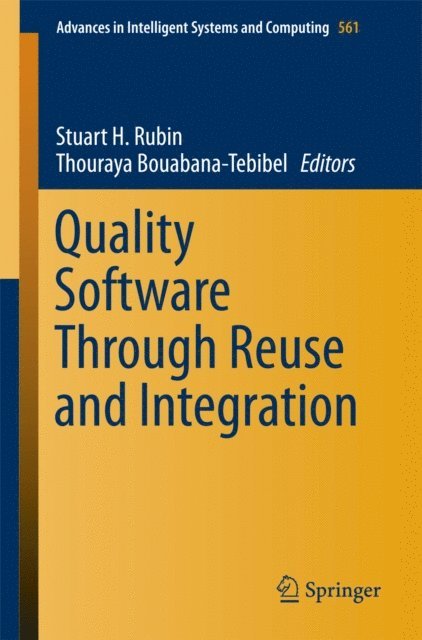
This book presents 13 high-quality research articles that provide long sought-after answers to questions concerning various aspects of reuse and integration. Its contents lead to the inescapable conclusion that software, hardware, and design productivity – including quality attributes – is not bounded. It combines the best of theory and practice and contains recipes for increasing the output of our productivity sectors.
The idea of improving software quality through reuse is not new. After all, if software works and is needed, why not simply reuse it? What is new and evolving, however, is the idea of relative validation through testing and reuse, and the abstraction of code into frameworks for instantiation and reuse. Literal code can be abstracted. These abstractions can in turn yield similar codes, which serve to verify their patterns. There is a taxonomy of representations from the lowest-level literal codes to their highest-level natural language descriptions. As a result,product quality is improved in proportion to the degree of reuse at all levels of abstraction. Any software that is, in theory, complex enough to allow for self-reference, cannot be certified as being absolutely valid. The best that can be attained is a relative validity, which is based on testing. Axiomatic, denotational, and other program semantics are more difficult to verify than the codes, which they represent! But, are there any limits to testing? And how can we maximize the reliability of software or hardware products through testing? These are essential questions that need to be addressed; and, will be addressed herein.Theory and Application of Reuse, Integration, and Data Science
1 091 kr
Skickas inom 10-15 vardagar
1 420 kr
Läs direkt efter köp