Stuart Lindsay – författare
Visar alla böcker från författaren Stuart Lindsay. Handla med fri frakt och snabb leverans.
4 produkter
4 produkter
E-bok
Engelska, 2009535 kr
Läs direkt efter köp
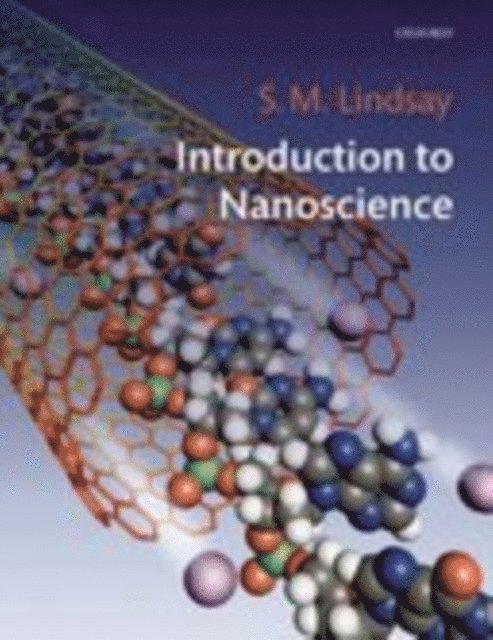
Nanoscience is not physics, chemistry, engineering or biology. It is all of them, and it is time for a text that integrates the disciplines. This is such a text, aimed at advanced undergraduates and beginning graduate students in the sciences. The consequences of smallness and quantum behaviour are well known and described Richard Feynman''s visionary essay ''There''s Plenty of Room at the Bottom'' (which is reproduced in this book). Another, critical, but thus far neglected, aspect of nanoscience is the complexity of nanostructures. Hundreds, thousands or hundreds of thousands of atoms make up systems that are complex enough to show what is fashionably called ''emergent behaviour''. Quite new phenomena arise from rare configurations of the system. Examples are the Kramer''s theory of reactions (Chapter 3), the Marcus theory of electron transfer (Chapter 8), and enzyme catalysis, molecular motors, and fluctuations in gene expression and splicing, all covered in the final Chapter on Nanobiology. The book is divided into three parts. Part I (The Basics) is a self-contained introduction to quantum mechanics, statistical mechanics and chemical kinetics, calling on no more than basic college calculus. A conceptual approach and an array of examples and conceptual problems will allow even those without the mathematical tools to grasp much of what is important. Part II (The Tools) covers microscopy, single molecule manipulation and measurement, nanofabrication and self-assembly. Part III (Applications) covers electrons in nanostructures, molecular electronics, nano-materials and nanobiology. Each chapter starts with a survey of the required basics, but ends by making contact with current research literature.
Del 1 - Anthem Studies in Gothic Literature
Chernobyl Trauma and Gothic
Testimony, Cultural Memory and Global Literary Perspectives
Inbunden, Engelska, 2026
1 421 kr
Skickas inom 5-8 vardagar
This scholarly monograph examines the concept of Chernobyl trauma by situating it at the interface of clinical diagnoses of survivors’ Post-Traumatic Stress Disorder, their expressions of this trauma in published testimonials translated into English, and through English-language literary explorations of contemporary Soviet trauma. It establishes a new perspective on the intergenerational and international reception of the nuclear disaster, one shaped by Soviet cultural memory as well as Science Fiction and the literary aesthetics of the Gothic. The monograph analyses first-generation Chernobyl survivors’ imaginative reconstruction of events through testimony in the face of the Soviet Party’s attempts to sublimate the narrative of the disaster into an official account. It also discusses the ways in which a second generation represents inherited, traumatic memory through a literary diaspora of Chernobyl and Soviet-Kazakh Semipalatinsk nuclear trauma, and how English-speaking writers not personally involved in the disaster engage in its memorialisation through discourses of horror and collective mourning.
505 kr
Tillfälligt slut
A textually rich, historically informed and theoretically sophisticated account of the Chernobyl crisis, its cultural antecedents and its aftermath in global culture.This scholarly monograph synthesises critical understandings of collective social trauma and the Gothic s discursive manifestation within the trauma paradigm in testimonial and literary expressions of the 1986 Chernobyl nuclear disaster. Gothic writing, more than just a historically specific manifestation of English eighteenth-century concerns about national identity and the French Revolution, functions as a textuality haunting that which it is not and an articulation of a society s collective fears. Chernobyl Gothic, then, is a testimony, literature and aesthetics that haunts the empty space of the Soviet authority s non-disclosure of the disaster, namely in the displaced survivor, the Exclusion Zone, and the exploded nuclear reactor housing. Chapters in this book examine the ways in which trauma and the Gothic coalesce around the writing of the Chernobyl disaster in various literary genres. Images of terror, fear and panic deployed satirically in Soviet Science Fiction published before the disaster portray a body politic in chaos and excess of Marxist homogeneity. Psychological hermeticism of individuals and social groups in Chernobyl testimony and fiction indicates the haunting of intergenerational trauma. Literature of international mourning, identifying in the Chernobyl eyewitness a lost subject who nevertheless survives and seemingly resists memorialisation, negotiates an ethics of exchange between self and other, visitor and native, living and dead. Cryptomimesis and mourning generate Gothic, uncanny effects within these texts through their inside-outness . This constitutes a pertinent Gothic structural aesthetics in analysing the traumas of a displaced network of survivors from a collapsed regime that nonetheless remains relevant in current geopolitics.In the continued aftermath of disaster, technological representations of Chernobyl and the Exclusion Zone in the contemporary Gothic, namely in Virtual Reality and computer games, explore a discursivity of ghosts and monstrosity respectively.
505 kr
Tillfälligt slut
This scholarly monograph examines the concept of Chernobyl trauma by situating it at the interface of clinical diagnoses of survivors' Post-Traumatic Stress Disorder, their expressions of this trauma in published testimonials translated into English, and through English-language literary explorations of contemporary Soviet trauma. It establishes a new perspective on the intergenerational and international reception of the nuclear disaster, one shaped by Soviet cultural memory as well as Science Fiction and the literary aesthetics of the Gothic. The monograph analyses first-generation Chernobyl survivors' imaginative reconstruction of events through testimony in the face of the Soviet Party's attempts to sublimate the narrative of the disaster into an official account. It also discusses the ways in which a second generation represents inherited, traumatic memory through a literary diaspora of Chernobyl and Soviet-Kazakh Semipalatinsk nuclear trauma, and how English-speaking writers not personally involved in the disaster engage in its memorialisation through discourses of horror and collective mourning.