Sungjoo Yoo - Böcker
Visar alla böcker från författaren Sungjoo Yoo. Handla med fri frakt och snabb leverans.
4 produkter
4 produkter
2 486 kr
Skickas inom 10-15 vardagar
Genetic programming (GP) is method for automatically creating computer programs. It starts from a high-level statement of what needs to be done and uses the Darwinian principle of natural selection to breed a population of improving programmes over many generations. This text presents the application of GP to a wide variety of problems involving automated synthesis of controllers, circuits, antennas, genetic networks, and metabolic pathways. It describes 15 instances where GP has created an entity that either infringes or duplicates the functionality of a previously patented 20th-century invention, six instances where it has done the same with respect to post-2000 patented inventions, two instances where GP has created a patentable new invention, and thirteen other human-competitive results.
2 414 kr
Skickas inom 10-15 vardagar
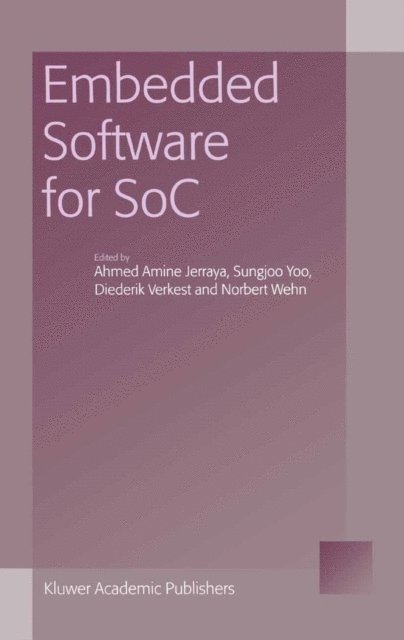
The evolution of electronic systems is pushing traditional silicon designers into areas that require new domains of expertise. In addition to the design of complex hardware, System-on-Chip (SoC) design requires software devel- ment, operating systems and new system architectures. Future SoC designs will resemble a miniature on-chip distributed computing system combining many types of microprocessors, re-configurable fabrics, application-specific hardware and memories, all communicating via an on-chip inter-connection network. Designing good SoCs will require insight into these new types of architectures, the embedded software, and the interaction between the embedded software, the SoC architecture, and the applications for which the SoC is designed. This book collects contributions from the Embedded Software Forum of the Design, Automation and Test in Europe Conference (DATE 03) that took place in March 2003 in Munich, Germany. The success of the Embedded Software Forum at DATE reflects the increasing importance of embedded software in the design of a System-on-Chip. Embedded Software for SoC covers all software related aspects of SoC design Embedded and application-domain specific operating systems, interplay between application, operating system, and architecture. System architecture for future SoC, application-specific architectures based on embedded processors and requiring sophisticated hardware/software interfaces. Compilers and interplay between compilers and architectures. Embedded software for applications in the domains of automotive, avionics, multimedia, telecom, networking, . . .
1 064 kr
Skickas inom 10-15 vardagar
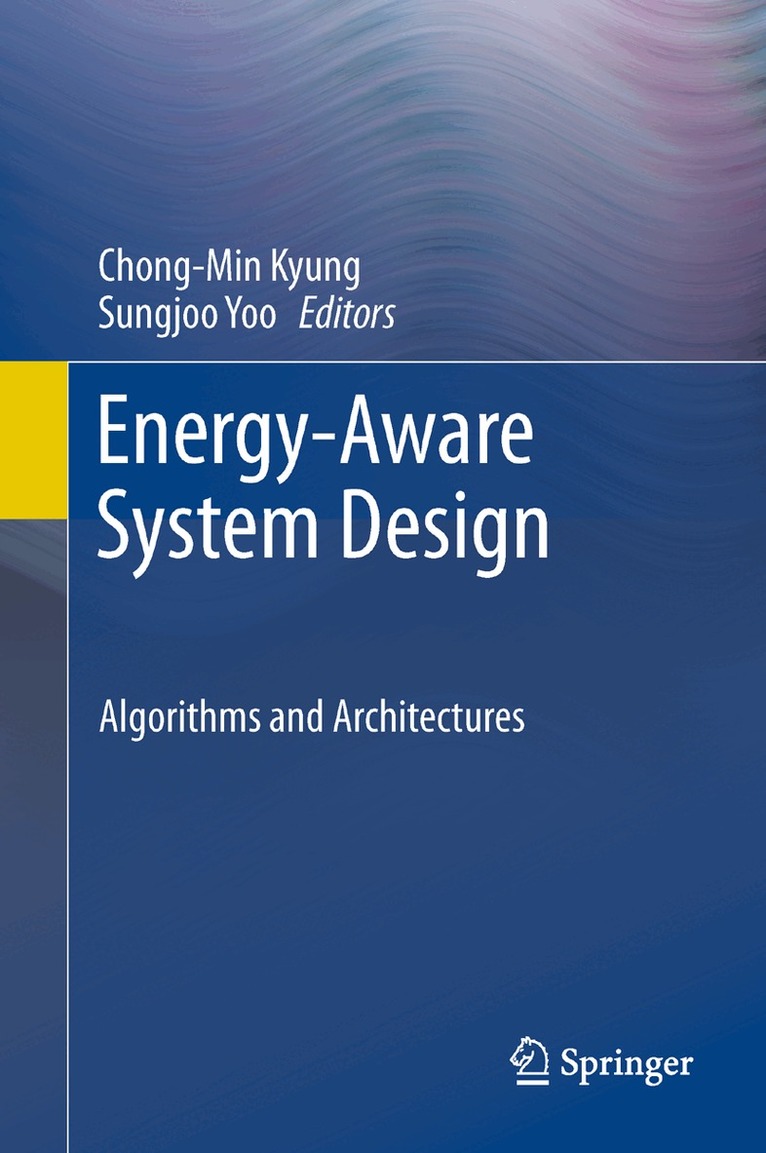
Power consumption becomes the most important design goal in a wide range of electronic systems. There are two driving forces towards this trend: continuing device scaling and ever increasing demand of higher computing power. First, device scaling continues to satisfy Moore’s law via a conventional way of scaling (More Moore) and a new way of exploiting the vertical integration (More than Moore). Second, mobile and IT convergence requires more computing power on the silicon chip than ever. Cell phones are now evolving towards mobile PC. PCs and data centers are becoming commodities in house and a must in industry. Both supply enabled by device scaling and demand triggered by the convergence trend realize more computation on chip (via multi-core, integration of diverse functionalities on mobile SoCs, etc.) and finally more power consumption incurring power-related issues and constraints. Energy-Aware System Design: Algorithms and Architectures provides state-of-the-art ideas for low power design methods from circuit, architecture to software level and offers design case studies in three fast growing areas of mobile storage, biomedical and security.Important topics and features:- Describes very recent advanced issues and methods for energy-aware design at each design level from circuit and architecture to algorithm level, and also covering important blocks including low power main memory subsystem and on-chip network at architecture level- Explains efficient power conversion and delivery which is becoming important as heterogeneous power sources are adopted for digital and non-digital parts - Investigates 3D die stacking emphasizing temperature awareness for better perspective on energy efficiency- Presents three practical energy-aware design case studies; novel storage device (e.g., solid state disk), biomedical electronics (e.g., cochlear and retina implants), and wireless surveillance camerasystems.Researchers and engineers in the field of hardware and software design will find this book an excellent starting point to catch up with the state-of-the-art ideas of low power design.
1 064 kr
Skickas inom 10-15 vardagar
Power consumption becomes the most important design goal in a wide range of electronic systems. There are two driving forces towards this trend: continuing device scaling and ever increasing demand of higher computing power. First, device scaling continues to satisfy Moore’s law via a conventional way of scaling (More Moore) and a new way of exploiting the vertical integration (More than Moore). Second, mobile and IT convergence requires more computing power on the silicon chip than ever. Cell phones are now evolving towards mobile PC. PCs and data centers are becoming commodities in house and a must in industry. Both supply enabled by device scaling and demand triggered by the convergence trend realize more computation on chip (via multi-core, integration of diverse functionalities on mobile SoCs, etc.) and finally more power consumption incurring power-related issues and constraints. Energy-Aware System Design: Algorithms and Architectures provides state-of-the-art ideas for low power design methods from circuit, architecture to software level and offers design case studies in three fast growing areas of mobile storage, biomedical and security.Important topics and features:- Describes very recent advanced issues and methods for energy-aware design at each design level from circuit and architecture to algorithm level, and also covering important blocks including low power main memory subsystem and on-chip network at architecture level- Explains efficient power conversion and delivery which is becoming important as heterogeneous power sources are adopted for digital and non-digital parts - Investigates 3D die stacking emphasizing temperature awareness for better perspective on energy efficiency- Presents three practical energy-aware design case studies; novel storage device (e.g., solid state disk), biomedical electronics (e.g., cochlear and retina implants), and wireless surveillance camerasystems.Researchers and engineers in the field of hardware and software design will find this book an excellent starting point to catch up with the state-of-the-art ideas of low power design.