Susan Addington - Böcker
Visar alla böcker från författaren Susan Addington. Handla med fri frakt och snabb leverans.
3 produkter
3 produkter
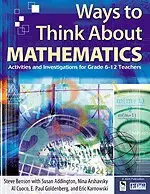
Ways to Think About Mathematics
Activities and Investigations for Grade 6-12 Teachers
Inbunden, Engelska, 2004
1 356 kr
Skickas inom 3-6 vardagar
Engaging in mathematical investigations yourself will help you be a better mathematics teacher! National, state, and local curriculum requirements and recommendations increasingly emphasize active student involvement in exploratory investigations. Teachers now face new demands when they field unexpected student discoveries, determine when some open-ended activity has played out its usefulness or is just on the verge of paying off in a major way, and judge which student-initiated directions are likely to lead to development of important mathematical ideas and which are dead ends. These pedagogical judgments depend heavily on deep mathematical knowledge. Ways to Think About Mathematics uses immersion experiences in algebra, geometry, and statistics to help mathematics teachers improve their knowledge and understanding of mathematical concepts. By experiencing open-ended problems, making and checking conjectures, and evaluating problem solving strategies, every math teacher can become better prepared to deal with day-to-day classroom decisions. Funded by the National Science Foundation and successfully field-tested in a wide variety of professional development and preservice settings, the materials in this book integrate mathematical thinking, effective teaching practices, and explicit connections to exemplary curricula. Because it is aligned with the principles and standards of the National Council of Teachers of Mathematics but is not fixed to any single curriculum, the materials in this book can be aligned with any state or district standards. Emphasizing all components of mathematical investigation, this accessible volume focuses on: Mathematical ways of thinking Discovering connections between mathematical ideas Posing and analyzing problems Making, modifying, testing, and proving conjectures Linking higher level mathematics to the content of grade 6-12 classrooms Ways to Think About Mathematics gives teachers the opportunity to grow as learners and teachers of mathematics by including problems for teachers to explore as well as selected "Problems for the Classroom" for the classes they teach.
Ways to Think About Mathematics
Activities and Investigations for Grade 6-12 Teachers
Häftad, Engelska, 2004
666 kr
Skickas inom 3-6 vardagar
Engaging in mathematical investigations yourself will help you be a better mathematics teacher! National, state, and local curriculum requirements and recommendations increasingly emphasize active student involvement in exploratory investigations. Teachers now face new demands when they field unexpected student discoveries, determine when some open-ended activity has played out its usefulness or is just on the verge of paying off in a major way, and judge which student-initiated directions are likely to lead to development of important mathematical ideas and which are dead ends. These pedagogical judgments depend heavily on deep mathematical knowledge. Ways to Think About Mathematics uses immersion experiences in algebra, geometry, and statistics to help mathematics teachers improve their knowledge and understanding of mathematical concepts. By experiencing open-ended problems, making and checking conjectures, and evaluating problem solving strategies, every math teacher can become better prepared to deal with day-to-day classroom decisions. Funded by the National Science Foundation and successfully field-tested in a wide variety of professional development and preservice settings, the materials in this book integrate mathematical thinking, effective teaching practices, and explicit connections to exemplary curricula. Because it is aligned with the principles and standards of the National Council of Teachers of Mathematics but is not fixed to any single curriculum, the materials in this book can be aligned with any state or district standards. Emphasizing all components of mathematical investigation, this accessible volume focuses on: Mathematical ways of thinking Discovering connections between mathematical ideas Posing and analyzing problems Making, modifying, testing, and proving conjectures Linking higher level mathematics to the content of grade 6-12 classrooms Ways to Think About Mathematics gives teachers the opportunity to grow as learners and teachers of mathematics by including problems for teachers to explore as well as selected "Problems for the Classroom" for the classes they teach.
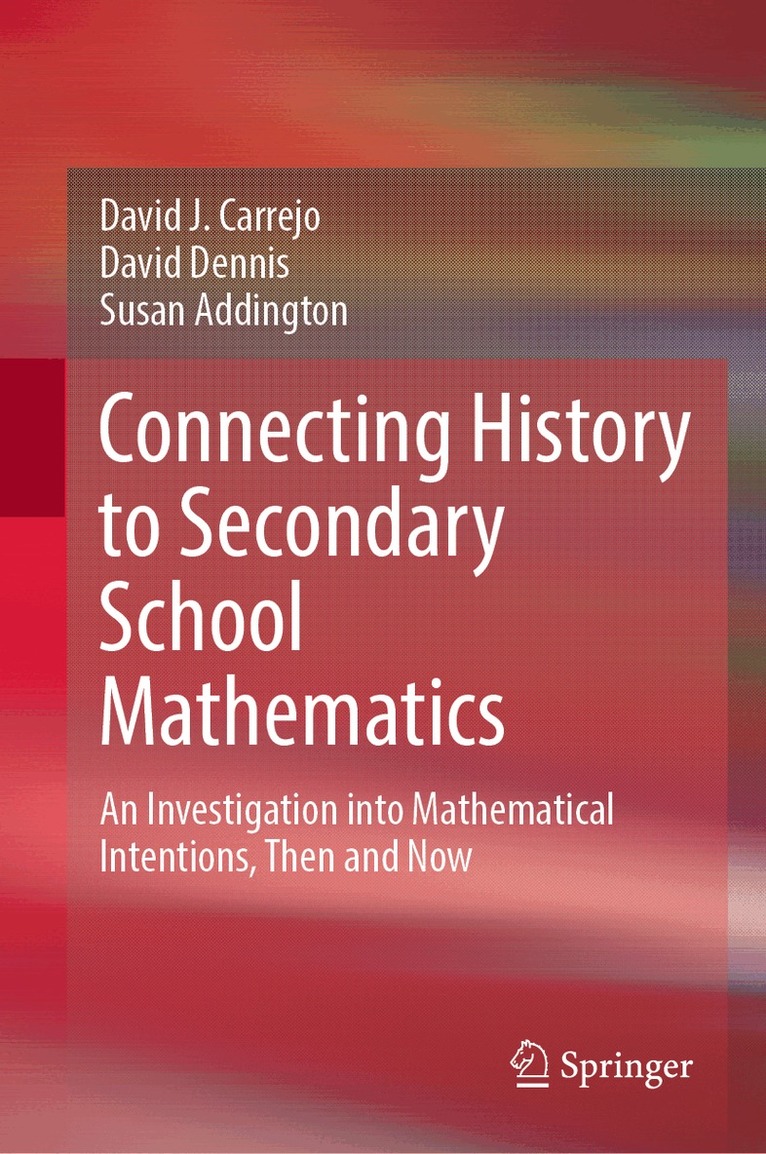
Connecting History to Secondary School Mathematics
An Investigation into Mathematical Intentions, Then and Now
Inbunden, Engelska, 2026
947 kr
Skickas inom 11-20 vardagar
This book provides a focused socio-historical analysis of the secondary mathematics curriculum, revealing how science and cultural factors influenced the genesis of many core mathematical ideas. The authors explore why certain concepts became foundational and why their original intentions matter. While seemingly epic in scope, the history provided here is more accessible than one might suspect. Much of the curriculum has its genesis in a rather narrow piece of social history and culture: Europe in the 1600s and the Scientific Revolution. Why history? Because intentions matter in mathematics and education, especially when a mandatory curriculum is tied to high-stakes testing. The authors' historical research reveals mathematics as a powerful, utilitarian approach to science, technology, and engineering. By studying the genesis of mathematical knowledge, the authors identify pathways for both practitioners and researchers to redesign curriculum and instruction in secondary and post-secondary STEM education. By discussing how old ideas could become new again, the authors argue that educators can gain deeper insight into the nature of mathematical reasoning and problem-solving, providing clarity on the complex relationship between mathematics, its history, and the future of STEM education.