Susan D. Clayton – författare
Visar alla böcker från författaren Susan D. Clayton. Handla med fri frakt och snabb leverans.
2 produkter
2 produkter
Inbunden, Engelska, 2012
3 544 kr
Skickas inom 5-8 vardagar
Environmental psychology, which studies the ways in which people perceive and respond to the physical environment, is an established area of study. Conservation psychology has a much more recent history, prompted by the desire to focus psychological research on the need to protect the natural environment. What is conservation psychology, and what is its relationship to environmental psychology? The Oxford Handbook of Environmental and Conservation Psychology includes basic research on environmental perceptions, attitudes, and values; research on specific environments, such as therapeutic settings, schools, and prisons; environmental impacts on human well-being; and ways to promote a more sustainable relationship between people and the natural environment. By presenting an extensive review of current research, the handbook serves as a thorough guide to the state of knowledge about a wide range of topics at the intersection of psychology and the physical environment. Beyond this, it provides a better understanding of the relationship between environmental and conservation psychology, and some sense of the directions in which these interdependent areas of study are heading. Research on the human-environment relationship is increasingly relevant to understanding and addressing the environmental challenges society is facing. This handbook should serve as a resource for professionals both within and outside of psychology who are trying to comprehend the human implications of environments, and to design programs, policies, and environments that are cognizant of human psychology.
E-bok
Engelska, 2025532 kr
Läs direkt efter köp
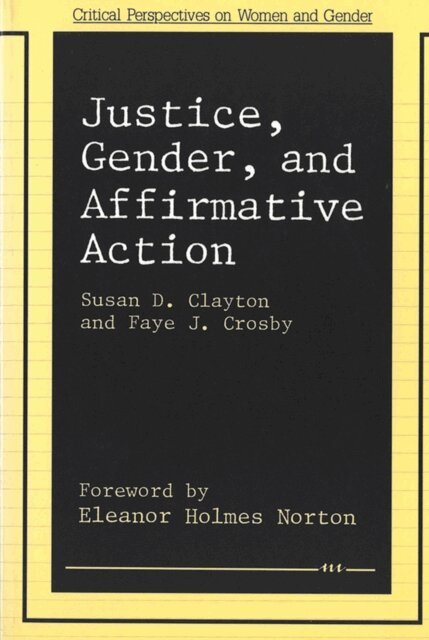
Justice, Gender, and Affirmative Action by Susan D. Clayton and Faye J. Crosby offers a deep dive into the complex debates surrounding affirmative action through the lens of gender and social psychology. Addressing the persistent gender disparities in the workplace, the authors argue for the necessity of affirmative action to combat ingrained biases and structural inequalities that permeate both economic and sociological dimensions. They use the theory of relative deprivation to illustrate how societal injustices can be overlooked by both victims and society, underscoring the importance of proactive measures like affirmative action. The book analyzes various judicial precedents shaping the discourse and application of affirmative action, highlighting their impact on women's progress, particularly white women, who have benefited significantly from these programs. With insights drawn from numerous studies, the authors argue that affirmative action is essential and propose strategies for its effective implementation, emphasizing that these policies should address systemic biases rather than attempt to compensate for perceived deficiencies within marginalized groups. Through a meticulous examination of the controversies and criticisms of affirmative action, Clayton and Crosby guide readers towards a nuanced understanding of its necessity in promoting justice and equity in contemporary society.