T. K. Wilson – författare
Visar alla böcker från författaren T. K. Wilson. Handla med fri frakt och snabb leverans.
4 produkter
4 produkter
Inbunden, Engelska, 2020
472 kr
Skickas inom 5-8 vardagar
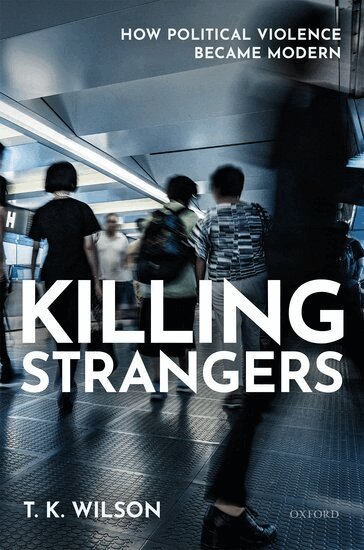
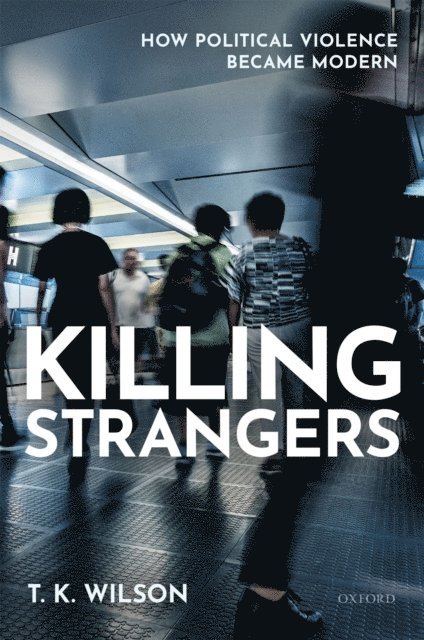
A bewildering feature of so much contemporary political violence is its stunning impersonality. Every major city centre becomes a potential shooting gallery; and every metro system a potential bomb alley. Victims just happen, as the saying goes, to 'be in the wrong place at the wrong time'.We accept this contemporary reality - at least to some degree. But we rarely ask: where has it come from historically? Killing Strangers tackles this question head on. It examines how such violence became 'unchained' from inter-personal relationships. It traces the rise of such impersonal violence by examining violence in conjunction with changing social and political realities. In particular, it traces both 'push' and 'pull' - the ability of modern states to force the violence of their challengers into niche forms: and the disturbing new opportunities that technological changes offer to cause mayhem in fresh and original ways.Killing Strangers therefore aims to highlight the very strangeness of contemporary experience when it is viewed against a long-term perspective. Atrocities regularly capture media attention - and just as quickly fade from public view. That is both tragic - and utterly predictable. Deep down we expect no different. And that is why such atrocities must be repeated if our attention is to be re-engaged. Deep down we expect that, too.So Killing Strangers deliberately asks the very simplest of questions. How on earth did we get here?
E-bok
PDF, Engelska, 20101 610 kr
Läs direkt efter köp
In the years after the First World War both Ulster and Upper Silesia saw violent conflicts over self-determination. The violence in Upper Silesia was more intense both in the numbers killed and in the forms it took. Acts of violation such as rape or mutilation were noticeably more common in Upper Silesia than in Ulster.Examining the nature of communal boundaries, Timothy Wilson explains the profound contrasts in these experiences of plebeian violence. In Ulster the rival communities were divided by religion, but shared a common language. In Upper Silesia, the rival sides were united in religion-92 per cent of the local population being Catholic-but ostensibly divided on linguistic grounds between German and Polish speakers. In practice, language in Upper Silesia proved a far more porous boundary than didreligion in Ulster. Language could not always be taken as a straightforward indication of national loyalties.At a local level, boundaries mattered because without them there could not be any sense of security. In Ulster, where communal identities were already clearly staked out, militants tended to concentrate on the limited task of boundary maintenance. In Upper Silesia, where national identities were so unclear, they focused upon boundary creation. This was a task that required more ''transgressive'' violence. Hence atrocity was more widely practised in Upper Silesia because it could, and did, act asa polarizing force.
E-bok
PDF, Engelska, 2020330 kr
Läs direkt efter köp
A bewildering feature of so much contemporary political violence is its stunning impersonality. Every major city centre becomes a potential shooting gallery; and every metro system a potential bomb alley. Victims just happen, as the saying goes, to ''be in the wrong place at the wrong time''.We accept this contemporary reality - at least to some degree. But we rarely ask: where has it come from historically? Killing Strangers tackles this question head on. It examines how such violence became ''unchained'' from inter-personal relationships. It traces the rise of such impersonal violence by examining violence in conjunction with changing social and political realities. In particular, it traces both ''push'' and ''pull'' - the ability of modern states to force the violence of their challengers into niche forms: and the disturbing new opportunities that technological changes offer to cause mayhem in fresh and original ways.Killing Strangers therefore aims to highlight the very strangeness of contemporary experience when it is viewed against a long-term perspective. Atrocities regularly capture media attention - and just as quickly fade from public view. That is both tragic - and utterly predictable. Deep down we expect no different. And that is why such atrocities must be repeated if our attention is to be re-engaged. Deep down we expect that, too.So Killing Strangers deliberately asks the very simplest of questions. How on earth did we get here?
E-bok
Engelska, 2020330 kr
Läs direkt efter köp
A bewildering feature of so much contemporary political violence is its stunning impersonality. Every major city centre becomes a potential shooting gallery; and every metro system a potential bomb alley. Victims just happen, as the saying goes, to ''be in the wrong place at the wrong time''.We accept this contemporary reality - at least to some degree. But we rarely ask: where has it come from historically? Killing Strangers tackles this question head on. It examines how such violence became ''unchained'' from inter-personal relationships. It traces the rise of such impersonal violence by examining violence in conjunction with changing social and political realities. In particular, it traces both ''push'' and ''pull'' - the ability of modern states to force the violence of their challengers into niche forms: and the disturbing new opportunities that technological changes offer to cause mayhem in fresh and original ways.Killing Strangers therefore aims to highlight the very strangeness of contemporary experience when it is viewed against a long-term perspective. Atrocities regularly capture media attention - and just as quickly fade from public view. That is both tragic - and utterly predictable. Deep down we expect no different. And that is why such atrocities must be repeated if our attention is to be re-engaged. Deep down we expect that, too.So Killing Strangers deliberately asks the very simplest of questions. How on earth did we get here?