T. M. Charlton – författare
Visar alla böcker från författaren T. M. Charlton. Handla med fri frakt och snabb leverans.
2 produkter
2 produkter
Häftad, Engelska, 2002
617 kr
Skickas inom 7-10 vardagar
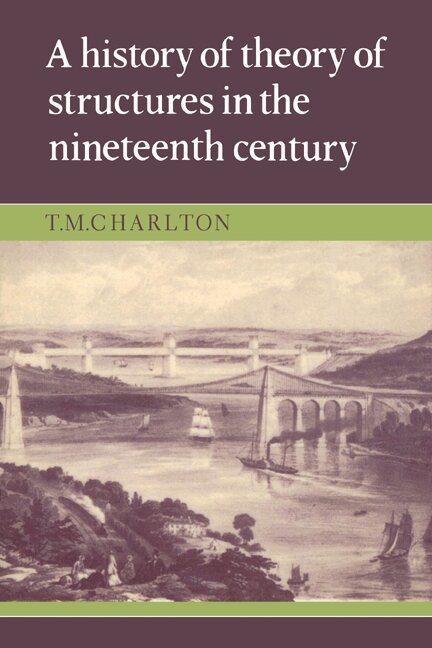
The spectacular structures of today, such as large suspension bridges, are the result of scientific principles established during the new iron age of the nineteenth century. The book is concerned with a detailed and critical account of the development and application of those principles (including statics and elasticity) by people of remarkable talent in applied mathematics and engineering. They were, of course, mainly motivated by the demands of the railway, construction boom. Among the outstanding examples chosen by the author is Robert Stephenson's use of novel principles for the design and erection of the Britannia tubular iron bridge over the Menai Straits. A History of the Theory of Structures in the Nineteenth Century is a uniquely comprehensive account of a century of the development of the theory; an account which skilfully blends the personalities and the great works and which is enlivened by little-known accounts of friendship and controversy.
E-bok
PDF, Engelska, 2013344 kr
Läs direkt efter köp
Model Analysis of Plane Structures deals with simple techniques of analysis plane structures with the aid of scale models. Model analysis of the kind considered herein is a means of replacing the numerical work of formal structural analysis by mechanical operations. It utilizes the same assumptions as formal analysis and offers nothing more in the end-product, but the user gains unique insight into structural behavior. The book begins with a discussion of early approaches to systematic model analysis and the limitations and accuracy of model analysis. This is followed by separate chapters on the approach to flexural similarity, which consists essentially of determining directly the conditions for the properties of deformation of two geometrically similar structures to be similar; the theory of indirect model analysis; and models of frame networks. The final two chapters deal with the use of models for indirect analysis and direct analysis, respectively; these conclude with sample problems to enable readers to test their understanding of the subject matter.