T. Mickiewicz – författare
Visar alla böcker från författaren T. Mickiewicz. Handla med fri frakt och snabb leverans.
4 produkter
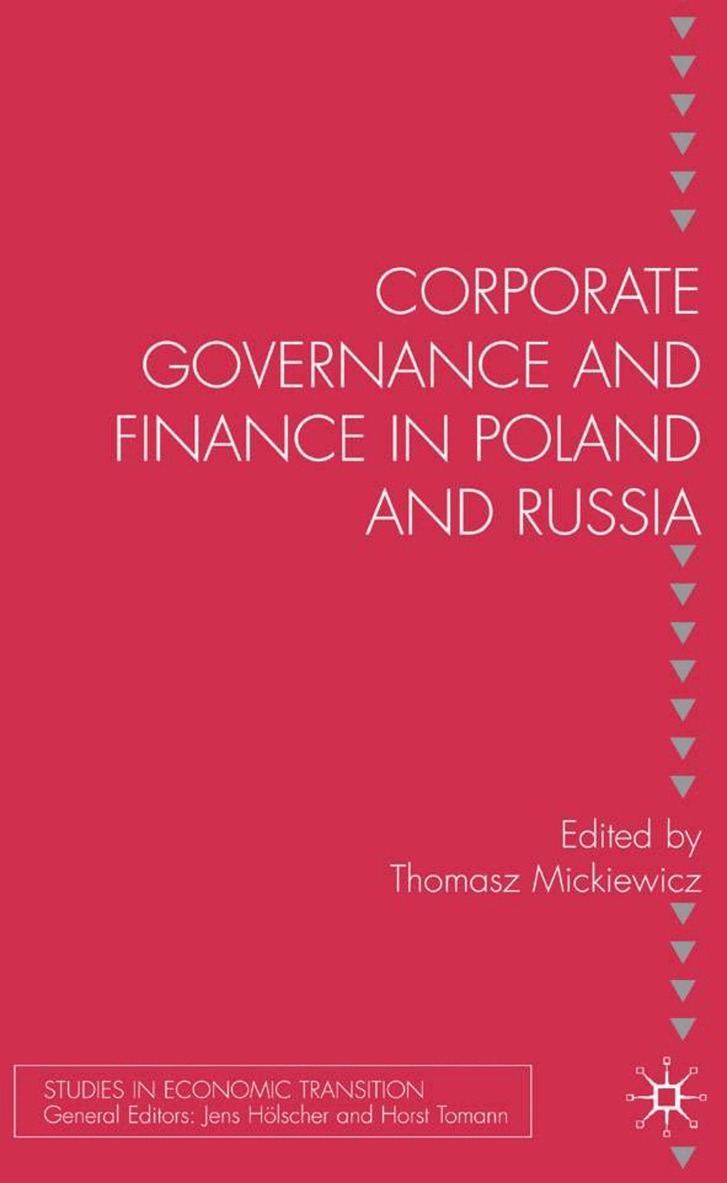
Corporate Governance and Finance in Poland and Russia
Inbunden, 2006
1128 kr
Lägg i varukorg
This book provides a comparative analysis of the emerging corporate control structures in the transition economies of Russia and Poland. It explores what kind of ownership structures are emerging and examines the directions of secondary ownership flows in both countries, and the impact of the …
Economic Transition in Central Europe and the Commonwealth of Independent States
E-bok, 2005
1596 kr
Lägg i varukorg
Fifteen years ago, twenty-seven countries in Europe and Central Asia embarked on their economic transition paths. For some, the outcome was a considerable success. Several others are still struggling to shed the inheritance of the past and to correct more recent policy mistakes. Why were …
Economic Transition in Central Europe and the Commonwealth of Independent States
Häftad, 2005
1128 kr
Lägg i varukorg
Fifteen years ago, twenty-seven countries in Europe and Central Asia embarked on their economic transition paths. For some, the outcome was a considerable success. Several others are still struggling to shed the inheritance of the past and to correct more recent policy mistakes. Why were …
Economic Transition in Central Europe and the Commonwealth of Independent States
Inbunden, 2005
1128 kr
Lägg i varukorg
Fifteen years ago, twenty-seven countries in Europe and Central Asia embarked on their economic transition paths. For some, the outcome was a considerable success. Several others are still struggling to shed the inheritance of the past and to correct more recent policy mistakes. Why were …