Taizo Yakushiji – författare
Visar alla böcker från författaren Taizo Yakushiji. Handla med fri frakt och snabb leverans.
3 produkter
3 produkter
Häftad, Engelska, 1992
215 kr
Skickas inom 5-8 vardagar
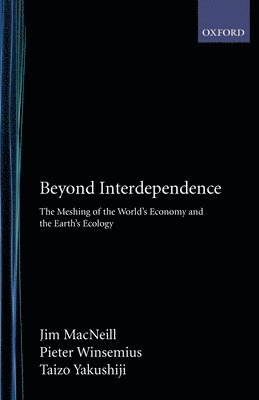
Jim MacNeill was the principal author of Our Common Future, hailed as `the most important document of the decade on the future of the world'. Beyond Interdependence builds on that report to demonstrate the relationship between the global environment, the world's economy, and the international order.Predicting that environmental and resource depletion will become the primary source of human and interstate conflict in the near future, the authors propose a range of new national security strategies that will lift the `ecological shadow' and alleviate world poverty.
E-bok
PDF, Engelska, 199192 kr
Läs direkt efter köp
Over the last year, the world has seen some cataclysmic changes. Eastern Europe is no longer yoked with Soviet communism, Germany is again a single, powerful nation, and Russia itself is pursuing a free-market economy at an almost frantic pace. Yet as we focus on the triumph of democracy, it is easy to overlook the potentially catastrophic changes that face the world environment, changes that are inextricably linked to the workings of the political and economic institutions of our time.Beyond Interdependence builds upon the Brundtland Commission''s landmark report Our Common Future, a book that has been hailed as "the most important document of the decade on the future of the world" and has sold over one-half million copies in nineteen foreign languages. Dr. Jim MacNeill, the principal author of both works, has in this latest study extended the Commission''s analysis of the critical relationships between the global environment, the world economy, and the international order. Together with his eminent colleagues, Pieter Winsemius and Taizo Yakushiji, MacNeill shows that while our global economy and ecology have become completely interlocked, they have remained separate in our institutions, and in the minds of our policymakers. The result is a wide range of domestic and international policies that are accelerating the depletion of Earth''s basic ecological (and economic) capital--its rivers, lakes, and oceans, its soils and forests, its flora and fauna, and its ozone shield. These short-sighted policies also threaten us in the next century with a greater rise in global warming and sea level than have occurred in the ten-thousand years since the last ice age. The authors argue that this environmental degradation and resource depletion will be the principal source of interstate conflict in the post-cold war world.Providing a fresh analysis of the issues of global change, and taking into account such recent events as the tidal-shift in East/West relations and the G7 Economic Summit in Houston, Beyond Interdependence shows how industrialized nations can take unilateral action to address environmental threats while improving macroeconomic efficiency and international competitiveness. It also demonstrates how developed nations can negotiate a series of mutually advantageous "bargains" with Eastern European and Third World nations.With its incisive analysis and far-reaching recommendations for policy reform, Beyond Interdependence shows us how we can act urgently but intelligently to advance our common future.
Häftad, Engelska, 1984
203 kr
Skickas inom 5-8 vardagar
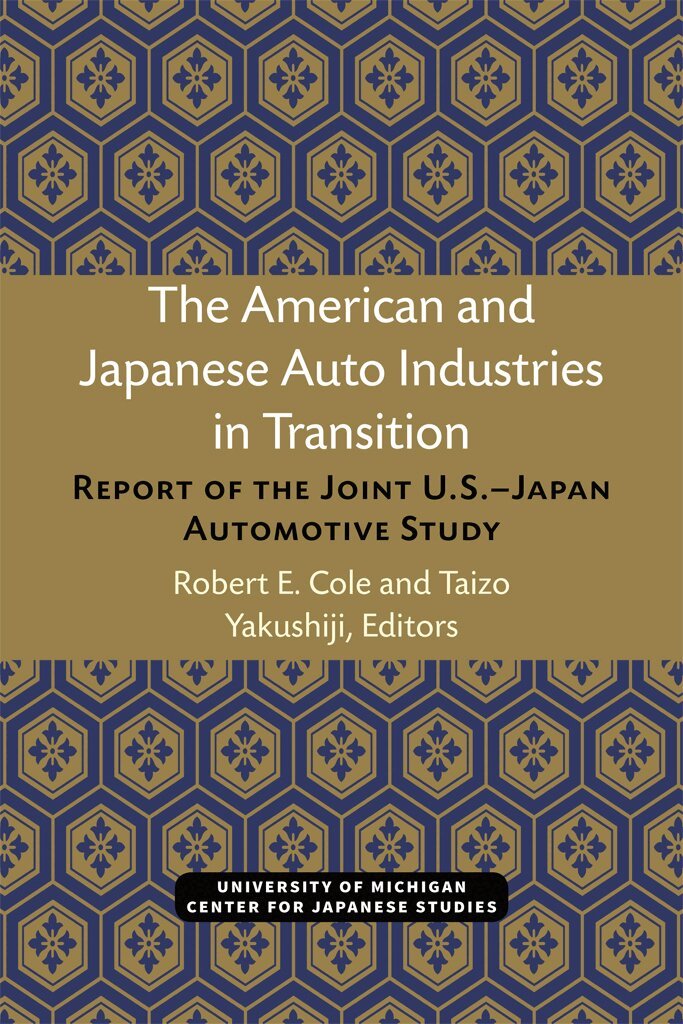
This report was prepared for the Policy Board by the U.S. and Japanese research staffs of the Joint U.S.–Japan Automotive Study under the general direction of Professors Paul W. McCracken and Keichi Oshima, with research operations organized and coordinated by Robert E. Cole on the U.S. side, in close communication with the Taizo Yakushiji on the Japanese side. [preface] In view of the importance of stable, long-term economic relationships between Japan and the United States, automotive issues have to be dealt with in ways consistent with the joint prosperity of both countries. Furthermore, the current economic friction has the potential to adversely affect future political relationships. Indeed, under conditions of economic stagnation, major economic issues inevitably become political issues. With these considerations in mind, the Joint U.S.–Japan Automotive Study project was started in September 1981 to determine the conditions that will allow for the prosperous coexistence of the respective automobile industries. During this two-year study, we have identified four driving forces that will play a major role in determining the future course of the automotive industry of both countries. These are: (1) consumers’ demands and aspirations vis-à-vis automobiles; (2) flexible manufacturing systems (FMS); (3) rapidly evolving technology; and (4) the internationalization of the automotive industry. [exec. summary]