Tania Granadillo - Böcker
Visar alla böcker från författaren Tania Granadillo. Handla med fri frakt och snabb leverans.
2 produkter
2 produkter
362 kr
Skickas inom 7-10 vardagar
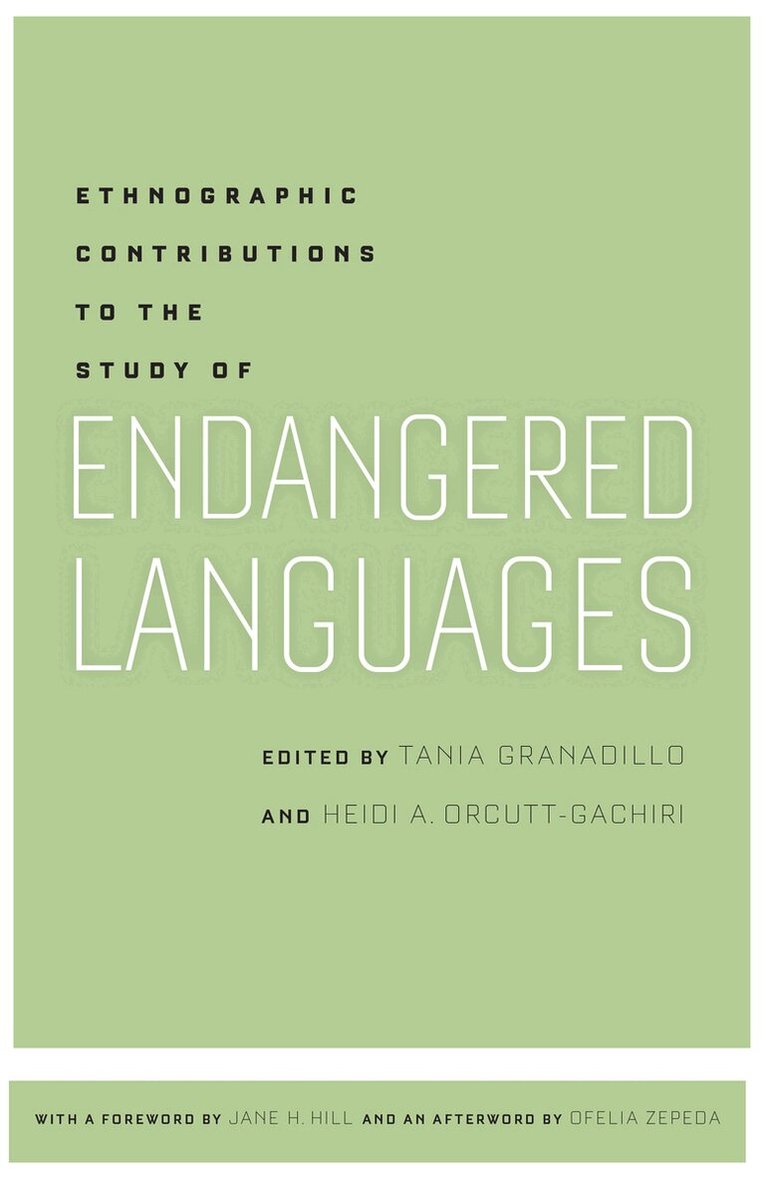
It is a feature of the twenty-first century that world languages are displacing local languages at an alarming rate, transforming social relations and complicating cultural transmission in the process. This language shift—the gradual abandonment of minority languages in favor of national or international languages—is often in response to inequalities in power, signaling a pressure to conform to the political and economic structures represented by the newly dominant languages. In its most extreme form, language shift can result in language death and thus the permanent loss of traditional knowledge and lifeways. To combat this, indigenous and scholarly communities around the world have undertaken various efforts, from archiving and lexicography to the creation of educational and cultural programs. What works in one community, however, may not work in another. Indeed, while the causes of language endangerment may be familiar, the responses to it depend on “highly specific local conditions and opportunities.” In keeping with this premise, the editors of this volume insist that to understand language endangerment, “researchers and communities must come to understand what is happening to the speakers, not just what is happening to the language.” The eleven case studies assembled here strive to fill a gap in the study of endangered languages by providing much-needed sociohistorical and ethnographic context and thus connecting specific language phenomena to larger national and international issues. The goal is to provide theoretical and methodological tools for researchers and organizers to best address the specific needs of communities facing language endangerment. The case studies here span regions as diverse as Kenya, Siberia, Papua New Guinea, Mexico, Venezuela, the United States, and Germany. The volume includes a foreword by linguistic anthropologist Jane Hill and an afterword by poet and linguist Ofelia Zepeda.
Del 6 - Brill's Studies in the Indigenous Languages of the Americas
Negation in Arawak Languages
Inbunden, Engelska, 2014
2 036 kr
Skickas inom 5-8 vardagar
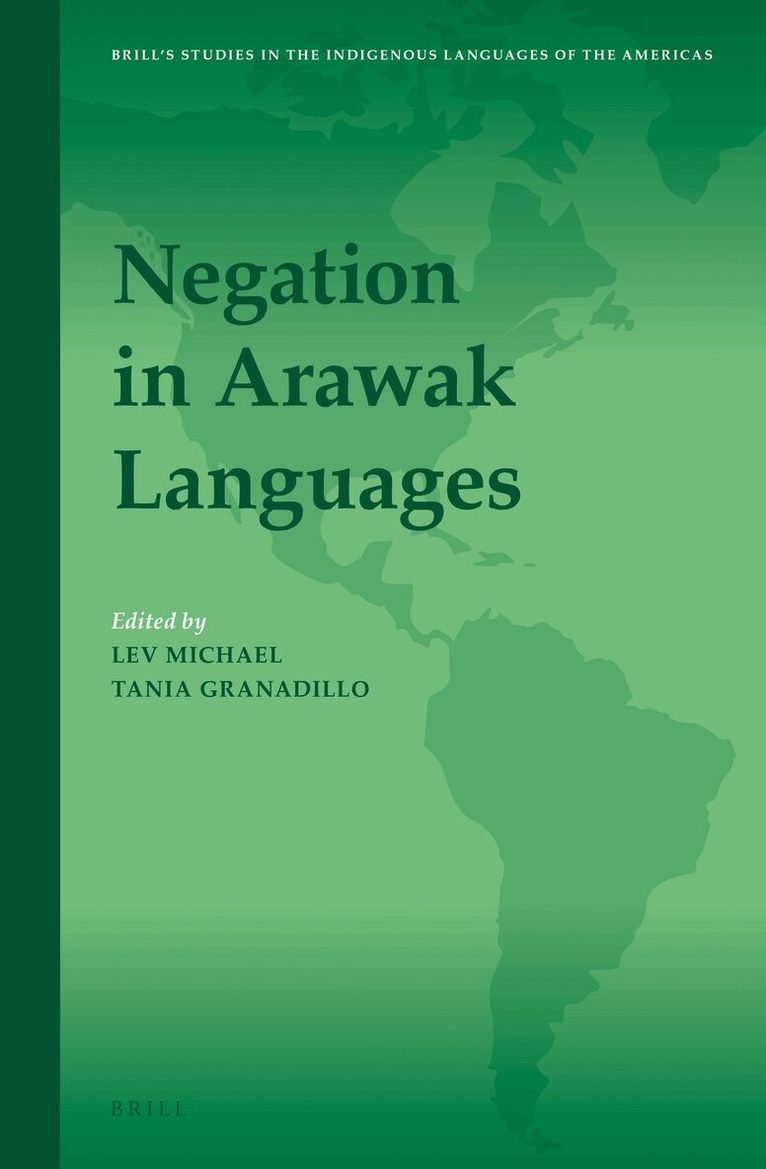
Negation in Arawak Languages presents detailed descriptions of negation constructions in nine Arawak languages (Apurinã, Garifuna, Kurripako, Lokono, Mojeño Trinitario, Nanti, Paresi, Tariana, and Wauja), as well as an overview of negation in this major language family. Functional-typological in orientation, each descriptive chapter in the volume is based on fieldwork by authors in the communities in which the languages are spoken. Chapters describe standard negation, prohibitives, existential negation, negative indefinites, and free negation, as well as language-specific negation phenomena such as morphological privatives, the interaction of negation with verbal inflectional categories, and negation in clause-linking constructions.Informed by typological approaches to negation, this volume will be of interest to specialists in Arawak languages, typologists, historical linguists, and theoretical linguists.