Tao C. Hsu – författare
Visar alla böcker från författaren Tao C. Hsu. Handla med fri frakt och snabb leverans.
21 produkter
21 produkter
E-bok
PDF, Engelska, 2013734 kr
Läs direkt efter köp
E-bok
PDF, Engelska, 20131 408 kr
Läs direkt efter köp
E-bok
PDF, Engelska, 20121 174 kr
Läs direkt efter köp
In recent years, because of advances in karyological techniques, we have witnessed a remarkable renewal of interest in studies of mammalian chromosomes. These techniques, generally involving the use of tissue culture, colchicine and hypotonic solution pretreatments, allow for a much clearer display of metaphase chromosomes of mammalian cells than the classic direct squash or tissue section methods. Consequently, what was known about the chromosome complement of most mammals must be revised. The most astonishing revision, of course, was that made by Tjio and Levan in 1956, who demonstrated that the diploid number of man is 46, not 48 as previously believed. Similar revisions will have to be made for many other mammalian species, either in number or in karyotype structure. Many animals are being examined cytologically for the first time. The findings are now extensive and scattered; they appear in numer ous periodicals and newsletters, or they are kept in cytologists'' file drawers without being published. It is difficult to have access to perti nent data for comparison among related species or for evaluation of various karyological characteristics within a karyotype. Such evaluations can be done only when reasonably uniform material is collected and placed side by side for comparison, accompanied by relative references. We considered that probably an Atlas of Mammalian Chromosomes would fulfill such a need. Needless to say, it is impossible to present karyotypes of all mam malian species at one time.
E-bok
PDF, Engelska, 20131 174 kr
Läs direkt efter köp
In recent years, because of advances in karyological techniques, we have witnessed a remarkable renewal of interest in studies of mammalian chromosomes. These techniques, generally involving the use of tissue culture, colchicine and hypotonic solution pretreatments, allow for a much clearer display of metaphase chromosomes of mammalian cells than the classic direct squash or tissue section methods. Consequently, what was known about the chromosome complement of most mammals must be revised. The most astonishing revision, of course, was that made by Tjio and Levan in 1956, who demonstrated that the diploid number of man is 46, not 48 as previously believed. Similar revisions will have to be made for many other mammalian species, either in number or in karyotype structure. Many animals are being examined cytologically for the first time. The findings are now extensive and scattered; they appear in numer ous periodicals and newsletters, or they are kept in cytologists'' file drawers without being published. It is difficult to have access to perti nent data for comparison among related species or for evaluation of various karyological characteristics within a karyotype. Such evaluations can be done only when reasonably uniform material is collected and placed side by side for comparison, accompanied by relative references. We considered that probably an Atlas of Mammalian Chromosomes would fulfill such a need. Needless to say, it is impossible to present karyotypes of all mam malian species at one time.
E-bok
PDF, Engelska, 2013734 kr
Läs direkt efter köp
E-bok
PDF, Engelska, 2013408 kr
Läs direkt efter köp
Since the inception of the Atlas of Mammalian Chromosomes, it is a surprise to us that we have finished five volumes with karyotypes of nearly 250 mam malian species. We acknowledge the fact that there are many imperfections in this series, but we also hope that these volumes have been useful to various investigators. Springer-Verlag has made a binder which will accommodate the material of all five volumes. We also revised our index to facilitate easy reference. If the material is arranged in the binder according to the Cumulative Contents, we believe one will find it convenient to consult with this book. Volume 5, as in the previous volumes, contains a Cumulative Index, Cumu lative Table of Contents, as well as an individual Index and Table of Contents for Volume 5. Previous Indices and Tables of Contents should be discarded. October, 1970 T. C. Hsu Kurt Benirschke v Instructions A special vinyl binder is available from the publisher which will accommo. date the material of the first five volumes. Twenty dividers have been provided with printed tabs. These dividers are intended to separate the Orders and the Index. It is suggested that the dividers be placed in the following sequence of Orders, which sequence will be followed in the future when presenting karyo.
E-bok
PDF, Engelska, 2013734 kr
Läs direkt efter köp
E-bok
PDF, Engelska, 2013734 kr
Läs direkt efter köp
E-bok
PDF, Engelska, 2013734 kr
Läs direkt efter köp
Häftad, Engelska, 2013
562 kr
Skickas inom 10-15 vardagar
Häftad, Engelska, 2013
562 kr
Skickas inom 10-15 vardagar
Häftad, Engelska, 2012
1 116 kr
Skickas inom 10-15 vardagar
Häftad, Engelska, 2013
562 kr
Skickas inom 10-15 vardagar
Häftad, Engelska, 2013
562 kr
Skickas inom 10-15 vardagar
Häftad, Engelska, 2013
562 kr
Skickas inom 10-15 vardagar
Häftad, Engelska, 2013
1 084 kr
Skickas inom 10-15 vardagar
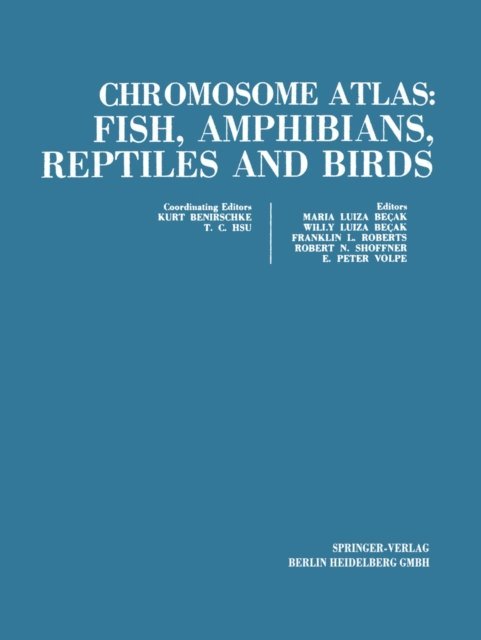
Since the publication of the first Atlas of Mammalian Chromosomes in 1967 the continuous compilation of mammalian karyotypes has become a useful instrument in cytologic and taxonomic studies. Technical advances in preparing mitotic cells from nonmammalian vertebrates have since allowed a better comparison of taxa in fishes, amphibia, reptiles, and birds. In these fields the literature is also widely scat tered; and it has become difficult to survey such information, published as well as unpublished, by nonspecialists. These were among the reasons for the new endeavor of compiling a chromosome atlas for nonmammalian vertebrates. An annual publication is planned with presentation of between 10 and 15 karyotypes from each class. In this second volume, 52 species are presented. For convenience in future colation, the numbering system employs class abbreviations, viz. , P-Pisces, Am-Amphibia, R-Reptilia, and Av-Aves. Within each class, the numbers are necessarily consecutive. In general the karyotypes are laid out following the format employed in An Atlas of Mammalian Chromosomes. Whenever possible both sexes are represented, even though sexual chromosomal dimorphism is not (currently) evident. When the sex chromosomes are known, they are so indicated by conventional nomenclature (XX/XY or ZW /ZZ). In the karyotypes of birds the so-called microchromosomes are grouped together at the end without an attempt at complete enumeration, which is presently impossible. They are usually considered as acrocentrics, but a few are distinctly biarmed.
Häftad, Engelska, 2014
1 299 kr
Skickas inom 10-15 vardagar
E-bok
PDF, Engelska, 20131 367 kr
Läs direkt efter köp
Since the publication of the first Atlas of Mammalian Chromosomes in 1967 the continuous compilation of mammalian karyotypes has become a useful instrument in cytologic and taxonomic studies. Technical advances in preparing mitotic cells from nonmammalian vertebrates have since allowed a better comparison of taxa in fishes, amphibia, reptiles, and birds. In these fields the literature is also widely scat tered; and it has become difficult to survey such information, published as well as unpublished, by nonspecialists. These were among the reasons for the new endeavor of compiling a chromosome atlas for nonmammalian vertebrates. An annual publication is planned with presentation of between 10 and 15 karyotypes from each class. In this second volume, 52 species are presented. For convenience in future colation, the numbering system employs class abbreviations, viz. , P-Pisces, Am-Amphibia, R-Reptilia, and Av-Aves. Within each class, the numbers are necessarily consecutive. In general the karyotypes are laid out following the format employed in An Atlas of Mammalian Chromosomes. Whenever possible both sexes are represented, even though sexual chromosomal dimorphism is not (currently) evident. When the sex chromosomes are known, they are so indicated by conventional nomenclature (XX/XY or ZW /ZZ). In the karyotypes of birds the so-called microchromosomes are grouped together at the end without an attempt at complete enumeration, which is presently impossible. They are usually considered as acrocentrics, but a few are distinctly biarmed.
E-bok
PDF, Engelska, 20131 733 kr
Läs direkt efter köp
Häftad, Tyska, 1971
577 kr
Skickas inom 10-15 vardagar
E-bok
PDF, Tyska, 2013555 kr
Läs direkt efter köp