Terence Wise – författare
Visar alla böcker från författaren Terence Wise. Handla med fri frakt och snabb leverans.
12 produkter
12 produkter
Del 75 - Men-at-Arms
Armies of the Crusades
Häftad, Engelska, 1978
156 kr
Skickas inom 10-15 vardagar
In the early crusades men of all ranks from all over Europe took the cross and went to fight Islam as volunteers.Some went out of religious fervour, others to escape the plagues and famine which were rife at the time, still others in search of land or a fortune in loot. Fighting alongside all of these were the armies raised in Outremer, the Holy Land itself.Together they waged a bloody religious war, the participants of which included such forces as the Knights Templar, the Teutonic Knights, and the Byzantine Army.
Del 77 - Men-at-Arms
Flags of the Napoleonic Wars (1)
Colours, Standards and Guidons of France and her Allies
Häftad, Engelska, 1978
156 kr
Skickas inom 10-15 vardagar
In the summer of 1804, the eagle was chosen as the symbol of the French Army by Napoleon himself.The Emperor's sculptor, Chaudet, made the original model, and from this were cast bronze copies in the workshop of Thomire, which would be proudly borne into battle by many a French regiment. This fascinating work by Terence Wise explores in depth the flags, colours and guidons of the Napoleonic wars, concentrating on France and her allies, and covering every faction from Baden to Würzburg.Featuring illustrations throughout, this book is a must for anyone interested in this fascinating topic.
Del 78 - Men-at-Arms
Flags of the Napoleonic Wars (2)
Colours, Standards and Guidons of Austria, Britain, Prussia and Russia
Häftad, Engelska, 1978
156 kr
Skickas inom 10-15 vardagar
From the Liebfahne and Ordinärfahne of Austria, to the eagle and wreath of Russia, the flags of the Napoleonic Wars comprised a range of designs and colours.The second in a series of three volumes focusing on flags of the Napoleonic Wars, this book examines the patterns, colours and guidons of Austria, Britain, Prussia and Russia, offering a rare glimpse into an often-overlooked subject in Napoleonic history.The text is packed with illustrations throughout, including colour plates, sketches and tables detailing flag variants, patterns and inspection colours.
Del 50 - Men-at-Arms
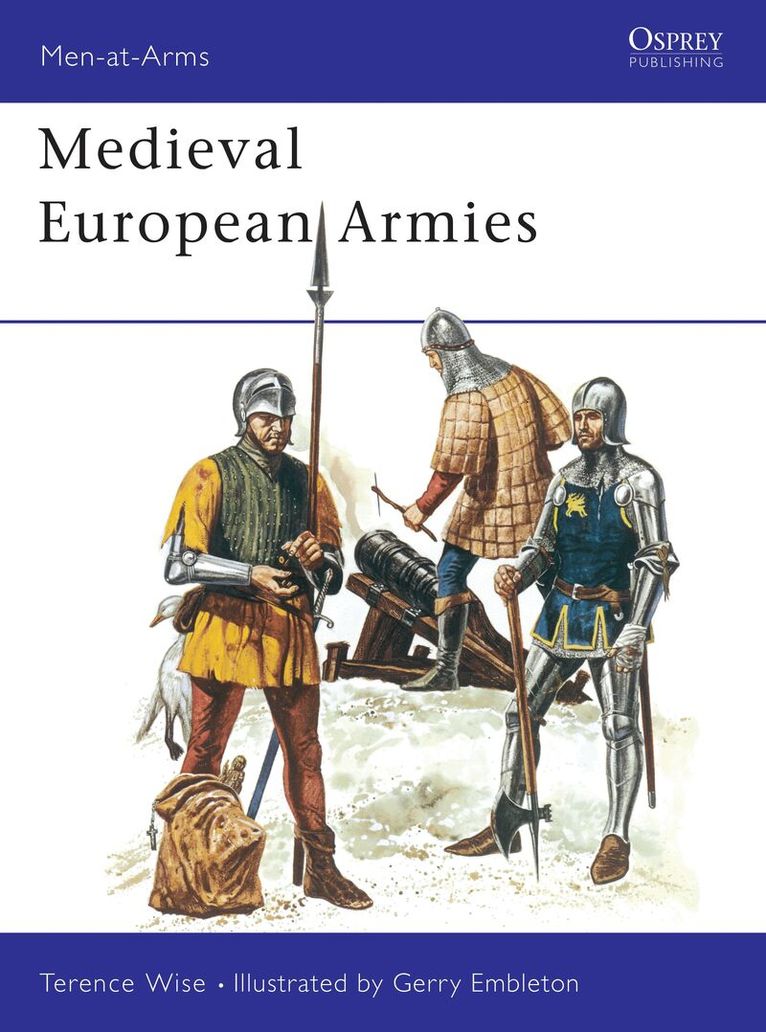
Medieval European Armies
Häftad, Engelska, 1975
156 kr
Skickas inom 10-15 vardagar
Almost continual warfare raged in Europe during the period 1300-1500.These wars were the furnaces in which many of the modern European nations were forged. Parallel with this emergence of the nations came the development of national armies to protect the newly-won borders and independence, yet throughout this period the old feudal method of raising an army persisted.This fascinating study by Terence Wise explores the organisation, weapons and equipment of the armies who fought across medieval Europe, from the Hundred Years War to the fight against the Moors in Spain and the French invasion of Italy.
Del 85 - Men-at-Arms
Saxon, Viking and Norman
Häftad, Engelska, 1979
156 kr
Skickas inom 10-15 vardagar
The Saxons, Vikings and Normans who inhabited the medieval world were a good deal more advanced than some writings would have us believe.This fascinating book by Terence Wise explores the history, organization, clothing, equipment and weapons of Saxon, Viking and Norman peoples, covering wide-ranging topics such as Anglo-Saxon shields, Viking raiding ships and the organization of Norman armies.The absorbing and readable text is enriched by numerous illustrations and museum photographs with commentaries, plus eight superbly drawn full page colour plates by renowned military artist Gerry Embleton.
Del 99 - Men-at-Arms
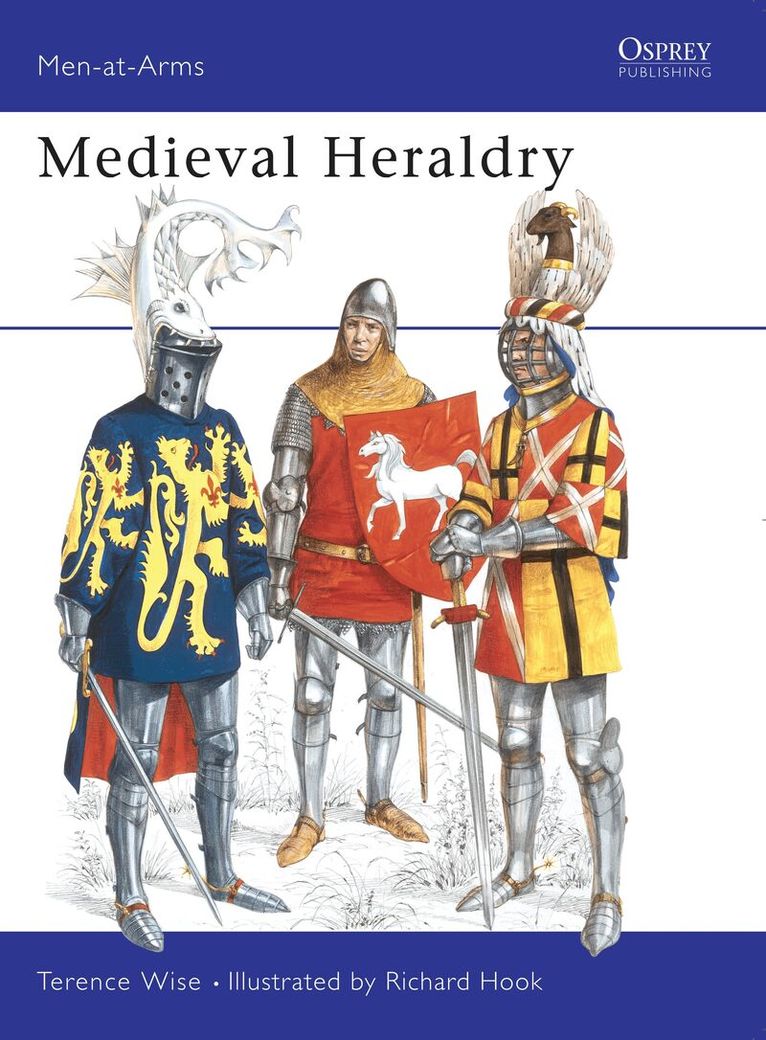
Medieval Heraldry
Häftad, Engelska, 1980
156 kr
Skickas inom 10-15 vardagar
Coats of arms were at first used only by kings and princes, then by their great nobles.But by the mid-13th century arms were being used extensively by the lesser nobility, knights and those who later came to be styled gentlemen. In some countries the use of arms spread even to merchants, townspeople and the peasantry.From the mundane to the fantastic, from simple geometric patterns to elaborate mythological beasts, this fascinating work by Terence Wise explores the origins and appearance of medieval heraldic devices in an engagingly readable style, accompanied by numerous illustrations including eight full page colour plates by Richard Hook.
Del 101 - Men-at-Arms
Conquistadores
Häftad, Engelska, 1980
156 kr
Skickas inom 10-15 vardagar
On 12 October 1492 Columbus 'discovered' the New World. In the following decade a number of Spanish colonies were founded in the West Indies, many of the settlers being ex-soldiers.They were a hardy, adventurous and unruly crew, no longer able to find suitable employment in Europe. They carved a foothold for Spain in the Indies, but quickly became restless in the role of settler. Anxious to avoid the dull work of the administrators and planters, these men began to seek new territories to exploit, once again turning their faces towards the unknown.This title documents both the Conquistadores themselves, and their formidable enemies in the New World - the Aztecs, Incas and Maya.
Del 109 - Men-at-Arms
Ancient Armies of the Middle East
Häftad, Engelska, 1981
156 kr
Skickas inom 10-15 vardagar
This text by Terence Wise explores some of the fascinating peoples who comprised the ancient armies of the Middle East.This includes the Sumerians, who were the first to introduce the use of bronze into warfare, and were centuries ahead of the Egyptians in the use of the wheel – The Akkadians, whose citizen army was composed almost entirely of light troops – The Babylonians, whose people were granted land in return for army service – the horned warriors of the Elamites – the Egyptians, with their heavy spearmen and archers – the tribal and warlike Libyans – Nubians and Ethiopians – Hyksos – the armies of the Hittite Empire – the Sea People and others.
Häftad, Engelska, 1984
156 kr
Skickas inom 10-15 vardagar
The third of three volumes examining the flags of the Napoleonic Wars (Men-at-Arms 77, 78 & 115).Terence Wise details colours, standards and guidons of Anhalt, Kleve-Burg, Brunswick, Denmark, Finland, Hanover, Hesse, the Netherlands, Mecklenburg, Nassau, Portugal, Reuss, Spain, Sweden, Switzerland & Westphalia.Ideal for vexillology enthusiasts, the text contains a plethora of illustrations including eight full page colour plates by Guido Rosignoli.
Del 121 - Men-at-Arms
Armies of the Carthaginian Wars 265–146 BC
Häftad, Engelska, 1982
156 kr
Skickas inom 10-15 vardagar
The epic conflict between Rome and Carthage remains one of the most compelling stories of military history.The wars included such legendary events as the crossing of the Alps by Hannibal, and the Battle of Cannae. Terence Wise's fine text details the armies of both sides of the wars, including the many different allied troops employed by the Carthaginians; Numidians, Celts, Spanish and others who helped make the army one of the most colourful and cosmopolitan of its day.The text is accompanied by numerous illustrations and photographs, including eight full page colour plates by Richard Hook.
Del 145 - Men-at-Arms
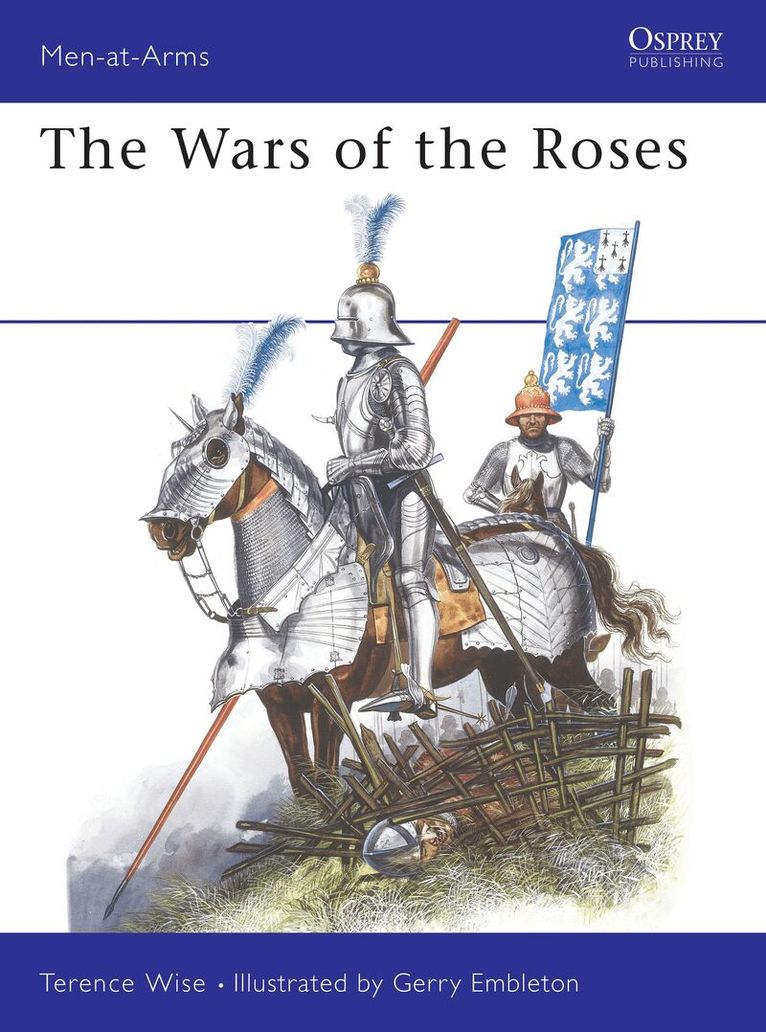
Wars of the Roses
Häftad, Engelska, 1983
156 kr
Skickas inom 10-15 vardagar
Much myth and fantasy surrounds the events of the Wars of the Roses: a bloody and prolonged dynastic struggle between the houses of York and Lancaster.Terence Wise's fascinating text lays bare the real story, and examines the armies, liveries and badges of the conflict. The author's readable account provides a comprehensive guide as to who fought whom, where, when, why and for what, from the origins of the Wars to such famous battles as Tewkesbury and Bosworth.The accompanying photographs, illustrations and colour plates by Gerry Embleton clearly detail the arms, armour and standards of the time.
Del 155 - Men-at-Arms
Knights of Christ
Häftad, Engelska, 1984
151 kr
Skickas inom 10-15 vardagar
The ancient warrior code which persisted in medieval Christian Europe dictated that a man's greatest virtues were physical strength, skill at arms, bravery, daring, loyalty to the chieftain and solidarity within the tribe.The primitive Church had been diametrically opposed to such ideals, however by the early 8th century the Church had grown wealthy, and the Saracen invasions of Spain and France posed a threat to that wealth. Alongside specially-commissioned artwork, Terence Wise explores how the Roman Church began to support war in defence of the faith, and by channelling the martial spirit into the service of God, the brutal warrior of the past was transformed into a guardian of society.